1. Frontal sled testing fundamentals
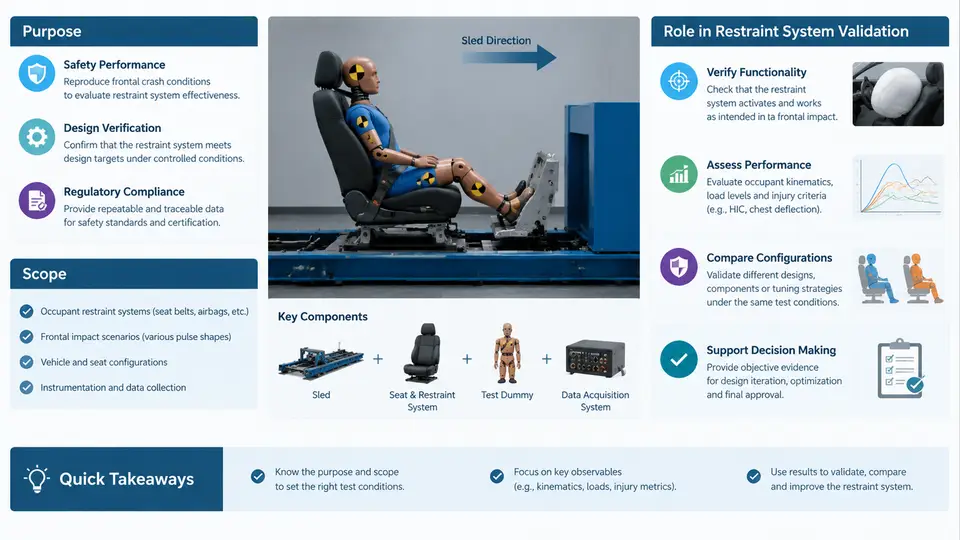
Frontal sled testing is a laboratory-based method for reproducing the crash pulse of a full-vehicle frontal impact on a stationary test buck that carries the occupant compartment, seats, seat belts, airbags, and instrumented Anthropomorphic Test Devices (ATDs). Instead of destroying an entire vehicle, the sled accelerates the buck along a guided track and then decelerates it with a programmable braking system so that the resulting acceleration–time history at the seat mounting points matches a target vehicle pulse. The purpose is to isolate the restraint system from the vehicle body so that its performance can be measured, compared, and tuned under controlled, repeatable conditions.
The distinction from a full-vehicle crash test matters. In a barrier impact, the vehicle's front structure absorbs energy and shapes the pulse that reaches the occupant; body deformation, steering column intrusion, and pedal movement all influence injury outcomes. A sled test removes most of that structural variability and replaces it with a prescribed pulse. This makes the sled the standard tool for restraint system development, occupant protection validation, and regulatory or consumer-programme compliance work where the pulse is already known from vehicle-level testing or from a regulation such as FMVSS 208 or UN R94/R137.
What the Sled Actually Controls
A frontal sled system controls four things that determine whether a test is valid: the crash pulse, the buck geometry, the restraint hardware state, and the ATD installation. The pulse is defined by a target acceleration curve, usually expressed as a corridor with upper and lower bounds over time. The buck must reproduce the seat position, belt anchor points, steering wheel location, knee bolster, and floor geometry of the production vehicle closely enough that occupant kinematics are representative. Restraint hardware — pretensioners, load limiters, airbags, and buckle switches — must be fired on the same timing as in the vehicle. The ATD must be positioned, instrumented, and clothed according to the applicable standard.
The Sled Pulse and Its Coordinate Convention
Throughout this course, the vehicle forward direction is +X, and the crash deceleration acts in the −X direction on the occupant. Sled acceleration is measured at the buck and reported as a positive magnitude in the direction of travel during the acceleration phase, then as deceleration during the braking phase. A typical frontal pulse for a 50 km/h barrier-equivalent test rises to roughly 25–40 g within 20–40 ms, holds a plateau, and decays by about 100–120 ms. The exact shape depends on the vehicle class and the regulation being addressed.
Pulse matching is a practical engineering task, not a formality. The sled's braking profile is programmed, the test is run with a non-instrumented or calibration buck, and the measured acceleration is compared against the corridor. If the measured curve exits the corridor, the braking profile is adjusted and the run repeated. Only after the pulse is validated is the instrumented occupant test performed. This two-stage approach — pulse validation, then occupant test — is the backbone of sled laboratory practice.
Scope: What a Sled Test Can and Cannot Validate
A frontal sled test is well suited to validating occupant restraint performance: belt geometry and routing, pretensioner and load-limiter behaviour, airbag deployment timing and coverage, seat structure under belt loading, and the resulting head, chest, and femur injury criteria. It is also the standard platform for comparing restraint variants — for example, a 4 kN versus a 6 kN load limiter — because the pulse and buck are held constant while only the restraint changes.
It is not a substitute for structural validation. Sled testing does not assess front-end crush, intrusion into the footwell, steering column collapse, or the interaction between the occupant and a deforming body. Those require full-vehicle or body-in-white testing. A sled result therefore answers the question "does the restraint system protect the occupant given this pulse and this occupant cell?" — not "does the vehicle protect the occupant in a real crash?" The two questions are complementary, and a mature programme uses both.
Role in the Validation Workflow
In a typical restraint development programme, sled testing sits between CAE simulation and full-vehicle validation. Simulation is used to screen concepts and tune restraint parameters; the sled confirms the simulation with physical hardware under a controlled pulse; the full-vehicle test then confirms that the pulse and occupant cell assumed in the sled are representative of the real vehicle. If the full-vehicle pulse differs from the sled pulse, the sled results must be re-examined, which is why pulse fidelity is treated as a first-class requirement.
The practical workflow for a single sled test is: define the target pulse and corridor from vehicle data or regulation; build or configure the buck to match the vehicle occupant cell; install and instrument the ATD; set restraint firing timing; run a pulse-validation test; adjust braking profile until the corridor is met; then run the instrumented occupant test and reduce the data against the applicable injury criteria. Each of these steps is covered in later chapters; the point here is that the sled is a controlled experiment whose value depends on how faithfully each input is reproduced.
Key Parameters and Typical Values
| Parameter | Typical value / range | Why it matters |
|---|---|---|
| Impact speed (equivalent) | 50 km/h (FMVSS 208 belted), 56 km/h (US NCAP), 64 km/h (Euro NCAP ODB equivalent) | Sets the energy level and pulse magnitude |
| Peak sled deceleration | 25–40 g | Drives occupant loading and airbag timing |
| Pulse duration | 100–120 ms | Determines ride-down and rebound phase |
| ATD | Hybrid III 50th percentile male; 5th female and 95th male for coverage | Injury criteria are ATD-specific |
| Belt load limiter | 3–6 kN (example range) | Trade-off between chest deflection and excursion |
| Pretensioner fire time | 0–15 ms after pulse onset (example) | Affects belt coupling and occupant kinematics |
Why Repeatability Is the Core Value
The reason sled testing occupies such a central place in restraint validation is repeatability. A full-vehicle crash test consumes a vehicle and produces one pulse with limited ability to repeat it exactly. A sled can run the same pulse many times, with the same buck and the same ATD, changing one variable at a time. That is what makes it possible to attribute a change in chest deflection to a change in load limiter force rather than to body deformation differences. The engineer's job is to protect that repeatability: verify the pulse every run, verify ATD calibration and positioning, verify restraint firing timing, and document every deviation. A sled result without a validated pulse and a documented setup is not evidence.
With the purpose, scope, and workflow position established, the remaining chapters build the practical detail: pulse definition and corridor matching, buck design and setup, ATD instrumentation and positioning, restraint firing and timing, data reduction against injury criteria, and the interpretation of results in the context of the full-vehicle programme.