4. Injury biomechanics fundamentals
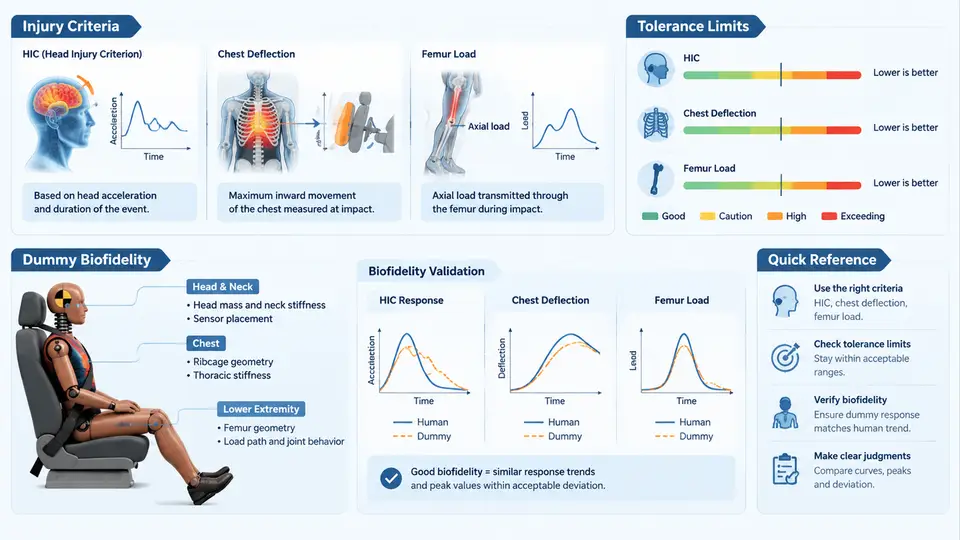
Restraint system development is ultimately a problem of managing human injury risk within a packaging envelope. Every airbag fold, seatbelt geometry, load-limiter characteristic, and pretensioner firing profile is judged against a small set of physical measurements that correlate with real-world injury outcomes. This chapter establishes the measurement language of occupant safety: the injury criteria computed from dummy signals, the tolerance limits those criteria are compared against, and the degree to which the dummy itself faithfully reproduces human response.
From Physical Signals to Injury Criteria
A crash test dummy does not measure injury; it measures acceleration, force, moment, and displacement. Injury criteria are the transfer functions that convert those raw channels into a scalar risk index. The three criteria that dominate frontal restraint tuning are Head Injury Criterion (HIC), chest deflection, and femur axial load. Each addresses a different injury mechanism, and each has a different sensitivity to restraint design decisions.
HIC captures the combined effect of head acceleration magnitude and duration. It is computed from the resultant translational acceleration at the head center of gravity:
HIC = max over t1,t2 of [ (t2 - t1) * ( (1/(t2-t1)) * ∫ a(t) dt from t1 to t2 )^2.5 ]

where a(t) is the resultant head acceleration in g,
t1 and t2 are chosen to maximize the expression,
and (t2 - t1) is capped at 36 ms for HIC36 (15 ms for HIC15).
The 2.5 exponent means HIC is strongly nonlinear: doubling average acceleration over the same window increases HIC by roughly a factor of 5.7. In practice this makes HIC extremely sensitive to short, high-amplitude spikes — exactly the signature of an over-aggressive airbag or a hard head-to-interior contact. A typical FMVSS 208 driver-side limit is HIC15 ≤ 700; Euro NCAP assessment schemes use HIC15 with a lower reference value and a sliding scale of points. When tuning, engineers rarely chase HIC directly; they chase the acceleration pulse shape, because HIC is a derived quantity.
Chest deflection addresses thoracic injury, dominated in frontal impacts by compression of the rib cage against the restraint. It is measured by a potentiometer or IR-TRACC (Infra-Red Telescoping Rod for Assessment of Chest Compression) inside the dummy thorax, reported as absolute deflection in millimeters or as a percentage of chest depth. The mechanism is direct: rib fracture and underlying organ injury correlate with the degree of sternum-to-spine compression. A belt that is too stiff, a load limiter set too high, or a pretensioner that over-tightens will all raise peak deflection. Typical limits are on the order of 50–63 mm for a 50th percentile male depending on the regulation and dummy variant; the Hybrid III 50th percentile thorax has a nominal depth of about 229 mm, so 63 mm corresponds to roughly 27% compression.
Femur load captures the axial compressive force transmitted through the femur, primarily from knee-to-knee-bolster contact and from belt loading through the lap portion. It is measured by load cells in the dummy's upper legs. The injury mechanism is femoral shaft fracture, and the criterion is a simple peak force limit — typically around 10 kN for the 50th percentile male in FMVSS 208, with lower values for smaller occupants. Femur load is a useful diagnostic because it isolates lower-extremity loading from the torso: a knee bolster that is too stiff or a lap belt routed too high will show up here before it shows up anywhere else.
Tolerance Limits and Their Interpretation
A tolerance limit is not a threshold between safe and injured; it is a statistical reference point derived from cadaver, animal, and volunteer data, typically associated with a defined injury probability. The commonly cited limits correspond roughly to a 25–50% risk of a specific injury severity (often AIS 2+ or AIS 3+) for a defined population. This matters for development because a test result at 95% of the limit is not "passing with margin" in any biomechanical sense — it is sitting near a probabilistic boundary.
| Criterion | Measurement | Injury Mechanism | Typical Reference Limit (50th male) |
|---|---|---|---|
| HIC15 | Resultant head CG acceleration | Skull fracture, brain injury | ≈ 700 |
| Chest deflection | Thorax compression (mm or %) | Rib fracture, thoracic organ injury | ≈ 50–63 mm |
| Femur axial load | Leg load cell force | Femoral shaft fracture | ≈ 10 kN |
Two practical cautions apply. First, limits are dummy-specific: a THOR dummy's chest deflection response differs from a Hybrid III's, and the limit must be paired with the correct dummy. Second, limits are occupant-specific: the 5th percentile female and the 95th percentile male have different tolerances, which is why modern regulations and consumer ratings evaluate multiple occupant sizes and why restraint systems increasingly use occupant classification to select deployment strategies.
Dummy Biofidelity: Why the Measurement Is Only as Good as the Surrogate
Biofidelity is the degree to which a dummy reproduces the biomechanical response of a human under the same loading. It is assessed against cadaver and volunteer response corridors — bands of force-deflection or acceleration-time data from human surrogates — and graded by correlation methods such as CORA. A dummy with poor biofidelity can produce a criterion value that passes a limit while the real occupant would have been injured, or vice versa.
The Hybrid III, still the regulatory workhorse, has well-known biofidelity limitations: a stiff thoracic spine, limited chest compliance in some loading directions, and a head-neck response tuned primarily for frontal impact. The THOR dummy was developed to improve thoracic and lower-extremity biofidelity, adding multi-point chest deflection measurement and a more human-like pelvis and femur. The THOR-M and THOR-AV variants extend this further. For frontal restraint development, the practical consequence is that a restraint tuned exclusively to Hybrid III may not transfer cleanly to THOR or to a human body model; cross-checking with a second surrogate or a validated FE human model is now standard practice in advanced programs.
Working Example: Reading a Frontal Test Result
Consider a development sled test with a Hybrid III 50th percentile male, 50 km/h delta-v, driver position, belt with a 4 kN load limiter and a retractor pretensioner, and a steering-wheel airbag. Suppose the post-test data reduction reports HIC15 = 620, peak chest deflection = 58 mm, and peak femur load = 8.2 kN. All three are below the reference limits, but the margins are uneven: HIC has roughly 11% margin, chest deflection roughly 8%, femur load roughly 18%. The chest is the binding constraint.
The engineering response is not to declare victory but to ask which design lever moves chest deflection without degrading HIC. Lowering the load limiter to 3.5 kN would reduce belt force into the chest and likely cut deflection by several millimeters, but it permits more forward excursion, which may raise HIC if the head reaches the airbag later in its deployment or contacts the wheel rim. The correct next step is a parameter sweep across load-limiter level and airbag venting, evaluating all three criteria at each point, and selecting the combination that maximizes the minimum normalized margin. This is the practical meaning of "optimization" in restraint development: not maximizing any single metric, but balancing the normalized margins across the criteria set.
Practical Takeaways for Restraint Tuning
- HIC is a pulse-shape problem. Control the acceleration spike through airbag venting, tethering, and head-to-interior geometry rather than trying to filter HIC after the fact.
- Chest deflection is a force-path problem. Load limiter level, belt routing, pretensioner force, and seatback compliance all set the force delivered into the thorax.
- Femur load is a contact-stiffness problem. Knee bolster stiffness and lap-belt position dominate; it is the earliest indicator of lower-extremity over-loading.
- Biofidelity sets the confidence level. A result that passes on Hybrid III but has not been cross-checked on THOR or an HBM carries residual risk that should be stated explicitly in the development report.
With these criteria, limits, and surrogate caveats established, subsequent chapters can treat restraint parameters as levers acting on a defined measurement set, and optimization as the disciplined search for balanced margins across that set.