4. Airbag deployment timing parameters
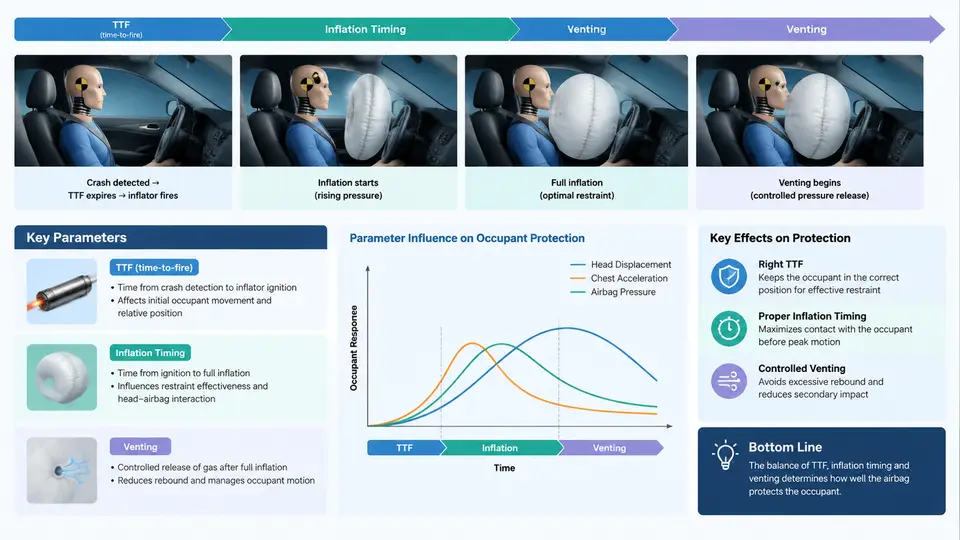
An airbag is only protective when it arrives at the right place at the right time. A fully inflated bag that meets the occupant too early can injure; a bag still inflating when the occupant arrives cannot absorb energy efficiently; a bag that has already vented too much pressure may bottom out against the steering wheel or instrument panel. This chapter examines the three timing levers that dominate frontal airbag performance — time-to-fire (TTF), the inflation profile, and venting — and shows how they interact with occupant kinematics to determine injury outcomes.
Time-to-Fire: The Decision Latency Budget
Time-to-fire is the interval between the physical impact event (or the crash pulse crossing the arming threshold) and the command to fire the inflator. In production restraint controllers, TTF is not a single number but the output of a discrimination algorithm that must satisfy two competing constraints: fire early enough that the bag is inflated before the occupant's forward excursion reaches the deployment zone, yet late enough to avoid firing in low-severity events, rough-road inputs, or misuse scenarios where deployment would do more harm than good.
A useful way to reason about TTF is as a budget. Consider a 50 km/h frontal barrier impact. The vehicle decelerates rapidly; the occupant, restrained by the seat belt, continues forward. The occupant's forward displacement relative to the vehicle interior grows roughly with the double integral of the relative deceleration. For a typical belted mid-size sedan, the occupant's chest may travel 100–150 mm forward within the first 50–60 ms. The airbag must therefore be substantially inflated by roughly 40–50 ms after impact to be in position. Working backward: if the inflator takes 25–30 ms to reach useful pressure, the fire command must be issued at approximately 15–25 ms. That is the TTF window the calibration engineer must hit — and it must be hit across the full range of crash severities and occupant sizes the system is designed to protect.
In practice, TTF is derived from crash-pulse features: the controller integrates acceleration, computes velocity change, and applies thresholds that vary with severity. A simplified discrimination rule might look like this:
// Illustrative discrimination logic (not production code)
// a = filtered longitudinal acceleration, positive = deceleration
// v = integrated velocity change since arming

if (v >= V_ARM && a >= A_ARM) {
    severity = classify(v, a, jerk);
    switch (severity) {
        case LOW:    ttf = 35 ms;  // delayed, reduced output
        case MEDIUM: ttf = 22 ms;  // nominal
        case HIGH:   ttf = 14 ms;  // early, full output
    }
    fire(ttf);
}
The numbers above are illustrative calibration values, not measured results. The point is structural: TTF is severity-dependent, and the controller trades latency against confidence. A common failure mode in calibration is a TTF that is correct for the 50 km/h barrier but too late for a 64 km/h offset deformable barrier (ODB) event, where the occupant loading is asymmetric and the bag must be positioned earlier on the struck side.
Inflation Timing and the Pressure Curve
Once the fire command is issued, the inflator's gas generation determines the pressure history inside the cushion. A pyrotechnic inflator typically delivers the bulk of its gas within 20–40 ms; a hybrid inflator stores compressed gas and releases it more gradually. The cushion's internal pressure rises, peaks, and then falls as gas escapes through vents and fabric porosity. The shape of this curve — not just its peak — governs how the bag interacts with the occupant.
Two timing features matter most. First, the time to first contact between occupant and cushion. If the occupant arrives before the cushion has developed meaningful pressure, the bag behaves like a limp membrane and provides little restraint. If the occupant arrives after the pressure peak, the bag may already be deflating and the occupant can "bottom out" against the module or steering wheel. Second, the pressure at contact determines the initial loading rate on the chest and head. A bag that is too stiff at contact produces high chest acceleration; a bag that is too soft allows excessive excursion.
Calibration engineers therefore tune the inflator output (number and size of gas generant wafers, or hybrid bottle pressure) together with the cushion volume and vent area so that the pressure curve aligns with the occupant's arrival time. The alignment is occupant-dependent: a 5th-percentile female arrives earlier and with less energy than a 95th-percentile male, which is why dual-stage inflators and occupant classification systems exist.
Venting: Controlling the Pressure Decay
Venting is the deliberate release of gas from the cushion — through sewn vents, one-way valves, or active venting mechanisms. It serves three purposes: it limits peak pressure to protect the occupant, it allows the cushion to conform to the occupant rather than acting as a rigid balloon, and it controls the post-peak decay so the bag does not remain stiff after the occupant has been arrested.
The vent area and vent timing are calibrated against the occupant's kinetic energy. A larger vent area produces a softer bag with lower peak pressure but greater occupant excursion; a smaller vent area produces a firmer bag with less excursion but higher loading. Active venting — where a tether or valve opens based on occupant size or severity — allows the same inflator to serve both small and large occupants by changing the effective vent area.
How the Three Parameters Interact
TTF, inflation, and venting are not independent knobs. Advancing TTF by 5 ms shifts the entire pressure curve earlier relative to the occupant, effectively increasing pressure at contact unless the inflator output is reduced or venting is increased. Increasing inflator output to compensate for a late TTF raises peak pressure and may require more venting, which in turn changes the decay and the bottom-out margin. The calibration problem is therefore a coupled optimization across a matrix of crash severities, occupant sizes, and belt usage states.
The SVG below maps this coupling as a timing chain: the crash pulse drives the discrimination logic, which sets TTF; the inflator converts the fire command into a pressure curve; venting shapes the decay; and the occupant's kinematics determine whether the pressure curve meets the occupant in the useful window.
Reading the Timing Chain in Practice
The figure makes the central calibration question visible: does the occupant arrival window overlap the useful portion of the pressure curve? In the illustrative curve shown, the occupant arrives near the pressure peak, which is generally desirable for a belted occupant in a moderate-severity event. If the arrival window were shifted left — a smaller or unbelted occupant moving forward earlier — the occupant would meet a rising pressure curve, producing a sharper loading rate. If shifted right, the occupant would meet a decaying curve and risk bottom-out.
When reviewing a calibration, engineers typically examine three alignment metrics: the time gap between TTF and occupant arrival, the pressure at the moment of contact, and the residual pressure at maximum excursion. A negative gap (occupant arrives before meaningful pressure) indicates TTF is too late or inflation is too slow. A large positive gap with high contact pressure indicates TTF is too early or the inflator is too aggressive. A low residual pressure at maximum excursion indicates excessive venting or insufficient inflator output.
Summary
TTF, inflation timing, and venting form a coupled timing system. TTF sets when the pressure curve begins; the inflator sets how fast and how high it rises; venting sets how it decays. The occupant's kinematics — governed by crash severity, belt usage, and occupant size — determine when and where the occupant meets that curve. Protection is achieved when the occupant arrival window overlaps the useful pressure region, and calibration is the process of aligning these three parameters across the design matrix. The next chapter examines how occupant size and position shift the arrival window and what adaptive restraint features compensate for that shift.