4. Restraint system architecture for far-si
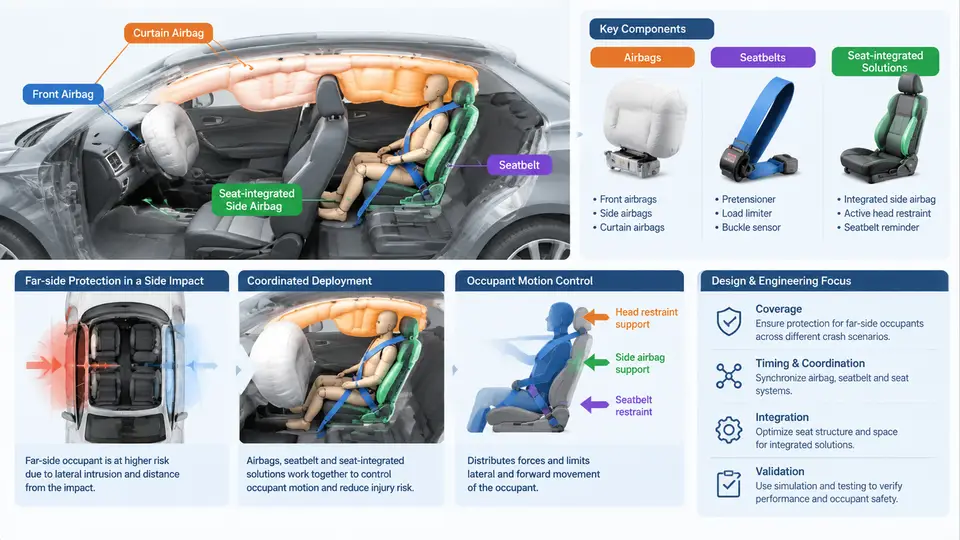
Far-side protection addresses the occupant seated on the side of the vehicle opposite the impact. In a right-hand-drive vehicle struck on the left, the driver is a far-side occupant; in a left-hand-drive vehicle struck on the right, the front passenger is far-side. Because there is no structure between the occupant and the vehicle interior on the struck side, the dominant injury mechanism is not intrusion but occupant excursion across the cabin: the torso slides out from under the diagonal belt, the head travels laterally toward the opposite B-pillar, console, or the other occupant, and the neck and thorax absorb the resulting bending and shear loads. The restraint architecture for far-side protection is therefore built around three questions: how do we keep the torso coupled to the belt, how do we decelerate the head before it reaches a hard interior surface, and how do we do both without creating new loading paths in near-side or frontal events?
Why the Three-Point Belt Alone Is Insufficient
In a far-side oblique or lateral impact, the diagonal belt's geometry works against the occupant. The belt runs from the outboard shoulder anchor diagonally across the chest to the inboard buckle, so a lateral acceleration directed toward the buckle side produces a component that pushes the torso out of the belt rather than into it. Once the shoulder slips under the diagonal, the upper body is essentially unrestrained and the head becomes the leading edge of the occupant's motion. This "submarining" of the shoulder is the single most important failure mode that far-side architecture must prevent, and it explains why far-side countermeasures are so often described as belt-coupling measures first and head-cushioning measures second.
Airbag-Based Countermeasures
Two airbag families dominate. The far-side airbag is a dedicated inflator and cushion mounted in the inboard side of the driver or passenger seat backrest, or occasionally in the center console. It deploys into the space between the two front occupants, creating a compliant barrier that limits lateral head and torso travel and prevents occupant-to-occupant contact. Because the cushion must fill a gap that varies with seat position and occupant size, its volume and venting are tuned for a broad range of fore-aft and recline positions, and deployment timing is typically later than a frontal bag — the cushion must be in place as the head arrives, not before.
The seat cushion airbag (sometimes called an anti-submarining or cushion bag) is a second, complementary device: an inflatable bladder in the seat pan that raises the front of the cushion and increases the ramp angle under the pelvis. By lifting the pelvis and tightening the lap-belt geometry, it resists the forward-and-lateral sliding that precedes shoulder slip-out. In practice the two devices are developed as a pair, because the cushion bag changes the occupant's position at the moment the far-side bag is loaded.
Seatbelt and Seat-Integrated Solutions
Belt-based measures attack the root cause. Belt-in-seat designs integrate the shoulder anchor and buckle into the seat frame rather than the B-pillar and floor, so the belt geometry follows the seat as it moves and reclines; this keeps the diagonal path consistent regardless of fore-aft position. Belt pretensioning on both outboard and inboard retractors removes slack early in the event, and a belt force limiter with a two-stage or adaptive characteristic controls how much load reaches the chest once the belt is coupled. The combination — early pretension to couple, then controlled payout to limit chest deflection — is what allows the belt to hold the shoulder in place without overloading the thorax.
Seat-integrated solutions extend this logic to the structure. An inboard side bolster or seat-integrated lateral support on the inboard side of the backrest gives the torso a reaction surface, reducing the lateral excursion that the belt must arrest. Some architectures add a seat-mounted far-side cushion that deploys from the inboard bolster itself, shortening the distance the cushion must span and making timing more repeatable. The trade-off is packaging: the inboard bolster competes with the center console, the armrest, and the other occupant's space, and it must not degrade near-side or rear-seat ingress.
Architecture Trade-offs and Development Practice
The three families are not independent options; they interact. A far-side airbag that is too aggressive can push the occupant back into the belt and increase chest loading; a cushion bag that lifts the pelvis too far can change the shoulder's path relative to the diagonal and either help or hurt coupling depending on seat position. Development therefore proceeds as a coupled optimization rather than a component-by-component sign-off.
A practical development sequence for a new architecture looks like this. First, define the occupant and impact matrix: 5th-percentile female through 95th-percentile male, seat positions from full-forward to full-rear, recline angles across the adjustment range, and impact angles spanning the far-side oblique corridor (typically around 30° to 75° from the longitudinal axis, with and without a moving deformable barrier). Second, instrument the observable quantities: head lateral displacement relative to the interior, head rotation about the vertical and lateral axes, shoulder belt slip-out (measured as the belt's position relative to the acromion), chest deflection, and pelvis lateral excursion. Third, run the matrix in simulation to screen architecture variants, then confirm a reduced matrix physically.
Judgement criteria should be set before testing, not after. A representative (illustrative, not measured) target set might be: shoulder belt remains inboard of the acromion throughout the event; head lateral displacement stays below a defined threshold before the far-side cushion is loaded; head rotation about the lateral axis stays within a neck-injury-based limit; and chest deflection remains within the force-limiter's design corridor. These are example targets for teaching purposes and must be replaced with the program's validated injury criteria.
Integration Constraints
Finally, the architecture must coexist with everything else in the seat and cabin. The far-side inflator adds mass and packaging volume to the inboard backrest, which affects seat comfort, the center console layout, and rear-seat knee clearance. The inboard bolster reduces the gap between seats, which can conflict with the other occupant's outboard space and with child-seat installation in the rear. Belt-in-seat designs move the anchor loads into the seat frame, which changes the seat's structural requirements and its attachment to the floor. These constraints are not afterthoughts — they are the reason far-side architecture is a system-level decision made early in the seat and interior package, not a countermeasure bolted on at the end of development.
The practical conclusion is that far-side protection is best understood as a belt-coupling problem with airbag assistance, delivered through a seat-integrated package. The belt and seat structure establish whether the occupant stays coupled; the airbags determine what happens to the head once coupling is lost or partially lost; and the development matrix determines whether the combination holds across the real range of occupants, positions, and impact angles.