1. Far-side occupant protection fundamental
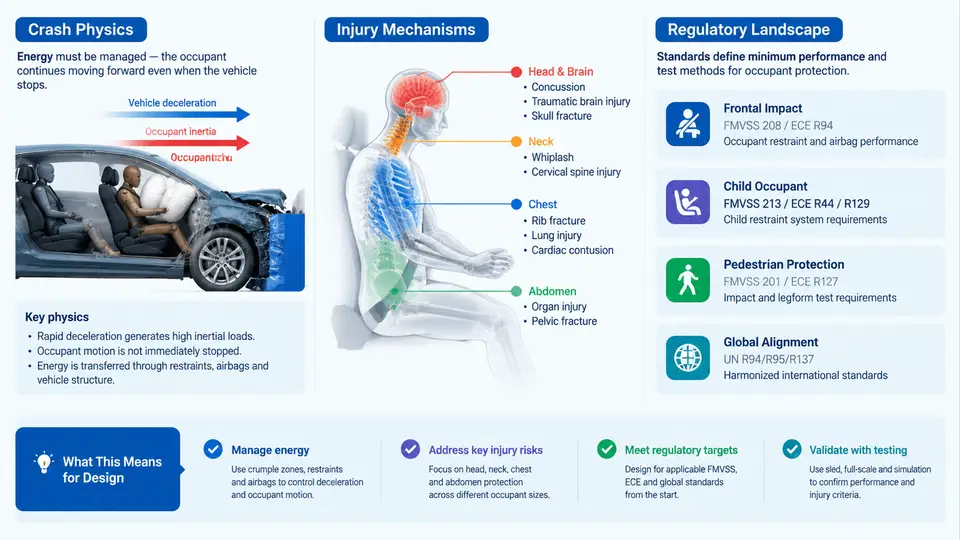
Far-side occupant protection addresses the occupant seated on the side of the vehicle opposite the impact. In a right-hand-drive vehicle struck on its right side, the far-side occupant is the driver on the left; in a left-hand-drive vehicle struck on the left, the far-side occupant is the front passenger on the right. Because the struck side absorbs the intrusion and the struck-side occupant is loaded directly by the barrier or striking vehicle, far-side occupants are often assumed to be "protected by distance." Real-world crash data and sled testing show the opposite: the far-side occupant is frequently the more severely injured of the two front occupants in a lateral impact, particularly for head and thorax injuries. This chapter establishes the physical basis for that counterintuitive result and the regulatory context that now drives far-side countermeasure development.
Crash physics: why the far-side occupant moves toward the impact
Establish the sign convention used throughout this course: the impact direction is the direction the striking object travels relative to the subject vehicle, and occupant excursion is measured in the vehicle-fixed frame. For a nearside (struck-side) impact, the vehicle is accelerated laterally away from the impact; the occupant, by inertia, remains near its original trajectory and therefore moves toward the impact in the vehicle frame. For a far-side occupant, the same inertial logic applies but the geometry is reversed: the vehicle is pushed away from the far-side occupant, so the occupant travels across the occupant compartment toward the struck side — across the center console, toward the opposite B-pillar, door trim, and the other occupant.
The key kinematic quantity is the relative lateral displacement between the occupant's head/thorax and the vehicle interior over the crash pulse. In a 50 km/h moving deformable barrier (MDB) side impact, the vehicle's lateral velocity change (Δv) at the struck sill is typically on the order of 8–12 m/s, and the crash pulse duration is roughly 60–100 ms. The far-side occupant, restrained only by a lap-shoulder belt and possibly a far-side airbag, does not decelerate with the struck sill; instead, the occupant's torso and head continue laterally while the belt pays out and the seat structure deforms. The result is a lateral excursion of the head relative to the seat that can exceed 200–300 mm in a severe pulse — enough to bring the head into contact with the opposite interior or the other occupant.
Two physical effects amplify the far-side problem. First, belt geometry: the outboard anchor and buckle are on the occupant's outboard side, so the diagonal belt loads the inboard shoulder and the lap belt loads the inboard pelvis. Under lateral acceleration, the belt tends to slip off the inboard shoulder (belt "swimming") and the occupant rotates about the belt, producing a combined lateral translation and yaw of the torso. Second, seat and console interaction: the center console and the inboard seat bolster provide only incidental restraint; they are not designed as occupant restraint surfaces, and their stiffness is uncontrolled. The far-side occupant therefore experiences a restraint system that is geometrically mismatched to the loading direction.
Injury mechanisms specific to the far side
Far-side injury patterns differ from nearside patterns in both mechanism and frequency. The dominant mechanisms are:
- Head injury from occupant-to-occupant contact. When two occupants are present, the far-side occupant's head can strike the near-side occupant's head or shoulder. This is a free-body collision between two unrestrained-in-lateral-direction masses, and the resulting head accelerations can be high because neither head is decelerated by a compliant structure. This mechanism is largely absent in nearside loading, where the head is loaded by the door and airbag.
- Head and neck injury from far-side interior contact. In the absence of a second occupant, the far-side head can contact the opposite B-pillar trim, the opposite door's armrest, or the roof rail. The contact velocity is the relative lateral velocity at the moment of contact, which can be 4–7 m/s even in a moderate pulse.
- Thoracic injury from belt loading and console contact. The diagonal belt loads the inboard rib cage at an oblique angle, producing rib fractures and, in more severe cases, aortic and solid-organ injury. The center console can load the inboard pelvis and lower thorax.
- Spine and pelvis injury from asymmetric belt loading. Because the lap belt is anchored outboard, the inboard pelvis is less restrained, allowing pelvis rotation and asymmetric spinal loading.
The practical consequence is that far-side countermeasures must address lateral head excursion and head-to-head contact as the primary target, with thorax and pelvis loading as secondary targets. This is why far-side airbags are typically seat-mounted or console-mounted devices that deploy into the gap between the occupants, rather than door-mounted devices.
Regulatory and rating landscape
Far-side protection has moved from a research topic to a regulated and rated requirement over the past decade. The principal instruments are:
| Instrument | Scope | Far-side relevance |
|---|---|---|
| FMVSS 214 (US) | Side impact, MDB and pole | Establishes the side-impact pulse and injury criteria (HIC, chest deflection, pelvis force) used as the baseline for far-side development; does not itself mandate a far-side test. |
| UN R95 / R137 | Side impact (MDB) and frontal offset | European side-impact pulse and injury criteria; far-side countermeasures are evaluated against these pulses in OEM internal requirements. |
| US NCAP side MDB and pole | Consumer rating | Star rating drives far-side performance targets; the pole test is particularly relevant because it produces high far-side head excursion. |
| Euro NCAP side impact and far-side occupant protection | Consumer rating | Includes a dedicated far-side occupant protection assessment using a far-side occupant (WorldSID or THOR) and evaluates head-to-head contact and excursion. |
| China NCAP (C-NCAP) side impact | Consumer rating | Increasingly includes far-side evaluation; relevant for vehicles developed for the Chinese market. |
Two regulatory trends matter for development. First, the shift from 50th-percentile male dummies to a broader occupant set — including the 5th-percentile female and the THOR dummy — changes the far-side problem because smaller occupants have different belt geometry and different head excursion. Second, the increasing use of far-side occupant monitoring and adaptive restraint means the restraint system must detect occupant presence and position on the far side and deploy accordingly; a far-side airbag that deploys when no far-side occupant is present is a cost and a potential out-of-position hazard.
What "good" looks like at the concept stage
At the concept stage, a far-side protection strategy should be evaluated against four questions. (1) Does the restraint system limit lateral head excursion to a level that keeps the head out of the opposite occupant's contact zone? (2) Does the system provide a compliant, energy-absorbing surface between the occupants when contact is unavoidable? (3) Does the belt geometry keep the diagonal belt on the inboard shoulder under lateral loading? (4) Does the system deploy only when a far-side occupant is present and positioned appropriately? These questions translate directly into the CAE load cases and the sled test matrix that follow in later chapters.
The physical picture established here — vehicle pushed away, occupant moving toward the impact, head excursion across the console, and head-to-head contact as the dominant mechanism — is the reference frame for every subsequent design decision in this course.