4. Anthropomorphic Test Devices (ATDs)
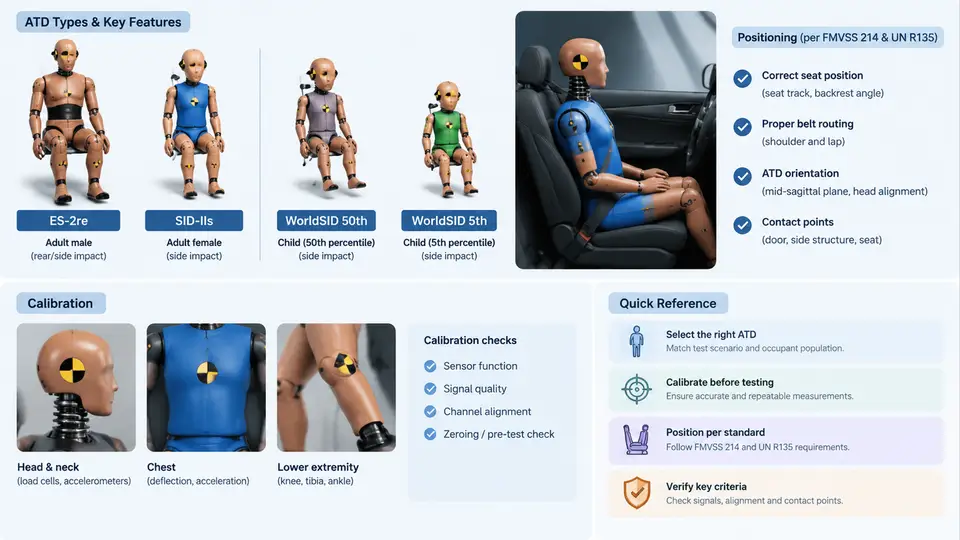
Side impact regulation is only as credible as the instrumented occupant that measures it. FMVSS 214 and UN R135 both rely on Anthropomorphic Test Devices (ATDs) to convert a crash pulse into injury-relevant numbers, but the two regimes do not use the same dummy family, and even where they overlap the positioning and calibration rules diverge. This chapter explains which ATD is used where, what each dummy is physically built to measure, how calibration is verified, and how positioning is executed so that a test result is defensible.
Which dummy, which regulation
FMVSS 214 (the dynamic side impact option, SID-IIs-based) uses the SID-IIs 5th percentile female dummy in the driver and rear-seat outboard positions, and the ES-2re 50th percentile male dummy in the front outboard position for the rigid moving deformable barrier (MDB) test at 53.9 km/h (33.5 mph). UN R135, by contrast, is built around the WorldSID 50th percentile male for the moving deformable barrier test and the WorldSID 5th percentile female for the pole test, with the ES-2re retained as an alternative in some contracting-party variants. The practical consequence: a laboratory that runs both regimes must maintain three distinct dummy types, each with its own calibration schedule, positioning procedure, and channel list.
| ATD | Percentile / mass | Primary regulation use | Key measured channels |
|---|---|---|---|
| ES-2re | 50th male, ~78 kg | FMVSS 214 MDB front outboard; some R135 variants | Rib deflection (3 ribs), abdominal force, pelvic force, T12/L1 moments |
| SID-IIs | 5th female, ~48 kg | FMVSS 214 MDB driver and rear outboard | Rib deflection (4 ribs), abdominal force, iliac/pubic force, head CG acceleration |
| WorldSID 50th | 50th male, ~78 kg | UN R135 MDB | Rib deflection (4 ribs), abdominal pressure, iliac force, pubic symphysis force, head acceleration |
| WorldSID 5th | 5th female, ~48 kg | UN R135 pole test | Same channel family as 50th, scaled geometry |
The ES-2re and SID-IIs are deflection-based dummies: their ribs are instrumented to report how far the chest is pushed inward, and the injury criteria (e.g., rib deflection limits, abdominal force limits) are expressed in millimetres and kilonewtons. The WorldSID family is also deflection-based but adds pressure-based abdominal measurement and a more anthropomorphic pelvic structure, which changes both the positioning procedure and the interpretation of abdominal readings. Do not assume a channel name means the same thing across dummies — "abdominal force" on an ES-2re and "abdominal pressure" on a WorldSID are different physical quantities and are not interchangeable in a report.
What calibration actually verifies
Calibration is not a single event; it is a set of component-level checks performed before a dummy is released for a test, plus periodic full-dummy verification. The purpose is to confirm that each transducer and each deformable element still responds within its certified corridor, so that a measured deflection can be trusted as a physical displacement rather than an artifact of a worn rib or a drifted accelerometer.
For the ES-2re and SID-IIs, the core checks are:
- Rib deflection calibration — each rib is loaded quasi-statically to a defined displacement and the output is checked against the certified sensitivity (mV/mm) and linearity. A rib that has been over-deflected in a previous test may read low; a rib with a loose strain-gauge bond may read noisy or non-linear.
- Abdominal force transducer — a known load is applied and the force output is verified against the calibration factor.
- Pelvic force / iliac force — load applied through the pelvic structure, output checked.
- Head accelerometer — static tilt and dynamic shock calibration (e.g., drop or pendulum) to confirm sensitivity and cross-axis response.
- Neck and spine load cells (where fitted) — moment and force calibration.
For the WorldSID 50th and 5th, the rib deflection calibration follows the same principle but the rib design and the certified corridors differ; the abdominal pressure sensor is calibrated against a known pressure source, and the iliac and pubic force transducers are checked individually. The WorldSID also carries a more extensive accelerometer set (head, chest, pelvis), each of which must be shock-calibrated.
Positioning: the part that most often invalidates a test
Positioning is where regulation compliance is most fragile, because a few millimetres of seat-back angle or a misplaced H-point changes the dummy's interaction with the door and the barrier. Both FMVSS 214 and UN R135 prescribe a positioning procedure built on the H-point machine and the dummy's own positioning jig, but the details differ.
The general sequence, common to both regimes, is:
- Set the seat to the position specified by the regulation (seat-back angle, cushion height, fore-aft position), using the H-point machine to establish the reference.
- Place the dummy in the seat using the specified lifting and settling procedure — lower it in, settle the pelvis, then the torso, then the limbs, without dragging.
- Apply the positioning jig — the dummy-specific device that sets pelvis angle, torso angle, and head orientation to the regulated values.
- Set limb positions — arm and leg placement per the regulation (e.g., arms forward and down, legs parallel and feet on the floor or specified support).
- Verify — measure H-point, torso angle, head height, and lateral position against the tolerances; record the as-positioned values.
The ES-2re and SID-IIs use their own positioning jigs and have specific pelvis and torso angle targets. The WorldSID uses a different jig and a different set of angle targets, and the 5th percentile version scales the geometry. A jig from one dummy family cannot be substituted for another. In practice, the most common positioning errors are: seat-back angle set by eye rather than by the H-point machine; the dummy settled with the pelvis rotated; the head not centred laterally; and the feet not in the regulated position, which changes leg loading and can shift the pelvis.
A worked positioning check
Consider a UN R135 MDB test with a WorldSID 50th. The seat is set to the regulated position and the H-point machine establishes the reference. The dummy is lowered in and settled; the WorldSID jig is fitted and the pelvis and torso angles are set to the regulated targets. Suppose the as-positioned torso angle reads 2° above the target and the head is 8 mm off lateral centre. Both are outside the typical tolerance band (often ±1° and a few millimetres, depending on the regulation's stated limits). The correct response is not to accept the reading and note it — it is to re-settle the dummy, re-fit the jig, and re-measure. If the torso angle will not come into band after re-settling, the seat-back angle or the cushion is suspect, and the seat should be re-set with the H-point machine before the dummy is placed again.
A second check that catches many errors: after positioning, confirm that the dummy's arm and leg positions match the regulation's drawing, not just "look reasonable." A WorldSID with the arm rotated slightly inward can pre-load the ribcage against the door trim before impact, which biases every rib deflection reading low. The same error on an ES-2re biases the abdominal force reading. Because the bias is systematic, it will not show up as noise — it will show up as a suspiciously clean, low result, which is exactly the kind of result that should trigger a positioning audit rather than a celebration.
What to record and why
For each test, the defensible record includes: ATD type and serial number; calibration date and the calibration certificate reference for every channel used; the as-positioned H-point, torso angle, head height and lateral offset; the seat settings; and the jig identification. These are not administrative extras — they are the evidence that the measured deflections correspond to a correctly positioned, correctly calibrated occupant. When a result is challenged, the first question is almost always "was the dummy in the right place and was it calibrated?", and the record is what answers it.
The three dummy families share a common logic — measure deflection, verify the transducer, position to a jig, record the as-positioned state — but they differ in geometry, channel definitions, and jig design. Treating them as interchangeable is the most reliable way to produce a test that looks compliant and is not.