1. Regulatory landscape and scope
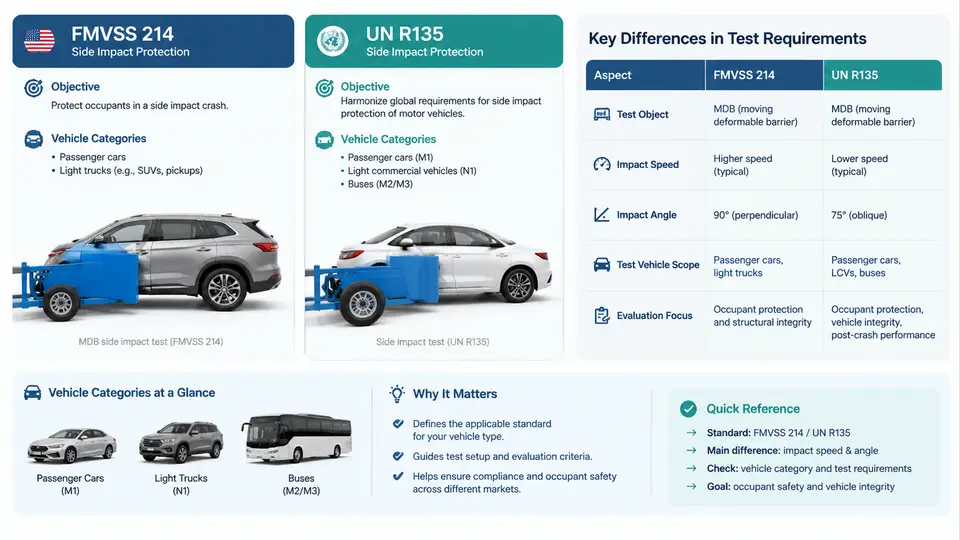
Side impact protection is one of the few areas of occupant safety where two major regulatory regimes — the United States Federal Motor Vehicle Safety Standard (FMVSS) 214 and the United Nations Regulation No. 135 (UN R135) — pursue the same fundamental objective through markedly different test architectures. Before any engineer can design a door trim, a side airbag, or a B-pillar reinforcement, they must understand which regulation applies to the vehicle, what physical event each regulation simulates, and how the pass/fail criteria differ. This chapter establishes that regulatory map.
Objectives and Regulatory Philosophy
FMVSS 214, titled Side Impact Protection, is issued under 49 CFR Part 571 by the National Highway Traffic Safety Administration (NHTSA). Its scope covers passenger cars, multipurpose passenger vehicles, trucks, and buses with a gross vehicle weight rating (GVWR) of 4,536 kg (10,000 lb) or less. The standard has two principal pillars: a dynamic side impact test using a moving deformable barrier (MDB), and a static door strength requirement (the "door crush" or side door beam test). The dynamic test evaluates occupant protection in a simulated vehicle-to-vehicle intersection collision, while the static test verifies that door structures resist intrusion loads.
UN R135, formally Uniform provisions concerning the approval of vehicles with regard to their side impact performance, is administered under the 1958 Agreement through the World Forum for Harmonization of Vehicle Regulations (WP.29). It applies to passenger cars and light commercial vehicles (categories M1 and N1). UN R135 was developed to consolidate and modernize the earlier side impact provisions (ECE R95) and introduces a mobile deformable barrier test with a pole test option, aligning more closely with real-world crash configurations while retaining the regulatory approval framework of type approval rather than self-certification.
Test Configuration Comparison
The most consequential engineering differences lie in the barrier, the impact angle, the impact speed, and the occupant injury criteria. The table below summarizes the principal parameters; note that these are the regulatory baseline values and that manufacturers frequently run additional internal tests beyond them.
| Parameter | FMVSS 214 (Dynamic MDB) | UN R135 (MDB) |
|---|---|---|
| Barrier type | Moving deformable barrier, 1,368 kg, honeycomb face | Mobile deformable barrier, 950 kg (M1) / 1,300 kg (N1), honeycomb face |
| Impact angle | 27° crab angle (barrier longitudinal axis to vehicle axis) | 90° perpendicular (barrier face parallel to vehicle side) |
| Impact speed | 53.9 km/h (33.5 mph) | 50 km/h |
| Struck-side occupant | SID-IIs (50th percentile male) | WorldSID 50th percentile male |
| Primary injury metrics | HIC, chest deflection (rib), pelvis force, abdominal force | HIC, chest deflection, abdomen force, pelvis force |
| Pole test | Not part of 214 dynamic (separate oblique pole in some OEM specs) | Optional pole test at 32 km/h |
The 27° crab angle in FMVSS 214 is a defining feature: the barrier strikes obliquely, producing a combined lateral and longitudinal loading that drives the struck vehicle into a yaw rotation. This configuration stresses door latch integrity, seat belt anchorage, and the interaction between the occupant and the far-side interior. UN R135's perpendicular impact concentrates energy more directly into the door structure and side airbag, making it a cleaner test of lateral intrusion resistance but arguably less representative of the angled intersection crashes that dominate real-world injury statistics.
Vehicle Categories and Applicability
Applicability determines which test matrix a program must execute. Under FMVSS 214, the dynamic requirement applies to vehicles with GVWR ≤ 4,536 kg; the static door strength requirement applies more broadly. Vehicles are tested in their "as-delivered" configuration, and NHTSA selects the struck side based on the vehicle's seating configuration — for left-hand-drive vehicles, the driver side is struck. UN R135 applies to M1 and N1 categories, with the barrier mass and test parameters adjusted for N1 vehicles. A vehicle type-approved to UN R135 for the European market may still require separate FMVSS 214 certification for the US market, and the two test campaigns cannot be substituted for one another.
Key Differences That Drive Test Planning
Three differences dominate the engineering workflow. First, the dummy: FMVSS 214 uses the SID-IIs, whose chest deflection measurement is based on rib displacement, while UN R135 uses WorldSID, which provides more biofidelic response and additional measurement channels. A restraint system tuned to SID-IIs thresholds will not automatically satisfy WorldSID criteria, and vice versa. Second, the barrier mass and speed: the 1,368 kg barrier at 53.9 km/h delivers substantially more kinetic energy than the 950 kg barrier at 50 km/h, so FMVSS 214 generally imposes higher structural intrusion demands on the struck door. Third, the approval pathway: FMVSS 214 compliance is demonstrated by the manufacturer's own test data and certification label, whereas UN R135 requires a formal approval number issued by a national authority after a witnessed test at an accredited facility.
A practical consequence: a vehicle program targeting both markets typically runs the FMVSS 214 oblique test as the structural worst case and the UN R135 perpendicular test as the airbag/restraint calibration case, then reconciles the two datasets. Where a single door architecture must satisfy both, engineers often design to the more severe intrusion metric (FMVSS 214) and calibrate the side airbag inflation profile against the WorldSID chest deflection channel (UN R135).
Scope Boundaries and What Each Regulation Does Not Cover
Neither regulation addresses every side impact scenario. FMVSS 214's dynamic test does not include a pole impact; NHTSA has evaluated oblique pole tests separately but they are not part of the current dynamic requirement. UN R135 includes an optional pole test at 32 km/h, but it is not mandatory for all approvals. Neither regulation directly evaluates far-side occupant protection, rear-seat side impact in all configurations, or compatibility between vehicles of different masses. These gaps are typically addressed through manufacturer-internal requirements, consumer rating programs (such as Euro NCAP and IIHS side tests), and future regulatory amendments. Understanding the boundary of each standard is as important as understanding its content, because it defines where additional validation evidence must be generated.
With this regulatory map established, subsequent chapters can move into the mechanics of the tests themselves: barrier construction and calibration, dummy instrumentation and positioning, sled and full-scale facility requirements, and the data reduction methods that convert accelerometer and load-cell signals into the pass/fail metrics summarized above.