4. Injury criteria and biomechanical limits
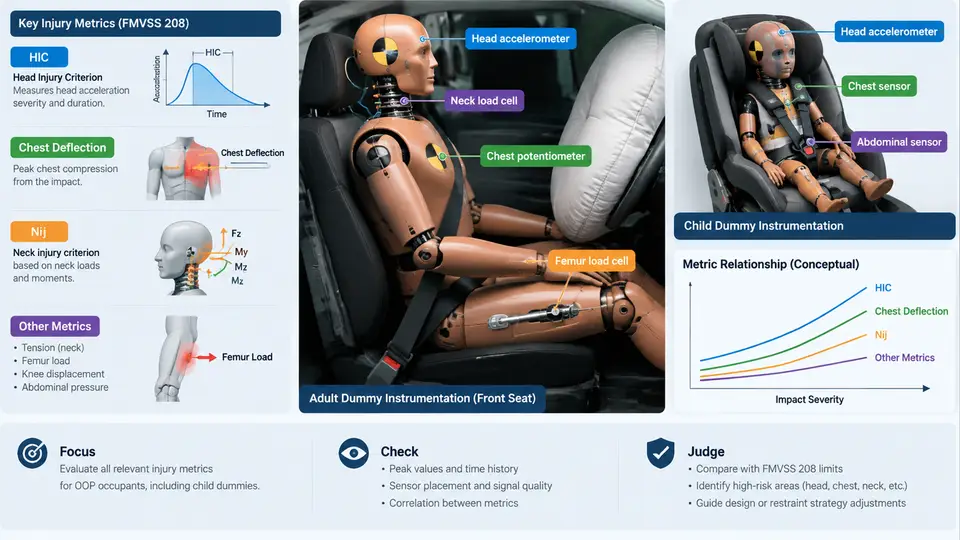
FMVSS 208 does not regulate "airbag force" directly. It regulates occupant response, expressed through a small set of physical measurements taken on instrumented Anthropomorphic Test Devices (ATDs) and compared against biomechanical tolerance limits. For out-of-position (OOP) occupants, these criteria do double duty: they define the pass/fail envelope for the static OOP deployment tests (the "low-risk deployment" requirement), and they explain why the suppression and low-power deployment logic exists. Understanding the metrics — what they physically measure, how they are computed, and where their limits come from — is the foundation for every calibration decision that follows.
Head Injury Criterion (HIC)
HIC is a weighted integral of resultant head acceleration over a time window, expressed as:
HIC = max over [t1, t2] of  (t2 - t1) * [ (1/(t2-t1)) * ∫ a(t) dt ]^2.5

where a(t) = resultant acceleration at the head CG, in g
      t2 - t1 ≤ 15 ms (HIC15) or ≤ 36 ms (HIC36)
The 2.5 exponent heavily penalizes high-magnitude, short-duration spikes, which is precisely the loading signature of an airbag striking a child's head at close range. FMVSS 208 uses HIC15 ≤ 700 for the OOP tests, with a companion requirement that the resultant head acceleration not exceed 250 g for any cumulative duration above 3 ms. The 700 limit is not a strict injury threshold — it corresponds roughly to a 5–10% risk of severe (AIS 4+) head injury in the adult population — but it is applied to child dummies in OOP testing, which is a deliberately conservative engineering choice: the dummy's mass and stiffness are scaled, but the limit is not relaxed.
Practical implication: HIC is dominated by the first few milliseconds of bag contact. In a typical OOP head-close-to-module test, the head is stationary when the bag begins to deploy; the venting strategy, module cover tear pattern, and bag fold sequence determine whether the head sees a sharp 200 g spike or a broader 120 g pulse. Calibrators therefore tune HIC primarily through initial bag inflation rate and vent area, not through the restraint's later energy absorption.
Chest Deflection and the Chest Injury Criterion
Chest deflection is measured by a potentiometer or IR-TRACC string between the sternum and the spine box of the dummy. FMVSS 208 OOP requirements cap chest deflection at 63 mm for the adult-sized dummies used in OOP tests (and the corresponding scaled value for the child dummy, typically 40 mm for the CRABI 12-month and 45 mm for the 3-year-old, depending on the dummy variant and the specific test). The chest injury criterion is often reported alongside as:
Chest Injury Criterion (CIC) = (D / 0.229)^1.5 * (a_chest / 9.81)^0.5

D = peak chest deflection (m), a_chest = peak resultant chest acceleration (g)
Limit commonly applied: CIC ≤ 1.0 (adult), scaled for child dummies
For OOP occupants, chest loading is rarely a pure belt problem — it is a bag-on-torso problem. A deploying bag that contacts the chest before full inflation delivers a concentrated pressure pulse over a small area, producing high deflection with modest acceleration. This is why OOP chest deflection is most sensitive to bag stand-off distance and module cover geometry: a cover that hinges open toward the chest can preload the sternum before the bag has any chance to distribute load.
Neck Injury Criteria: Nij and Nkm
The neck is the most consequential structure in OOP child loading, because a deploying bag under the chin produces combined axial tension/compression and bending. FMVSS 208 uses the Nij criterion:
Nij = (Fz / Fzc) + (My / Myc)

Fz  = axial force (N), tension positive
My  = bending moment about the y-axis (N·m)
Fzc = critical axial force (tension 6806 N, compression 6160 N for adult)
Myc = critical moment (tension 310 N·m, compression 310 N·m for adult)

Limit: Nij ≤ 1.0
For child dummies the critical values are scaled down (for example, the CRABI 12-month uses Fzc ≈ 2120 N tension / 2120 N compression and Myc ≈ 40 N·m). The criterion is a combined loading index: a neck can survive a large moment if axial load is low, and vice versa, but the sum of normalized components must stay below 1.0. In OOP testing, the dominant failure mode is extension moment from a bag striking the chin or lower face, often accompanied by tension as the head is driven upward. This is the single most common reason a low-risk deployment calibration fails and must be re-tuned.
Other Metrics Applied to OOP Occupants
- Femur load (≤ 10 kN adult, scaled for child): relevant when the bag contacts the knees or when the occupant is positioned with legs against the instrument panel.
- Knee displacement (≤ 15 mm): captures the same loading path as femur load but at the joint.
- Abdominal penetration / belt load: for OOP occupants restrained by a belt, the bag can drive the belt into the abdomen; the criterion is belt force and penetration depth.
- Head excursion and contact: in OOP tests, the head may contact the A-pillar or header; the criterion is not just HIC but also whether the head strikes a hard surface at all.
Child Dummy Instrumentation: What Is Actually Measured
The child dummies used in FMVSS 208 OOP testing (CRABI 12-month, Hybrid III 3-year-old, and the 6-year-old) carry a specific instrumentation set. The CRABI 12-month, for example, is instrumented with:
| Location | Sensor | Measured quantity | Relevant criterion |
|---|---|---|---|
| Head CG | Triaxial accelerometer | Resultant acceleration | HIC15, 250 g / 3 ms |
| Upper neck | Six-axis load cell | Fz, My (and Mx) | Nij |
| Chest | Deflection potentiometer / IR-TRACC | Sternum-to-spine displacement | Chest deflection, CIC |
| Chest | Triaxial accelerometer | Chest acceleration | CIC |
| Pelvis | Accelerometer | Pelvis acceleration | Secondary check |
Two instrumentation details matter for OOP work. First, the child dummy's neck load cell is small — its rated capacity is a few kN, and a bag strike that produces a 3 kN tension spike is already near the scaled Nij limit. Second, the chest deflection sensor's stroke is short (tens of millimeters), so a bag that compresses the chest beyond the sensor's range will clip the signal; a clipped deflection trace is a calibration red flag, not a pass. Always verify that the recorded deflection is below the sensor's full-scale before trusting the number.
Reading the Results: A Calibration Example
Consider a representative (illustrative, not measured) OOP calibration iteration for a passenger-side module tested against a CRABI 12-month dummy positioned with the head 150 mm from the module cover. The first deployment produces:
HIC15        = 812   (limit 700)   FAIL
Nij          = 1.24  (limit 1.0)   FAIL
Chest defl.  = 38 mm (limit 40)    PASS (marginal)
Peak neck Fz = 2.6 kN (limit 2.12) FAIL component
The failure signature — high HIC and high Nij with marginal chest — points to a bag that is arriving too fast and too concentrated at the chin. The diagnostic sequence is: (1) confirm the neck load cell is not clipping; (2) inspect the high-speed video for cover hinge direction and bag-to-chin contact timing; (3) reduce initial inflator output by one step and increase vent area by roughly 15–20%; (4) re-run. A second iteration with a lower-output inflator and a cover that hinges away from the occupant typically brings HIC into the 550–650 range and Nij to 0.7–0.85, at the cost of slightly slower full inflation — which is acceptable because OOP tests do not require the bag to be fully inflated at a specific time, only that the occupant response stays inside the envelope.
The metrics above are the vocabulary of OOP compliance. Every subsequent design decision — suppression thresholds, seat position sensing, low-power inflator staging — is ultimately justified by its effect on these four numbers: HIC15, Nij, chest deflection, and the secondary femur/knee loads. Mastering their computation and their physical meaning is what separates a calibration that merely passes from one that is robust across the OOP position matrix.