1. Regulatory landscape and scope
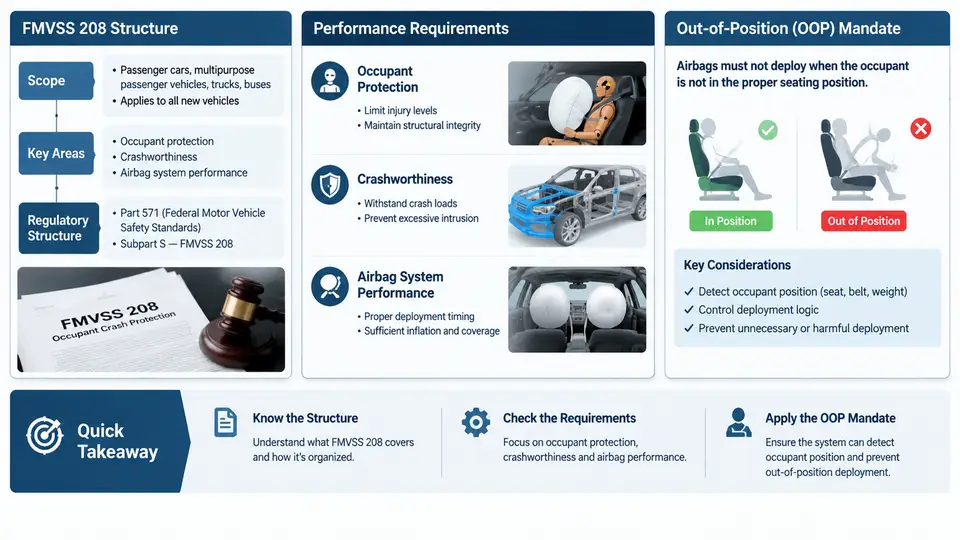
FMVSS 208, formally titled Occupant Crash Protection, is the single most consequential federal motor vehicle safety standard for restraint system engineering. It governs what happens to occupants during frontal and, in certain configurations, lateral impacts, and it defines the boundary conditions within which airbag and seat belt systems must perform. For engineers working on out-of-position (OOP) airbag safety, FMVSS 208 is not merely a compliance checkbox — it is the document that establishes the performance envelope, the test matrix, and the specific suppression or low-risk deployment obligations that shape the entire restraint architecture.
Understanding the standard requires separating three layers: its structural organization (how the regulation is partitioned), its performance requirements (what measurable outcomes must be achieved), and its OOP mandate (the special provisions for occupants who are not in the nominal seated posture when a deployment occurs). Each layer drives different engineering decisions, and conflating them is a common source of late-stage compliance failures.
Structural Organization of FMVSS 208
FMVSS 208 is organized into a scope statement, definitions, general requirements, and a series of detailed test procedures and performance criteria. The regulation addresses both belted and unbelted occupants, and it distinguishes between vehicles by type (passenger cars, multipurpose passenger vehicles, trucks, buses) and by configuration (driver, right front passenger, rear seating positions). The standard's requirements are commonly grouped as follows:
- Frontal barrier crash requirements — full frontal rigid barrier impacts at specified velocities, with injury criteria evaluated on instrumented Anthropomorphic Test Devices (ATDs).
- Offset and angled impact provisions — depending on the vehicle category and model year applicability, additional crash configurations apply.
- Static and dynamic OOP tests — low-speed deployment tests using out-of-position ATD placements, with specific body-region injury criteria.
- Airbag suppression and low-risk deployment requirements — the obligation to either suppress deployment or deploy at reduced risk for occupants detected in defined OOP zones.
- Tell-tale and warning requirements — occupant-facing indicators for airbag status and suppression state.
The regulation is performance-based rather than design-prescriptive: it does not mandate a particular airbag architecture, sensor count, or suppression algorithm. Instead, it specifies measurable outcomes — head injury criterion (HIC), chest deflection, neck injury measures, and for OOP tests, specific limits on head, neck, and chest responses during deployment. This performance orientation gives engineers design freedom but places the burden of proof squarely on test evidence.
Performance Requirements in Practice
The core frontal crash requirements are evaluated using instrumented ATDs — typically the Hybrid III 50th percentile male for driver and passenger positions, with additional ATDs (5th percentile female, 95th percentile male, and child restraints) used in specific test configurations. The measured injury criteria include:
| Measure | Typical Criterion (illustrative) | Body Region |
|---|---|---|
| HIC15 | ≤ 700 (varies by test and position) | Head |
| Chest deflection | ≤ 63 mm (50th percentile male) | Chest |
| Neck injury (Nij) | ≤ 1.0 | Neck |
| Femur axial force | ≤ 10 kN | Lower extremities |
These values are illustrative of the standard's structure; the actual limits depend on the specific test configuration, ATD, and seating position, and engineers must consult the current regulatory text and applicable test procedures. The key engineering implication is that restraint performance is judged by measured occupant response, not by component-level specifications. A restraint system that meets component targets but produces excessive chest deflection in the barrier test is non-compliant.
The Out-of-Position Mandate
The OOP provisions address a fundamentally different scenario from the barrier crash: an occupant who is close to, or in contact with, the airbag module when deployment occurs. In this condition, the airbag's rapid inflation can impart injurious loads to the head, neck, and chest — particularly for small occupants, children, and occupants leaning forward. The OOP mandate requires that the restraint system either suppress deployment when an occupant is detected in a defined OOP zone, or deploy at low risk such that injury criteria are not exceeded.
The standard defines specific OOP test positions — for example, occupants positioned close to the instrument panel, leaning forward, or with the head near the airbag module — and specifies dynamic deployment tests at low speed with the airbag firing. The ATD responses are evaluated against OOP-specific injury criteria, which are generally more restrictive than the barrier crash criteria because the occupant is unprotected by the belt and in direct proximity to the deploying airbag.
This creates a dual-architecture problem. The restraint system must:
- Deploy aggressively enough to protect a belted or unbelted occupant in a high-speed barrier crash, and
- Deploy in a controlled, low-risk manner — or not at all — when an occupant is detected in an OOP zone.
These requirements pull in opposite directions. The resolution typically involves occupant sensing (weight, position, belt status), a suppression or dual-stage deployment strategy, and careful calibration of inflator output and venting. The OOP mandate is therefore not a standalone test requirement but a system-level constraint that propagates into sensor selection, airbag module design, and restraint control algorithm development.
Why the OOP Mandate Reshapes the Engineering Program
The OOP requirement is often treated as a late-stage calibration activity, but that framing is expensive. Because the OOP decision depends on occupant sensing, the sensor suite must be selected and validated early; because low-risk deployment depends on inflator output and venting, the airbag module design must accommodate a dual-mode or staged strategy from the concept phase; and because suppression logic interacts with the tell-tale requirements, the human-machine interface must be defined alongside the restraint control algorithm.
A practical way to scope the program is to build a compliance matrix early. For each vehicle configuration and seating position, list the applicable barrier crash tests, the applicable OOP test positions, the ATD types, and the injury criteria. Then map each row to the subsystem that owns it — belt, airbag module, sensor, or control algorithm. This matrix becomes the program's traceability backbone and exposes gaps before hardware is frozen.
Scope Boundaries and What the Standard Does Not Cover
FMVSS 208 addresses frontal and specified lateral crash protection and OOP deployment safety. It does not prescribe side airbag performance in all configurations, nor does it cover rear-seat OOP in the same detail as front-seat positions in every model year. Engineers should also distinguish FMVSS 208 from related standards — for example, FMVSS 207 (seating systems), FMVSS 209 (seat belt assemblies), and FMVSS 213 (child restraint systems) — because compliance is evaluated per standard, and a restraint design that satisfies 208 may still require separate validation against belt and child-seat requirements.
The regulatory landscape is also dynamic: applicability dates, test procedure revisions, and ATD updates change over time. A compliance program should maintain a current mapping of the regulation text to the vehicle's certification basis, and should treat the OOP provisions as a living requirement rather than a fixed target. The engineering takeaway is straightforward: FMVSS 208 defines the performance envelope, the OOP mandate defines the occupant-proximity constraint, and the restraint system must satisfy both simultaneously — which is why OOP safety engineering begins at architecture definition, not at final calibration.