1. Frontal crash protection system overview
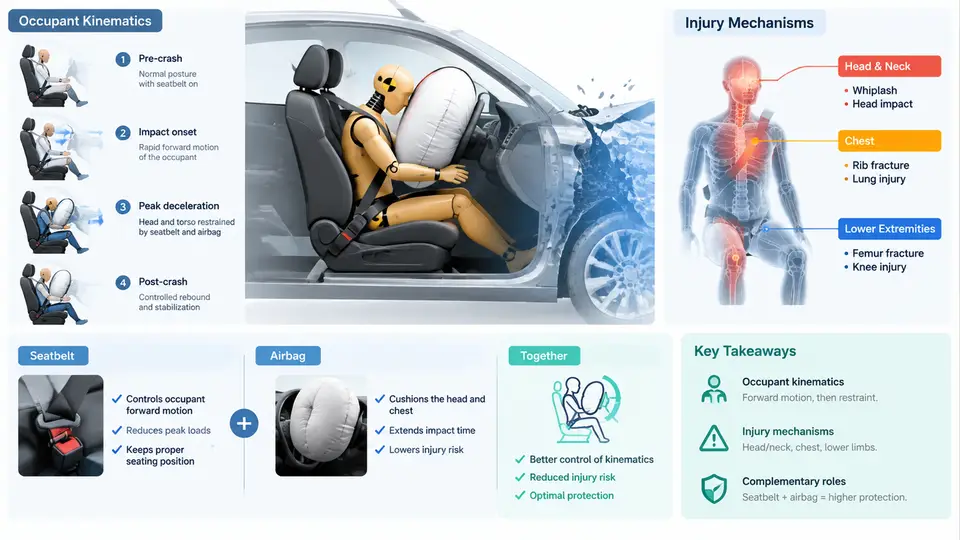
A frontal crash protection system is not a single device but a coordinated restraint chain. The vehicle body absorbs and redirects crash energy, the seatbelt couples the occupant to the decelerating structure, and the airbag provides a compliant cushion between the occupant and the interior. Each element acts on a different timescale and against a different injury mechanism. Understanding where each component sits in that chain — and what happens when one of them is missing, mistimed, or misused — is the foundation for every calibration, validation, and diagnostic decision that follows in this course.
Occupant kinematics in a frontal impact
Consider a 50 km/h full-frontal barrier impact, a standard regulatory and consumer-test condition. The vehicle's longitudinal deceleration pulse typically rises to 30–45 g within 20–40 ms and decays over roughly 80–120 ms. The occupant, however, is not rigidly attached to the vehicle. At the moment of impact the occupant continues forward at approximately the pre-crash velocity while the vehicle structure decelerates beneath them. The relative displacement between occupant and interior is what the restraint system must manage.
Three phases describe the motion. In the pre-loading phase (0–30 ms), the occupant moves forward relative to the vehicle; the belt begins to engage, webbing pays out through the retractor and stretches, and the occupant loads the belt geometry. In the restraint phase (30–90 ms), belt force rises, the occupant's torso and pelvis decelerate, and the head pitches forward and downward as the neck rotates. In the rebound phase (after roughly 100 ms), stored belt and seat energy returns the occupant rearward into the seat back. Airbag deployment is timed to occur inside the restraint phase — the bag must be inflated and venting before the head and chest arrive at the module, but not so early that the occupant strikes a fully pressurized bag.
Two reference conventions are used throughout this course. Longitudinal acceleration is positive in the vehicle's forward direction of travel; during a frontal impact the measured deceleration is therefore negative, and we report it as a magnitude in g. Occupant displacement is measured relative to the vehicle interior, positive forward. These conventions are held consistently in all figures and calculations.
Injury mechanisms and the metrics that track them
Frontal crash injuries cluster into four mechanisms, each with a corresponding physical quantity that restraint design tries to control:
- Head injury — contact with the steering wheel, instrument panel, or A-pillar, plus rotational loading of the brain. Tracked by HIC36/HIC15 and, increasingly, by rotational velocity criteria such as BrIC.
- Neck injury — tension, compression, and bending from head inertia loading the cervical spine. Tracked by Nij and neck tension/compression limits.
- Chest injury — sternal and rib deflection from belt loading and steering-wheel contact. Tracked by chest deflection (mm), chest acceleration (3 ms clip, g), and viscous criterion.
- Lower-extremity injury — knee-thigh-hip loading against the knee bolster and toe-pan intrusion. Tracked by femur axial force and tibia index.
The key insight is that these mechanisms peak at different times and respond to different restraint characteristics. Belt loading is distributed over the pelvis and chest but concentrates force on narrow webbing paths; the airbag spreads load over a much larger area but only for the head and upper torso, and only during a short window. Neither alone covers the full injury set.
Why seatbelt and airbag are complementary, not redundant
The seatbelt's primary job is to couple the occupant to the vehicle early, so that deceleration is spread over the longest possible distance and time. A belt that engages at 15–25 ms begins decelerating the pelvis and chest while the occupant still has tens of milliseconds of ride-down available. It also controls the occupant's position: without a belt, the occupant's forward excursion is large and unpredictable, and the airbag's geometry — designed around a belted occupant's head trajectory — no longer matches.
The airbag's primary job is to manage the head and upper chest in the window where belt geometry cannot: it provides a distributed, energy-absorbing surface that limits head excursion and reduces contact with hard interior structures. It is deliberately designed to vent, so that it absorbs rather than rebounds the head. Critically, the airbag is a supplemental restraint — its calibration assumes the occupant is belted and positioned within a defined envelope.
The figure below maps the restraint chain as a signal-and-load path: from crash pulse through sensing and deployment decision, into the parallel belt and airbag load paths, and out to the injury metrics each path controls.
Reading the chain in practice: a worked example
Suppose a calibration engineer is reviewing a sled test at 50 km/h with a belted 50th-percentile male Hybrid III. The observed chest deflection is 42 mm against a 50 mm target, but HIC36 is 780 against a 700 target, and the head is contacting the bag late — the bag is already venting when the head arrives. The chain view tells the engineer where to look. Chest deflection is acceptable, so the belt load limiter is not the primary problem. The head metric is high and the timing is late, which points to the airbag path: either the fire time is too late, the inflator output is low, or the module is positioned so the head travels too far before contact.
A structured check proceeds as follows. First, confirm the fire time from the ACU log against the crash pulse; a fire time that lands after the pulse peak shortens the usable cushion window. Second, verify the bag's free-expansion and venting behavior on a static deployment test — a bag that vents too early loses the pressure needed to arrest the head. Third, check the occupant's head trajectory against the module centerline; a head path that passes above or below the bag's effective area produces late, glancing contact. Each check isolates one link in the chain rather than adjusting the whole system at once.
Design envelope and the limits of complementarity
The belt–airbag partnership holds within a defined envelope: occupant size and mass, seating position, belt use, and crash severity and direction. Out-of-position occupants, unbelted occupants, rear-facing child seats in the front passenger seat, and oblique or offset impacts all push the system outside the assumptions its calibration was built on. This is why modern systems add occupant classification, belt-reminder logic, pretensioner firing strategies, and multi-stage inflators — each is an attempt to keep the two load paths complementary across a wider range of real conditions.
For the remainder of this course, treat every restraint component as a link in this chain. A pretensioner that fires late, a load limiter set too high, an inflator with the wrong vent area, or a sensor that misclassifies the crash all show up as a specific, diagnosable distortion of the load paths and timing shown above. The next chapters build the sensing, belt, and airbag subsystems in detail, always against this reference picture of what the chain must accomplish.