1. Automotive CAE portfolio landscape
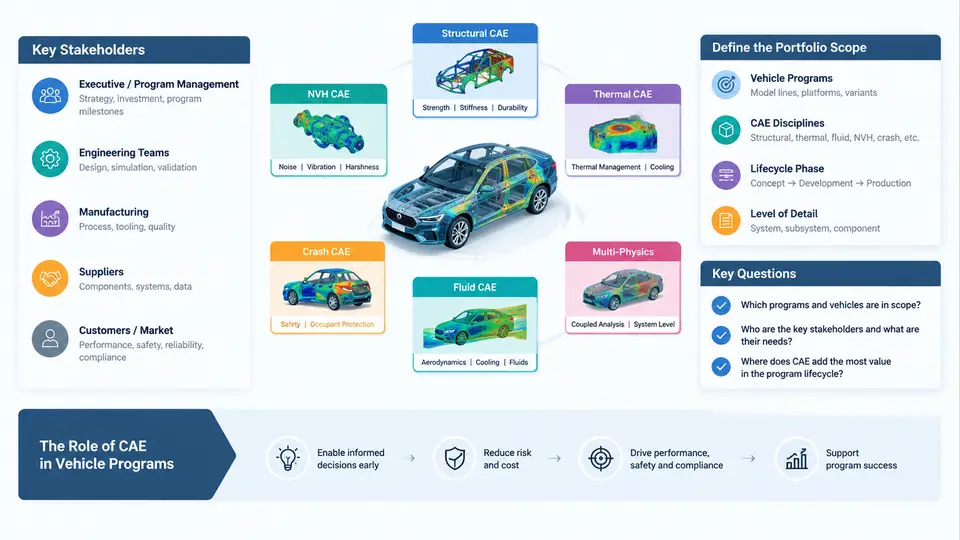
In a modern vehicle program, Computer-Aided Engineering (CAE) is no longer a single discipline performed by a single team. It is a portfolio: a structured collection of simulation capabilities, models, methods, tools, and deliverables that together support engineering decisions across the entire vehicle development lifecycle. Understanding this portfolio — its scope, its stakeholders, and its role within vehicle programs — is the foundation for managing it effectively.
Defining the CAE Portfolio Scope
The CAE portfolio encompasses every simulation activity that contributes to a vehicle program. This includes, but is not limited to:
- Structural analysis — stiffness, strength, durability, crashworthiness, and NVH (Noise, Vibration, Harshness)
- Fluid dynamics — aerodynamics, thermal management, HVAC, and underhood airflow
- Multi-body dynamics — suspension kinematics, ride comfort, and handling
- Manufacturing simulation — stamping, welding, casting, and injection molding
- Electromagnetic simulation — antenna performance, EMC/EMI, and electric motor design
- System-level simulation — powertrain integration, energy management, and vehicle-level performance
Each of these domains has its own tools, solvers, model formats, and validation requirements. The portfolio manager must understand not only what each domain does, but how they interact, where data flows between them, and where dependencies create risk.
A critical distinction is between capability and capacity. Capability refers to what the CAE organization can simulate — the methods, tools, and expertise available. Capacity refers to how much simulation work can be executed within a given timeframe — the compute resources, licenses, and personnel. Portfolio management must balance both: a capability without capacity creates bottlenecks, while capacity without capability produces results that cannot be trusted.
Stakeholders in the CAE Portfolio
The CAE portfolio serves a diverse set of stakeholders, each with different expectations, timelines, and definitions of success. Mapping these stakeholders is essential for prioritization and communication.
| Stakeholder | Primary Interest | Typical CAE Deliverable | Decision Supported |
|---|---|---|---|
| Vehicle Program Management | Timeline, cost, risk | Milestone simulation reports | Gate reviews, resource allocation |
| Body Engineering | Structural performance, weight | Stiffness, crash, durability results | Design changes, material selection |
| Powertrain Engineering | Thermal, structural, NVH | Thermal maps, stress analysis | Component design, cooling strategy |
| Chassis Engineering | Ride, handling, durability | MBD results, fatigue life | Suspension tuning, component sizing |
| Safety & Compliance | Regulatory compliance | Crash simulation, occupant safety | Certification, design validation |
| Manufacturing | Feasibility, cost | Forming, welding simulation | Process planning, tooling design |
| CAE Analysts | Methodology, accuracy | Models, scripts, validation data | Method improvement, automation |
Each stakeholder group has a different tolerance for simulation uncertainty. Safety-critical decisions require high-fidelity, validated models with conservative assumptions. Early-stage concept studies may accept lower fidelity if it enables faster iteration. The portfolio manager must ensure that the right level of fidelity is applied to the right decision at the right time.
The Role of CAE in Vehicle Programs
CAE is not an end in itself. It exists to support engineering decisions that would otherwise require physical prototypes, expensive testing, or guesswork. In a typical vehicle program, CAE contributes across several phases:
- Concept phase — parametric studies, topology optimization, and feasibility assessments to narrow design space
- Design phase — detailed analysis of candidate designs, trade-off studies, and design sensitivity analysis
- Validation phase — correlation with physical test results, final performance prediction, and certification support
- Launch phase — root cause analysis for issues found in testing or production, and support for change management
The value of CAE is measured not by the number of simulations run, but by the quality and timeliness of the decisions it enables. A simulation that arrives after a design freeze has limited value, regardless of its accuracy. Conversely, a moderately accurate simulation that arrives in time to influence a decision can save millions in tooling changes or recall costs.
Key insight: The CAE portfolio is a decision-support system, not a simulation factory. Its success is measured by the engineering decisions it improves, not by the volume of analyses it produces.
Portfolio Structure and Data Flow
CAE activities are not isolated. They form a connected network of models, data, and dependencies. A crash model depends on the body-in-white geometry, which depends on the CAD design, which depends on the styling surface. A thermal model depends on the powertrain layout, which depends on the chassis packaging. Understanding these dependencies is essential for scheduling and risk management.
The following diagram illustrates the typical structure of an automotive CAE portfolio, showing the major domains, their relationships, and the flow of data from CAD through simulation to decision-making.
Practical Example: Mapping a Portfolio for a New EV Program
Consider a hypothetical new battery electric vehicle (BEV) program. The CAE portfolio manager must define the scope of simulation work required and map it to program milestones. A simplified example of this mapping is shown below.
| Program Milestone | CAE Activity | Domain | Key Output | Decision Enabled |
|---|---|---|---|---|
| Concept (Month 0–3) | Topology optimization of body structure | Structural | Mass-efficient load paths | Body architecture selection |
| Concept (Month 0–3) | Battery pack thermal simulation | Fluid/Thermal | Cooling channel layout | Battery pack concept |
| Design (Month 4–9) | Full-vehicle crash simulation | Structural | Crash pulse, intrusion | Body structure design |
| Design (Month 4–9) | Suspension K&C analysis | MBD | Kinematics, compliance | Suspension geometry |
| Validation (Month 10–15) | Correlation with crash test | Structural | Model accuracy assessment | Design sign-off |
| Validation (Month 10–15) | Thermal correlation with test | Fluid/Thermal | Temperature prediction | Thermal management sign-off |
This mapping is not merely a schedule. It defines the portfolio's critical path: which simulations must be completed before which decisions can be made. If the crash simulation is delayed, the body structure design cannot be frozen, which delays tooling, which delays production. The portfolio manager must identify these dependencies and ensure that resources are allocated to protect the critical path.
Practical tip: When mapping a CAE portfolio, start from the decisions that must be made, not from the simulations that can be run. Work backwards from each program milestone to identify which simulations are on the critical path. This prevents over-investing in interesting but non-critical analyses.
Common Pitfalls in Portfolio Definition
Several recurring issues undermine CAE portfolio effectiveness:
- Scope creep — the portfolio expands to include every possible simulation, diluting resources and delaying critical work. A well-defined portfolio has explicit boundaries: what is in scope, what is out of scope, and why.
- Stakeholder misalignment — different groups expect different things from CAE. Without a shared understanding of priorities and deliverables, the portfolio satisfies no one.
- Capability–capacity mismatch — investing in new simulation methods without the compute or personnel to run them creates frustration and unused capability.
- Ignoring the decision context — running high-fidelity simulations for low-stakes decisions wastes resources; running low-fidelity simulations for safety-critical decisions creates risk.
Warning: A CAE portfolio that is not explicitly defined will be implicitly defined by whoever shouts loudest. Without a clear scope and stakeholder map, the portfolio becomes reactive, and critical program decisions may lack the simulation support they require.
Summary
The automotive CAE portfolio is a structured collection of simulation capabilities, data, and deliverables that support engineering decisions across a vehicle program. Its scope spans multiple domains — structural, fluid, thermal, MBD, manufacturing, and electromagnetic — each with distinct tools, methods, and stakeholders. The portfolio's value is measured by the decisions it enables, not by the volume of simulations it produces. Effective portfolio management requires clear scope definition, stakeholder alignment, capability–capacity balance, and a focus on the critical path of program decisions. The next chapter will examine how to establish governance and operating models for managing this portfolio across a large organization.