1. Course overview
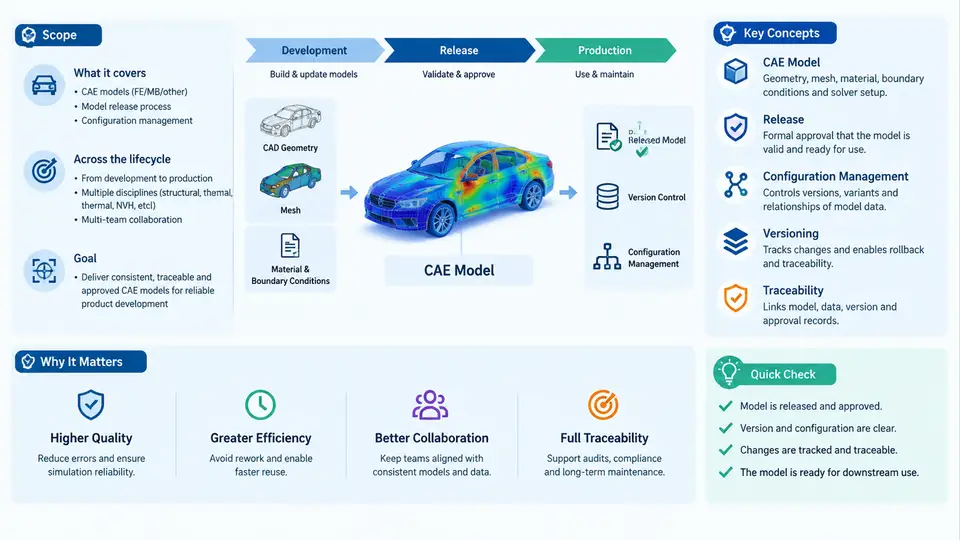
In automotive product development, a CAE model is rarely a single file. A full-vehicle crash model, a body-in-white (BIW) stiffness model, or a powertrain durability model typically consists of thousands of components, multiple solver decks, material libraries, connection definitions, and boundary condition sets. When dozens of engineers modify these models in parallel across several vehicle programs, the central engineering question is no longer "can we build the model?" but "which version of the model is the correct one, and can we prove it?" This course addresses that question through the discipline of CAE model release and configuration management.
What This Course Covers
The course scope spans the full lifecycle of a CAE model as a controlled engineering deliverable, from the moment a modeling task is assigned to the moment a released model is consumed by downstream teams. The major areas are:
- Model structure and decomposition — how a vehicle CAE model is partitioned into assemblies, subsystems, and components, and how that structure maps to the CAD product structure and the Bill of Materials (BOM).
- Version and revision control — the difference between a working version, a checked-in revision, and a released baseline, and how naming and numbering conventions encode this state.
- Configuration identification — how variant content (body style, powertrain, market regulation, suspension type) is captured so that one model family can produce many buildable configurations.
- Release workflow and gates — the review, verification, and approval steps a model must pass before it becomes a controlled baseline.
- Change management — how an engineering change request (ECR) or CAD change propagates into CAE models, and how impact is assessed and recorded.
- Data management tooling — PDM/PLM integration, CAE-specific data managers, metadata schemas, and traceability links between CAD, CAE, and test.
- Audit and traceability — reconstructing, months later, exactly which model, which solver version, and which input deck produced a given result.
What the course deliberately does not cover is meshing technique, solver theory, or result interpretation methodology except where those topics intersect with configuration control — for example, when a mesh refinement changes the model's identity and therefore requires a new revision.
Key Concepts and Terminology
Precision in vocabulary is essential because ambiguous terms cause real release errors. The following definitions are used consistently throughout the course.
| Term | Definition | Typical Identifier |
|---|---|---|
| Model | A complete, solver-ready representation of a physical system, including geometry, mesh, properties, connections, and boundary conditions. | BIW_Stiffness_Full |
| Version | A working iteration of a model, mutable, not yet approved for downstream use. | v03 |
| Revision | A checked-in, immutable snapshot of a version at a point in time. | r07 |
| Baseline | A released, frozen configuration of one or more revisions approved for a defined purpose. | BL_2025_Q1_Crash |
| Configuration | A specific combination of variant options that defines one buildable product instance. | SUV_LWB_AWD_CN |
| Release | The formal act of making a baseline available and authoritative for downstream consumers. | — |
| Effectivity | The range of programs, build dates, or VIN ranges to which a baseline applies. | MY2026 SOP+ |
Two distinctions deserve emphasis. First, version versus revision: a version is what an engineer edits; a revision is what the system records. Confusing them leads to the classic failure where two engineers believe they are working on "the same model" because both opened v03, while their local copies have already diverged. Second, baseline versus configuration: a baseline is a controlled snapshot in time; a configuration is a logical selection of variant content. A single baseline may contain the data required to instantiate several configurations.
Why Release and Configuration Management Matters
The value of this discipline becomes concrete when we consider what goes wrong without it. In a typical automotive program, a frontal offset crash CAE result may be used to support a design decision, a regulation submission, and a correlation study against physical test. If the model that produced that result cannot be uniquely identified and reproduced, all three uses are compromised. Configuration management provides the mechanism that makes the result defensible.
Three engineering consequences follow directly:
- Reproducibility. A released baseline, together with its recorded solver version, hardware environment, and input deck checksums, allows any engineer to re-run the analysis and obtain a comparable result. Without this, a result is an anecdote, not evidence.
- Traceability. Every released model is linked to the CAD geometry revision, the material specification, and the test data it was correlated against. When a regulation auditor or a program manager asks "where did this number come from?", the chain is reconstructable.
- Parallel development safety. Multiple engineers, multiple programs, and multiple variants can proceed concurrently without overwriting each other, because the configuration rules define what may change and the release gates define when a change becomes authoritative.
The CAE Model Lifecycle in Context
To see where release and configuration management sits, consider the end-to-end flow from CAD to decision. The diagram below shows the principal stages and the control points where configuration management intervenes.
The control layer is not a single tool or a single team. It is a set of practices, metadata conventions, and workflow gates that span CAD, CAE, and test. The feedback loop on the right is critical: when a physical test reveals a correlation gap, the resulting change must propagate back through the same controlled path, not through an informal file exchange.
How This Course Is Organized
The remaining chapters build from foundations to practice. Early chapters establish model decomposition, naming conventions, and metadata schemas. Middle chapters cover version control mechanics, variant configuration rules, and the release gate process. Later chapters address change management, PLM/PDM integration, audit preparation, and common failure modes with their remedies. Each chapter is designed to be usable on its own, but the concepts compound: a release gate is only meaningful if the model structure and naming conventions from earlier chapters are in place.
By the end of the course, you should be able to design and operate a CAE model release process that produces baselines which are reproducible, traceable, and safe for parallel development — and to recognize, diagnose, and correct the configuration failures that most often undermine CAE credibility in automotive programs.