1. Airbag system program landscape
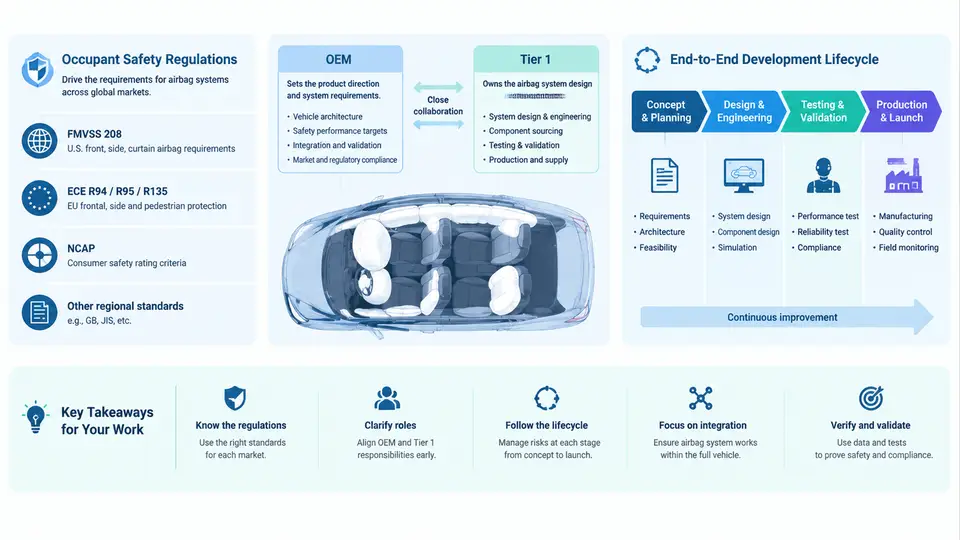
An airbag system program is not a single engineering task; it is a multi-year, multi-company development effort that spans regulatory compliance, vehicle-level integration, supplier component design, and manufacturing launch. Before any CAD model is created or any calibration is run, the program team must understand the landscape it operates in: which regulations govern the system, how responsibilities are divided between the OEM and the Tier 1 supplier, and what the end-to-end development lifecycle looks like from concept to start of production (SOP). This chapter establishes that landscape as the foundation for all subsequent program management decisions.
Regulatory Framework: What the Airbag System Must Satisfy
Airbag systems are regulated as part of occupant crash protection. The specific requirements depend on the target market, but the major regimes share a common structure: they define crash test conditions, occupant injury criteria, and performance thresholds that the vehicle must meet.
In the United States, FMVSS 208 (Federal Motor Vehicle Safety Standard 208) is the primary occupant crash protection standard. It mandates frontal airbags for both driver and front passenger seating positions, specifies unbelted and belted test conditions, and defines injury criteria including HIC (Head Injury Criterion), chest deflection, and femur load. FMVSS 208 also includes requirements for occupant classification systems (OCS) that suppress the passenger airbag under certain conditions, such as when a rear-facing child restraint is detected.
In Europe, ECE R94 and ECE R95 govern frontal and side impact protection respectively. These regulations define offset deformable barrier (ODB) tests and side pole tests that differ from the US full-frontal rigid barrier. The European New Car Assessment Programme (Euro NCAP) adds further requirements that often exceed regulatory minimums, including far-side impact protection and advanced dummy positioning.
China's GB 11551 and related standards establish similar frontal and side impact requirements, with the China New Car Assessment Programme (C-NCAP) driving additional performance targets. Other markets—Japan, Korea, India, Brazil—each have their own regulatory frameworks, and a global vehicle program must satisfy all applicable regimes simultaneously.
Key regulatory parameters that directly affect airbag system design:
- Crash pulse: The deceleration-time history of the vehicle body during impact, which determines when the airbag must deploy and how much energy it must absorb.
- Occupant positioning: The range of occupant sizes (5th percentile female to 95th percentile male) and positions (including out-of-position) that the system must protect.
- Injury criteria thresholds: HIC ≤ 700 (FMVSS 208), chest deflection ≤ 63 mm, femur load ≤ 10 kN, among others.
- Deployment timing: The airbag must be fully inflated before the occupant's head reaches the steering wheel or instrument panel, typically within 30–50 ms of impact.
OEM and Tier 1 Roles: Who Does What
The airbag system is developed through a partnership between the vehicle manufacturer (OEM) and one or more Tier 1 suppliers. The division of responsibility is not arbitrary; it follows from who owns the vehicle-level architecture and who owns the component-level design.
The OEM owns the vehicle platform, the body structure, the occupant packaging space, and the overall safety strategy. The OEM defines the crash pulse through body structure design, determines the available space for airbag modules, specifies the electrical architecture (including the crash sensing and diagnostic module, or SDM), and integrates the airbag system into the vehicle's overall safety concept. The OEM also holds the regulatory responsibility: the vehicle must pass homologation tests, and the OEM signs the declaration of conformity.
The Tier 1 supplier owns the airbag module design, the inflator technology, the folding pattern, the textile and seam design, and the module-level validation. The Tier 1 typically also supplies the SDM and the crash sensors, and may own the calibration of the deployment algorithm. The Tier 1 works from the OEM's requirements—crash pulse, packaging envelope, electrical interface, and performance targets—and delivers a validated module that meets those requirements.
In practice, the boundary is not perfectly sharp. The OEM may specify the inflator output curve, or the Tier 1 may propose a body structure change to improve the crash pulse. Effective program management requires clear interface definitions and a shared understanding of who owns each requirement, each risk, and each validation activity.
The End-to-End Development Lifecycle
An airbag system program typically follows a phased lifecycle that aligns with the vehicle program's overall timing. The phases are not arbitrary; each one answers a specific question and produces specific deliverables that gate the next phase.
Phase 1: Concept and Requirements (Program Start – 12 to 18 months before SOP). The OEM defines the vehicle-level safety targets, the occupant packaging space, and the regulatory markets. The Tier 1 is nominated, and the two parties agree on the system requirements specification. Key outputs include the initial crash pulse target, the airbag module packaging envelope, and the electrical interface definition.
Phase 2: Design and Simulation (12 to 9 months before SOP). The Tier 1 develops the module design: inflator selection, airbag cushion geometry, folding pattern, and venting strategy. CAE simulations—typically explicit finite element analysis using LS-DYNA or PAM-CRASH—predict occupant injury values for the target crash modes. The OEM runs full-vehicle simulations to verify that the body structure and airbag system work together. Design iterations reduce HIC and chest deflection to within target margins.
Phase 3: Prototype Build and Testing (9 to 6 months before SOP). Physical prototypes are built and tested. Sled tests validate the airbag module performance against the crash pulse without the full vehicle. Full-vehicle crash tests validate the complete system. The Tier 1 runs module-level tests: inflator tank tests, airbag deployment tests at hot and cold temperatures, and out-of-position (OOP) tests. The OEM runs vehicle-level tests for regulatory compliance and NCAP performance.
Phase 4: Calibration and Validation (6 to 3 months before SOP). The deployment algorithm is calibrated to fire the airbag at the correct time for each crash mode. This involves tuning the crash sensing thresholds, the safing logic, and the deployment timing. Validation testing confirms that the system meets all regulatory and internal requirements across the full range of environmental conditions, occupant sizes, and crash severities.
Phase 5: Production Launch (3 months before SOP to SOP). The production tooling is installed and qualified. Production parts are built and tested to confirm that they match the validated design. The OEM and Tier 1 complete the Production Part Approval Process (PPAP) and the OEM signs off on the system for production. SOP marks the transition from development to series production.
Program Management Implications
Understanding this landscape has direct consequences for how the program is managed. First, the regulatory requirements are not negotiable; they define the minimum performance that the system must achieve, and the program must plan sufficient margin to account for production variation and test variability. Second, the OEM–Tier 1 interface must be managed as a formal requirements flow-down: every vehicle-level requirement must be traceable to a module-level requirement, and every module-level validation must be traceable back to the vehicle-level target. Third, the phased lifecycle creates natural gate reviews where the program team must assess readiness before committing to the next phase. A program that skips or rushes a gate—for example, proceeding to prototype build before the CAE model is correlated—will typically encounter expensive late-stage failures.
Practical guidance for program managers: At the start of any airbag program, build a requirements traceability matrix that links each regulatory requirement to the specific vehicle-level test, the module-level design feature, and the validation activity that demonstrates compliance. This matrix becomes the backbone of the program's verification and validation plan, and it is the first document a regulatory auditor will ask to see.
The airbag system program landscape is therefore defined by three interlocking elements: the regulatory framework that sets the performance bar, the OEM–Tier 1 partnership that divides the work, and the phased lifecycle that structures the development from concept to production. The remaining chapters of this course will examine each phase in detail, beginning with requirements definition and flowing through design, validation, and launch.