1. Program management in the automotive res
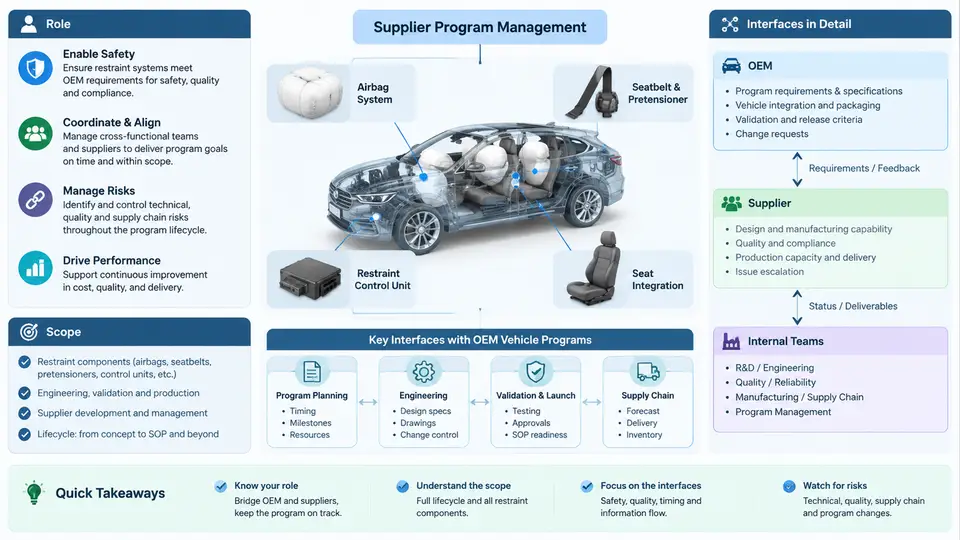
In the automotive restraint industry, a Program Manager (PM) is the single point of accountability for delivering a restraint system — airbags, seat belts, pretensioners, steering-wheel modules, and their electronic control units — from award through Start of Production (SOP) and into service. Unlike a functional manager who owns a department, the PM owns a program: a temporary, cross-functional endeavor with a defined scope, budget, timing, and customer. The role sits at the intersection of engineering, manufacturing, quality, purchasing, and the OEM's own vehicle program, and its success is measured by whether the restraint system meets all requirements on the OEM's milestone dates at the agreed cost and quality level.
What the Role Actually Owns
The PM's scope can be grouped into four accountability areas. First, deliverable ownership: the PM ensures every contractual deliverable — design records, DV/PV test reports, PPAP packages, IMDS entries, and tooling — is complete and on time. Second, timing and milestone management: the PM maps the supplier's internal plan to the OEM's vehicle program milestones (e.g., a typical sequence of Kickoff, A-sample, B-sample, C-sample, Tooling Kickoff, PPAP, and SOP). Third, financial control: tracking program budget, tooling investment, engineering change costs, and profitability against the awarded business case. Fourth, risk and issue management: identifying and escalating anything that threatens timing, cost, quality, or regulatory compliance.
Critically, the PM does not personally design the airbag or write the ECU software. The PM creates the conditions in which the engineering, manufacturing, and quality teams can deliver. This distinction matters: a PM who tries to do functional work will neglect the coordination that only the PM can perform.
Interfaces with the OEM Vehicle Program
The restraint supplier's program does not exist in isolation; it is a sub-program of the OEM's vehicle program. The PM therefore manages a set of interfaces that are both technical and organizational. The most important are:
- OEM Program Management — the counterpart who owns the vehicle timing, change control, and milestone reviews. The supplier PM reports status, raises deviations, and negotiates timing or scope changes through this interface.
- OEM Engineering (Restraint Systems) — defines performance requirements, packaging constraints, and validation criteria. The supplier PM coordinates design reviews and sample submissions here.
- OEM Purchasing — owns the commercial contract, tooling orders, and change pricing. The PM supports cost negotiations with data from the program's actuals.
- OEM Quality / Supplier Quality — audits the supplier's quality system, approves PPAP, and manages containment if defects occur.
- Internal functions — the PM's own engineering, manufacturing, quality, purchasing, and logistics teams, who execute the work.
Each interface has its own cadence and language. The OEM program manager cares about milestone dates and open issues; the OEM engineer cares about requirements and test results; the OEM buyer cares about cost and tooling. A skilled PM translates the same program reality into the form each audience needs.
A Concrete Example: The B-Sample Milestone
Consider a typical B-sample delivery for a driver airbag module. The OEM vehicle program requires B-samples by a fixed date so that vehicle-level crash testing can begin. The supplier PM's job is to make that date real. A reproducible sequence might look like this:
Inputs:
  - OEM B-sample request date: 2026-03-15
  - Design freeze status: released (Rev C)
  - Tooling status: soft tool available 2026-02-01
  - Component lead times: inflator 8 weeks, cover 4 weeks

Execution:
  1. Confirm design freeze and release BOM to manufacturing.
  2. Place purchase orders for long-lead inflators by 2026-01-05.
  3. Schedule soft-tool trials for week of 2026-02-02.
  4. Build 30 B-sample modules; inspect dimensional and functional
     characteristics per the control plan.
  5. Ship 20 modules to OEM crash lab; retain 10 for internal testing.

Observable outputs:
  - Dimensional report: all critical characteristics within tolerance.
  - Functional test: deployment time and pressure curve within spec.
  - Shipment confirmation with tracking to OEM.

Failure symptoms and troubleshooting:
  - Inflator late: escalate to purchasing; evaluate alternate
    supplier or air freight.
  - Cover fit issue: root-cause in tooling; adjust mold before
    next trial.
  - Test failure: contain affected units; notify OEM quality;
    initiate 8D.
This example shows the PM's real work: not performing the tests, but ensuring the inputs are ready, the sequence is feasible, the outputs are verified, and failures are contained and communicated. The PM's value is visible when something goes wrong — a late inflator, a tooling defect, a test failure — and the program still recovers because the PM had a plan and an escalation path.
Scope Boundaries and Common Pitfalls
New PMs often confuse program management with project management in a narrow sense. In the restraint supplier context, the scope is broader: it includes commercial profitability, regulatory compliance (FMVSS 208, ECE R94/R95, and similar), and the supplier's own manufacturing readiness. A PM who ignores the financial dimension may deliver on time but destroy margin; one who ignores regulatory compliance may deliver a product that cannot be sold.
Another pitfall is treating the OEM interface as a one-way reporting channel. Effective PMs use the interface to influence — negotiating a realistic sample date, proposing a design change that reduces cost, or flagging a risk early enough that the OEM can adjust its own plan. The PM who only reports status is a clerk; the PM who shapes decisions is a program leader.
Visualizing the Interface Structure
The diagram below maps the restraint supplier's program management function against the OEM vehicle program and the internal functions it coordinates. It is a structural view, not a process flow: it shows who the PM connects to, what flows across each interface, and where accountability sits.
The diagram makes the PM's position explicit: every OEM interface flows through the PM, and every internal execution function is coordinated by the PM. The arrows are bidirectional in practice — the PM both receives requirements and reports status — but the structural point is that the PM is the hub, not a spoke. When an OEM engineer contacts a supplier's design engineer directly, the PM must still be informed, because only the PM sees the full program picture and can assess the impact on timing, cost, and other deliverables.
Why This Matters for the Rest of the Course
Understanding the role, scope, and interfaces is the foundation for everything that follows: milestone planning, risk management, change control, cost tracking, and supplier quality. A PM who cannot articulate where their accountability starts and ends will struggle to make decisions, escalate issues, or negotiate with the OEM. The restraint system's safety-critical nature raises the stakes — a missed milestone or an uncontained defect is not just a commercial problem but a regulatory and reputational one. The PM's job is to keep all of these dimensions visible and managed, from award to SOP and beyond.