1. Oblique impact fundamentals
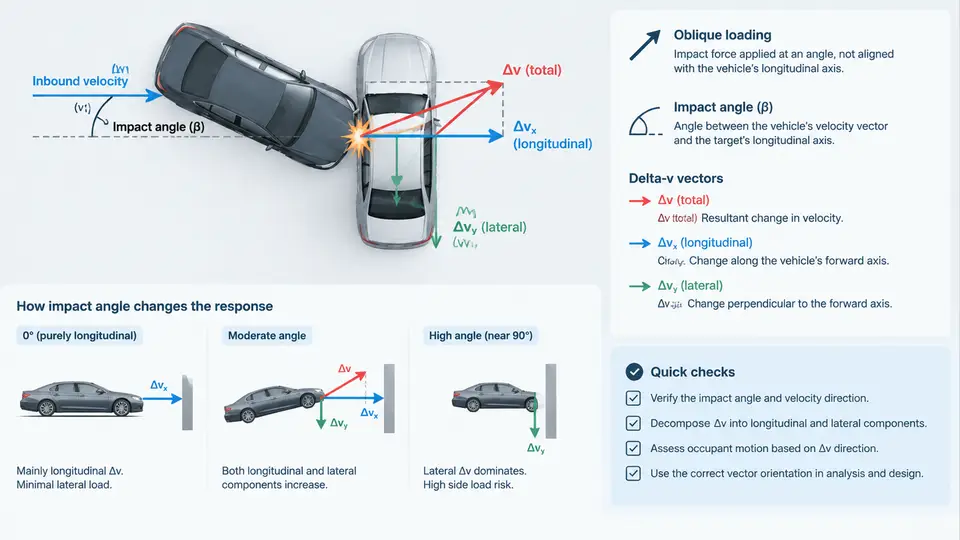
Most real-world crashes are not perfectly frontal. A vehicle struck at the front-left corner, a pole impact offset from the longitudinal axis, or a side-swipe that rotates the occupant compartment all produce oblique loading — a force and deceleration field that does not align with the vehicle's principal axes. Restraint systems designed only around full-frontal barrier tests can behave very differently under these conditions, which is why oblique impact has become a central concern in occupant kinematics and restraint design.
This chapter establishes the vocabulary and geometric framework used throughout the course: what makes an impact "oblique," how impact angle is defined and measured, and how delta-v is represented as a vector rather than a single scalar magnitude.
What Makes an Impact Oblique
An impact is classified as oblique when the principal force direction (or the resulting delta-v vector) is neither parallel to the vehicle's longitudinal axis (pure frontal or rear) nor perpendicular to it (pure lateral). In practice, oblique loading spans a broad band: a 15° front-corner impact and a 60° side-oblique impact share the same fundamental problem — the occupant's inertia carries them along a path that does not match the restraint's primary deployment or engagement direction.
Two reference frames matter here, and they must be kept distinct:
- Vehicle frame: x-axis points forward (longitudinal), y-axis points to the driver's left (lateral), z-axis points up. This is the standard SAE vehicle coordinate convention.
- Impact/global frame: aligned with the principal force or velocity-change direction of the collision, which may be rotated relative to the vehicle.
Impact angle is the rotation between these frames. Confusing the two is one of the most common sources of sign errors in crash reconstruction and sled-test setup.
Defining Impact Angle
Impact angle (often denoted θ) is the angle between the vehicle's longitudinal axis and the direction of the applied force or the resulting delta-v vector, measured in the horizontal plane. A frontal impact has θ ≈ 0°; a pure lateral impact has θ ≈ 90°. The sign convention must be stated explicitly: in this course, positive θ indicates the force vector rotated toward the vehicle's left side (driver's side in a left-hand-drive vehicle), and negative θ toward the right.
Impact angle alone does not fully describe severity. A 30° impact at 20 km/h and a 30° impact at 60 km/h share geometry but differ enormously in energy. Angle describes direction; delta-v describes magnitude and direction together.
Delta-V as a Vector
Delta-v (Δv) is the change in velocity of a vehicle (or occupant) over the duration of the collision. It is a vector quantity:
Δv = v_after − v_before

In vehicle-frame components:
  Δv_x = v_x,after − v_x,before   (longitudinal)
  Δv_y = v_y,after − v_y,before   (lateral)

Magnitude:  |Δv| = sqrt(Δv_x² + Δv_y²)
Direction:  θ_Δv = atan2(Δv_y, Δv_x)
The scalar "delta-v" quoted in crash reports is the magnitude |Δv|. For restraint design, the direction θ_Δv is equally important, because it determines the occupant's post-impact velocity relative to the compartment and therefore the loading path into the belt, airbag, and seat structure.
Consider a simplified example. A vehicle traveling forward at 50 km/h (13.9 m/s) is struck on its front-right corner and ends up moving at 8 m/s in a direction 40° to the left of its original heading. Resolving into vehicle-frame components (taking forward as +x, left as +y):
v_before = (13.9, 0) m/s
v_after  = (8·cos40°, 8·sin40°) = (6.13, 5.14) m/s

Δv_x = 6.13 − 13.9 = −7.77 m/s
Δv_y = 5.14 − 0    = +5.14 m/s

|Δv| = sqrt(7.77² + 5.14²) ≈ 9.32 m/s ≈ 33.5 km/h
θ_Δv = atan2(5.14, −7.77) ≈ 146°  (measured from +x, i.e. rearward-left)
These numbers are illustrative, not measured. The key observation is that a nominally "frontal" crash produced a delta-v vector pointing substantially rearward and to the left — a classic oblique signature. An occupant restrained only by a frontal airbag and a three-point belt will load the belt diagonally and may rotate or slide outboard, which is exactly the kinematics this course addresses.
Why Direction Matters for Occupant Kinematics
During the collision, the occupant continues forward at the pre-impact velocity while the vehicle decelerates. The occupant's motion relative to the compartment is therefore approximately the negative of the vehicle's delta-v vector. If Δv points rearward-left, the occupant moves forward-right relative to the seat — toward the door, the B-pillar, or past the airbag's coverage zone.
This relative motion is what restraint designers must manage. A frontal airbag optimized for a 0° impact may be contacted off-center, allowing the head to rotate and the torso to slip laterally. The belt may load the shoulder in a direction that encourages submarining or out-of-position excursion. Understanding the delta-v vector is the prerequisite for predicting these outcomes.
Reference Frame Summary
| Quantity | Symbol | Definition | Typical Range |
|---|---|---|---|
| Impact angle | θ | Angle between vehicle longitudinal axis and force/Δv direction, horizontal plane | 0° (frontal) to 90° (lateral) |
| Longitudinal delta-v | Δv_x | Change in forward velocity component | −20 to +20 m/s |
| Lateral delta-v | Δv_y | Change in leftward velocity component | −15 to +15 m/s |
| Delta-v magnitude | |Δv| | Scalar speed change | 5 to 25 m/s |
| Delta-v direction | θ_Δv | atan2(Δv_y, Δv_x) | −180° to +180° |
The table values are representative ranges for passenger-vehicle crashes, provided as orientation rather than regulatory limits.
From Geometry to Design Input
With impact angle and delta-v vector defined, the next step in the design workflow is to translate them into a load case: a crash pulse (acceleration vs. time) applied along the delta-v direction, and an occupant model whose initial velocity is the pre-impact velocity. The restraint system is then evaluated for how well it controls occupant motion under that oblique load path.
The SVG below summarizes the geometric relationship between the vehicle frame, the impact angle, and the delta-v vector, and shows how the occupant's relative motion follows from the vector direction.
Key Takeaways
- Oblique impact means the force or delta-v direction is neither parallel nor perpendicular to the vehicle's longitudinal axis.
- Impact angle θ is measured in the horizontal plane from the vehicle's +x axis; the sign convention must be stated and held consistent.
- Delta-v is a vector. Its magnitude gives severity; its direction gives the load path that drives occupant kinematics.
- The occupant's motion relative to the compartment is approximately the negative of the vehicle's delta-v vector — this is the quantity restraint systems must control.
- Angle and delta-v are not independent parameters; they are two views of the same vector, and inconsistent specification produces invalid load cases.
These definitions form the geometric foundation for everything that follows: crash pulse construction, occupant trajectory prediction, and restraint engagement analysis under oblique loading.