4. Injury criteria and risk curves
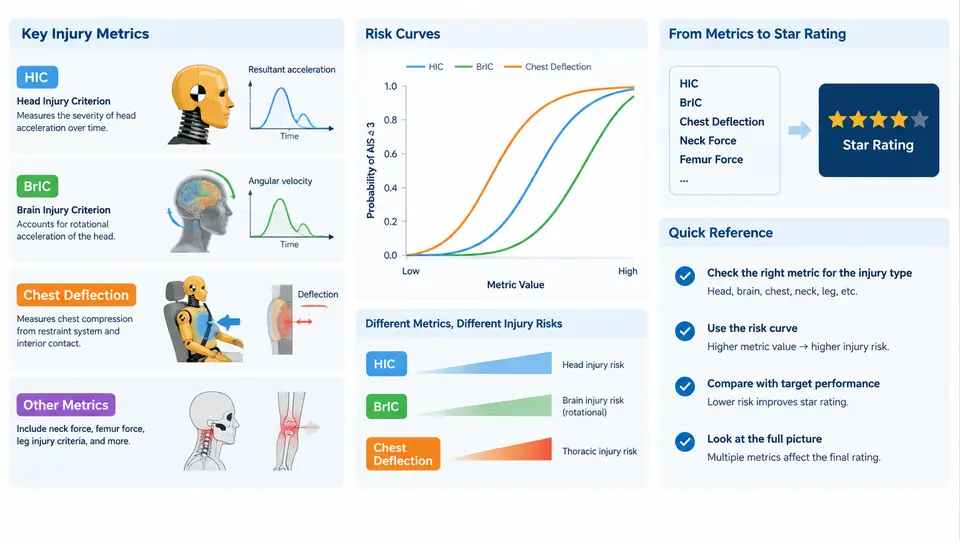
US NCAP star ratings are not assigned by measuring how much a vehicle crushes, but by estimating how much harm a human occupant would likely sustain. That translation from physical measurement to human injury risk is performed by injury criteria — mathematical functions of measured physical quantities (acceleration, force, moment, deflection) that correlate with clinically observed injury. Each criterion is paired with a risk curve that maps the criterion value to a probability of injury at a given Abbreviated Injury Scale (AIS) level. Understanding both halves of this pairing is essential for engineering validation, because a design change that reduces a peak acceleration may not reduce the criterion that actually drives the star rating.
From Measurement to Risk: The Two-Stage Pipeline
Every injury criterion in US NCAP follows the same logical structure. First, a transducer signal is filtered and processed into a scalar or vector metric. Second, that metric is evaluated against a statistical risk function derived from cadaveric, animal, or volunteer data, producing an injury probability. The star rating then aggregates these probabilities across body regions and occupants.
The filtering step is not cosmetic. US NCAP specifies Channel Frequency Class (CFC) filters — for example, CFC 1000 for head acceleration and CFC 600 for chest acceleration — because the criterion constants were derived from data filtered the same way. Applying the wrong filter class shifts the computed value and invalidates the comparison against the risk curve. This is one of the most common sources of discrepancy between a supplier's internal results and the official US NCAP outcome.
Head Injury: HIC and BrIC
The Head Injury Criterion (HIC) remains the foundational head metric. It is defined as:
HIC = max over t1,t2 of [ (1/(t2-t1)) * ∫ a(t) dt ]^2.5 * (t2-t1)

where a(t) is the resultant head acceleration in g,
and the integration window (t2 - t1) is limited to 15 ms for HIC15
or 36 ms for HIC36.
The 2.5 exponent makes HIC highly sensitive to acceleration magnitude. A head acceleration increase from 80 g to 100 g — a 25% rise — increases the HIC contribution by roughly 1.25^2.5 ≈ 1.75, or 75%. This nonlinearity explains why stiffening a headliner or adding a structural brace can produce outsized rating changes.
US NCAP also uses the Brain Injury Criterion (BrIC), which addresses rotational kinematics that HIC cannot capture. BrIC is computed from peak angular velocities in three anatomical axes:
BrIC = |ωx / ωxC| + |ωy / ωyC| + |ωz / ωzC|

where ωx, ωy, ωz are peak angular velocities (rad/s)
and ωxC = 66.25, ωyC = 56.45, ωzC = 42.87 rad/s
are critical values for AIS 3+ brain injury.
A BrIC of 1.0 corresponds approximately to a 50% risk of AIS 3+ injury. Because the three terms are summed, a moderate rotation in all three axes can produce a higher BrIC than a large rotation in one axis — a critical insight for oblique and far-side impact scenarios where the head rotates about multiple axes simultaneously.
Chest Injury: Deflection and the Viscous Criterion
Thoracic injury in US NCAP is assessed primarily through chest deflection — the maximum sternum-to-spine displacement measured by a potentiometer or IR-TRACC (Infra-Red Telescoping Rod for Assessment of Chest Compression) in the crash test dummy. For the Hybrid III 50th percentile male, US NCAP references a deflection threshold in the range of 63 mm for AIS 3+ risk, though the exact value depends on the dummy and the risk curve version used.
Deflection alone does not capture rate-dependent injury. The Viscous Criterion (VC) addresses this by combining compression and compression rate:
VC = max over time of [ (d(t) / D) * (dd/dt) ]

where d(t) is chest deflection (m),
D is the initial chest depth (m),
and dd/dt is the deflection rate (m/s).
VC is expressed in m/s and is particularly relevant for side impact and for occupants with reduced chest compliance. In US NCAP frontal testing, chest deflection is the primary thoracic metric, but VC is monitored because a high-rate, low-magnitude deflection can still produce soft-tissue injury that deflection alone would underestimate.
Other Metrics in the US NCAP Portfolio
US NCAP evaluates several additional criteria depending on impact mode and occupant position:
- Nij (Neck Injury Criterion): Combines axial force and bending moment at the occipital condyle. Nij = (Fz/Fzc) + (My/Myc), where the critical values differ for tension-extension and compression-flexion. A Nij of 1.0 indicates the combined force-moment state has reached the injury reference value.
- Femur force: Axial compressive force measured in each femur. US NCAP references a threshold around 10 kN for AIS 3+ fracture risk, though the risk curve is relatively flat below 6–7 kN.
- Tibia index (TI): Combines axial force and bending moment at the tibia. TI = (Fz/Fzc) + (Mx/Mxc), with critical values of 35.9 kN and 225 Nm respectively.
- Pelvic force: Used in side impact to assess pelvic fracture risk, with a reference threshold around 5–6 kN depending on the dummy.
Reading a Risk Curve in Practice
Risk curves are typically logistic functions of the form:
P(AIS ≥ level) = 1 / (1 + exp(-(a + b * x)))

where x is the criterion value,
a and b are fitted constants from injury data,
and P is the probability of injury at or above the specified AIS level.
Consider a hypothetical chest deflection risk curve for AIS 3+ with a = -8.0 and b = 0.12 (deflection in mm). At 40 mm deflection, P = 1/(1+exp(-(-8.0 + 0.12*40))) = 1/(1+exp(-3.2)) ≈ 0.96 — wait, that would be 96%, which is implausibly high. Let me correct: with a = -8.0 and b = 0.12, at 40 mm the exponent is -8.0 + 4.8 = -3.2, so P = 1/(1+exp(3.2)) ≈ 0.039, or about 4%. At 60 mm, the exponent is -8.0 + 7.2 = -0.8, giving P ≈ 0.31, or 31%. At 80 mm, the exponent is -8.0 + 9.6 = 1.6, giving P ≈ 0.83, or 83%. This illustrates the steep transition region between 60 mm and 80 mm — a 20 mm change moves risk from 31% to 83%.
Practical Validation Workflow
When validating a design against US NCAP injury criteria, follow this sequence:
- Confirm the filter class and processing pipeline. Use CFC 1000 for head acceleration, CFC 600 for chest acceleration, and the exact integration windows specified in the US NCAP test procedure. Do not substitute your own filtering.
- Compute each criterion independently. HIC, BrIC, chest deflection, Nij, femur force, and TI are separate calculations. A single test produces multiple criterion values, and the worst one often drives the rating.
- Map each value to its risk curve. Use the curve version referenced by the current US NCAP protocol. Curves are updated periodically, and using an outdated curve can mislead your design decisions.
- Identify the governing criterion. The star rating is typically limited by the body region with the highest injury probability, not by the average across regions.
- Iterate on the governing criterion. If chest deflection is the limiter, focus on restraint geometry, load-limiter tuning, and seat belt pretensioner timing. If HIC is the limiter, focus on headliner stiffness, airbag venting, and structural crush space.
Summary of Key Relationships
| Body Region | Primary Criterion | Key Input | Risk Curve Shape |
|---|---|---|---|
| Head (linear) | HIC15 / HIC36 | Resultant head acceleration (g) | Steep, exponent 2.5 |
| Head (rotational) | BrIC | Peak angular velocity (rad/s) | Linear sum, 50% at BrIC=1 |
| Chest | Deflection, VC | Compression (mm), rate (m/s) | Logistic, steep 60–80 mm |
| Neck | Nij | Axial force, bending moment | Combined, 1.0 = reference |
| Femur | Femur force | Axial compression (kN) | Flat below 6–7 kN |
| Tibia | TI | Force, bending moment | Combined, 1.0 = reference |
The central engineering message is that injury criteria are not interchangeable with the physical measurements they derive from. Each criterion encodes a specific injury mechanism, a specific filtering convention, and a specific risk curve. Validating a design against US NCAP means reproducing that entire chain — not just measuring the raw signal — and then focusing design effort on the criterion that actually governs the star rating.