1. US NCAP program overview
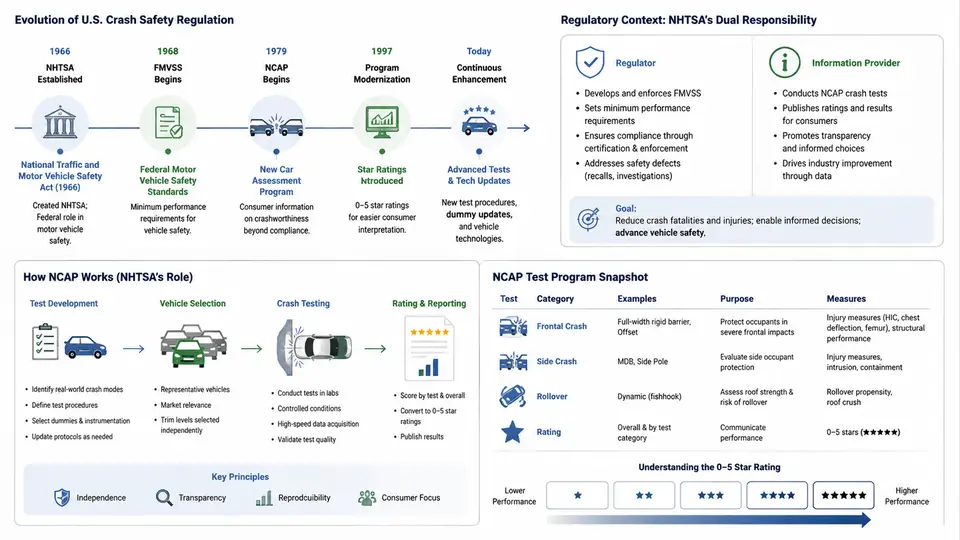
The United States New Car Assessment Program (US NCAP) is the federal government's consumer-facing crash safety rating system. Unlike the Federal Motor Vehicle Safety Standards (FMVSS), which are mandatory minimum requirements enforced under the National Traffic and Motor Vehicle Safety Act, US NCAP is a voluntary disclosure program: manufacturers are not legally required to submit vehicles, but the ratings published by the National Highway Traffic Safety Administration (NHTSA) carry substantial market weight. Understanding this distinction is the foundation for every engineering decision that follows in this course, because it determines what "passing" means, who defines the test matrix, and how results are communicated to the public.
Origins and Legislative Context
US NCAP began in 1979 as a response to a simple observation: compliance with FMVSS proved that a vehicle met a minimum legal bar, but it told consumers nothing about relative safety between two compliant vehicles. NHTSA introduced frontal crash testing at 35 mph into a fixed barrier and published the results as a comparative star rating. The program expanded over the following decades:
- 1979 — Frontal NCAP launched (35 mph fixed-barrier test, later aligned with the FMVSS 208 belted barrier condition).
- 1997 — Side NCAP added, using a moving deformable barrier (MDB) striking a stationary vehicle.
- 2001 — Rollover Resistance rating introduced, based on the Static Stability Factor (SSF) and later a dynamic fishhook maneuver.
- 2011 — The modernized NCAP introduced a single Overall Vehicle Score (OVS) combining frontal, side, and rollover results, plus the female 5th-percentile occupant in frontal testing and a side pole test.
- 2020s onward — NHTSA has proposed further updates addressing pedestrian protection, advanced driver assistance systems (ADAS), and updated crash test dummies such as THOR.
The program's authority derives from 49 U.S.C. § 32302 and the agency's general rulemaking and research powers. Because NCAP is not a standard, NHTSA can revise test procedures through Federal Register notices and public comment rather than the full FMVSS rulemaking path — a flexibility that lets the program evolve faster than the mandatory standards it complements.
NHTSA's Role and Organizational Function
NHTSA occupies three distinct roles that engineers must keep separate:
- Regulator — issues and enforces FMVSS (e.g., FMVSS 208 occupant crash protection, FMVSS 214 side impact, FMVSS 216 roof crush).
- Assessment body — operates US NCAP, contracts or conducts testing at the Vehicle Research and Test Center (VRTC) in East Liberty, Ohio, and publishes star ratings at
nhtsa.gov/ratings. - Defect investigator — runs recall campaigns under the National Traffic and Motor Vehicle Safety Act when field data indicate a safety defect.
For a vehicle program, this means a single agency can influence design through three separate channels: a mandatory rule, a voluntary rating, and a post-sale investigation. A design change made for NCAP star improvement may also affect FMVSS compliance margins, so the two must be tracked together.
How the Rating Structure Works
The current US NCAP Overall Vehicle Score is a 5-star scale derived from three sub-scores. Each sub-score is itself a 5-star rating, and the overall score is computed from a lookup table rather than a simple average. The key test conditions are summarized below.
| Test | Condition | Primary Metric | Dummy / ATD |
|---|---|---|---|
| Frontal NCAP | 35 mph, fixed rigid barrier, 100% overlap | HIC, chest deflection, femur loads | Hybrid III 50th male (driver), 5th female (passenger) |
| Side NCAP (MDB) | 38.5 mph moving deformable barrier, 27° crab angle | Head, chest, pelvis injury measures | ES-2re (driver), SID-IIs (rear) |
| Side Pole | 20 mph, 75 mm pole, 75° angle | Head, thorax, pelvis | SID-IIs |
| Rollover | Static Stability Factor + dynamic fishhook | Rollover resistance | N/A (vehicle dynamics) |
Injury Assessment Reference Values (IARVs) define the threshold between a "good" and "poor" outcome for each channel. For example, HIC is capped at 700 for the frontal test, and chest deflection limits are set per dummy type. A vehicle earns stars based on how far its measured values fall below these thresholds, not merely on whether it passes.
Why This Matters for Engineering Validation
Because NCAP is voluntary, the decision to pursue a target star rating is a business and engineering choice. In practice, most OEMs target 5 stars for the overall score in major segments, which drives design requirements earlier than regulation alone would. The validation workflow therefore has to satisfy two parallel tracks: FMVSS compliance testing (mandatory, binary) and NCAP development testing (voluntary, graded). The two share hardware, dummies, and facilities but differ in test matrix, instrumentation channels, and acceptance criteria.
A typical engineering sequence for a new program looks like this:
- Define the NCAP target (e.g., 5-star overall) and map it to sub-score targets.
- Run CAE (LS-DYNA or equivalent) frontal and side models to predict injury metrics.
- Conduct sled and component tests to validate the CAE correlation.
- Execute full-vehicle development tests at a contracted facility.
- Submit production-representative vehicles to NHTSA for official rating.
Each step has its own acceptance criteria. For instance, a CAE frontal model might be considered correlated when predicted HIC is within 15% of the sled test value and chest deflection within 10%. These are engineering targets, not NHTSA requirements, and they are set by the OEM to manage risk before the official test.
Program Structure and Data Flow
The diagram below shows how NHTSA's three roles interact with a vehicle program and how data flows from testing to public rating.
Practical Implications for Validation Engineers
Three practical consequences follow from the program structure. First, the test matrix is fixed by NHTSA and cannot be negotiated; the only variable is how well the vehicle performs. Second, the star rating is published publicly and is directly comparable across vehicles, so a one-star difference can affect sales. Third, because NCAP is voluntary, the timing of submission is a strategic decision — manufacturers typically submit after internal development testing confirms the target is achievable, but before the model year ends.
In the chapters that follow, each test mode, dummy type, injury metric, and acceptance criterion introduced here will be examined in detail, along with the CAE and physical validation methods used to predict and confirm performance before official NHTSA testing.