1. IIHS crashworthiness evaluation framewor
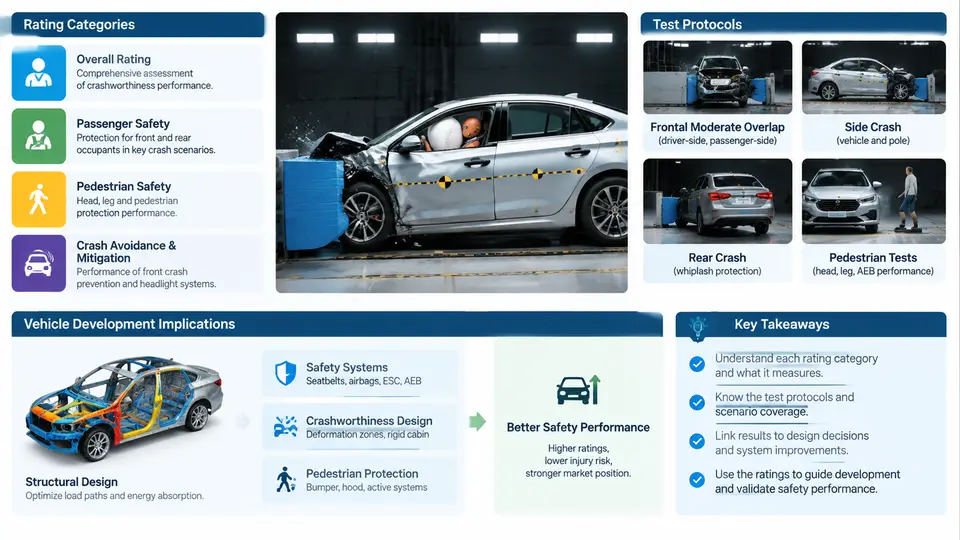
The Insurance Institute for Highway Safety (IIHS) crashworthiness program is one of the most influential consumer-information test regimes in the global automotive industry. Unlike a regulatory compliance standard, IIHS ratings are published as comparative consumer guidance, which means a vehicle that merely "passes" can still earn a poor rating if competitors perform better. For vehicle development teams, this distinction is fundamental: the target is not a pass/fail threshold but a competitive position within a continuously tightening test matrix.
This chapter establishes the structural logic of the IIHS crashworthiness framework — what is rated, how each test is conducted, how the four-level rating scale is assigned, and how these elements translate into concrete body-structure, restraint-system, and validation requirements during vehicle development.
Rating Categories and the Four-Level Scale
IIHS crashworthiness evaluation is organized into distinct test categories, each rated independently on a four-level scale: Good (G), Acceptable (A), Marginal (M), and Poor (P). The categories historically comprise:
- Moderate overlap frontal (40% overlap, deformable barrier, ~64 km/h)
- Driver-side small overlap frontal (25% overlap, rigid barrier, ~64 km/h)
- Passenger-side small overlap frontal (25% overlap, rigid barrier, ~64 km/h)
- Side impact (moving deformable barrier, originally ~50 km/h; updated protocols raise severity)
- Roof strength (quasi-static crush test, strength-to-weight ratio)
- Head restraints and seats (whiplash protection, static and dynamic evaluation)
To earn a Top Safety Pick (TSP) or Top Safety Pick+ (TSP+) award, a vehicle must achieve Good ratings across the applicable crashworthiness categories and meet additional requirements, including an acceptable or good rating in front crash prevention (vehicle-to-vehicle and, in later criteria, vehicle-to-pedestrian) and headlight performance. The award structure is deliberately cumulative: a single Marginal rating in any required category disqualifies the vehicle from the award regardless of other strong results.
Test Protocols: What Is Actually Measured
Each protocol produces both physical measurements and video-based kinematic assessment. Ratings are not derived from a single number; they combine structural intrusion, dummy injury measures, and restraint-system performance.
| Test | Barrier / Overlap | Primary Structural Metric | Primary Occupant Metric |
|---|---|---|---|
| Moderate overlap frontal | Deformable, 40% | Footwell and A-pillar intrusion | Head, neck, chest, femur injury criteria |
| Small overlap frontal | Rigid, 25% | Lower/upper cabin intrusion, wheel intrusion | Head excursion, airbag contact, lower-extremity loading |
| Side impact | Moving deformable barrier | B-pillar and door intrusion velocity | Head, thorax, pelvis, abdomen injury measures |
| Roof strength | Quasi-static plate | Peak force / vehicle weight ratio | Structural (no dummy) |
| Head restraints | Static geometry + sled | Backset and height geometry | Neck shear and extension moment |
In the small overlap test, the rigid barrier engages only the outer 25% of the vehicle width, bypassing the primary longitudinal rails. Load must therefore be redirected through the upper rail, shotgun, hinge pillar, rocker, and subframe. This is why small overlap performance is dominated by load-path architecture rather than by rail crush energy alone. A vehicle with excellent moderate-overlap performance can still rate Poor in small overlap if the wheel and suspension are driven rearward into the footwell.
From Rating to Development Requirement
The development implication is that IIHS targets must be decomposed into structural and restraint sub-targets early in the program, before body-in-white (BIW) architecture is frozen. A practical decomposition for a small overlap target of Good might include:
- Maximum lower cabin intrusion at the brake pedal: ≤ 150 mm (example target, program-specific)
- Maximum upper cabin intrusion at the A-pillar: ≤ 100 mm
- Wheel rearward displacement limited so that tire does not contact the footwell
- Head must not contact the A-pillar or window frame; side curtain airbag deployment timing validated
- Dummy injury criteria (HIC, Nij, chest deflection, femur load) within Good thresholds
These targets drive specific design actions: adding a lower load path (e.g., a subframe extension or "shotgun" reinforcement), tuning the hinge pillar and rocker section, and calibrating the side curtain and frontal airbag deployment. Because the small overlap load path is asymmetric, the driver-side and passenger-side structures must be evaluated separately — a vehicle with a strong driver-side load path may still rate Marginal on the passenger side if the corresponding reinforcement is absent.
Validation Workflow and Observable Checkpoints
Development validation typically progresses through CAE (finite element simulation), sled testing, and full-scale barrier testing. A reproducible sequence for a small overlap program is:
- CAE baseline: Build a full-vehicle FE model with the rigid 25% barrier and a validated dummy model. Run the baseline and extract intrusion and injury metrics.
- Load-path iteration: Modify the upper and lower load paths, then re-run. Track the intrusion contour at the footwell, A-pillar, and rocker.
- Sled validation: Validate restraint-system timing (airbag and pretensioner firing) on a sled before full-scale testing.
- Full-scale confirmation: Run the physical barrier test and compare measured intrusion and dummy response against CAE predictions.
Typical failure symptoms and their diagnostic directions:
- Excessive footwell intrusion: lower load path insufficient or wheel intrusion not controlled — inspect subframe and rocker load transfer.
- Head contacts A-pillar: side curtain timing or coverage inadequate, or excessive upper cabin intrusion — review airbag geometry and hinge-pillar stiffness.
- High femur load: knee bolster or lower instrument panel contact — review knee airbag and IP structure.
- CAE/physical mismatch: check strain-rate material models, weld failure modeling, and barrier alignment.
Key Takeaways for Development Teams
The IIHS framework is best understood as a competitive, multi-category rating system rather than a single regulatory test. Three practical consequences follow. First, targets must be set per category and per side (driver and passenger), because the rating scale is ordinal and award eligibility is cumulative. Second, structural load-path design — especially for small overlap — must be addressed at the architecture stage, since retrofitting a lower load path after BIW freeze is costly and often ineffective. Third, validation must combine CAE, sled, and full-scale testing, with explicit checkpoints for intrusion, dummy injury metrics, and restraint timing. The rating is the output; the load path, restraint calibration, and validation discipline are the controllable inputs.