4. Occupant packaging and restraint interac
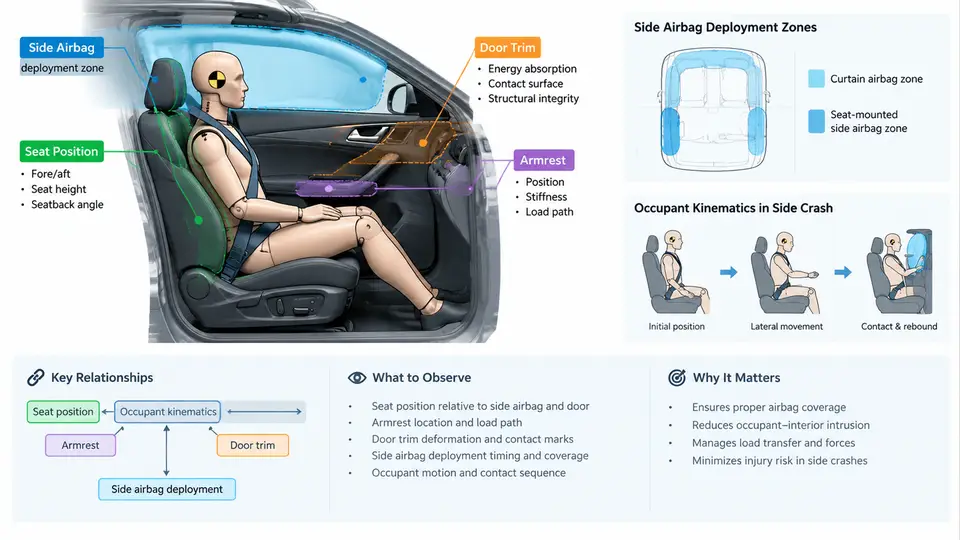
Side impact protection is fundamentally a packaging problem. Unlike frontal crashes, where the occupant has substantial longitudinal crush space ahead of the torso, a side impact offers only the narrow band between the occupant's outboard surface and the striking object. Every millimeter of that band — seat position, armrest geometry, door trim profile, airbag module location, and the occupant's own posture — determines whether the restraint system can intervene before the intruding structure reaches the occupant. This chapter examines how these elements interact and how engineers reason about them during packaging and validation.
Seat Position as the Primary Packaging Variable
Seat position defines the baseline geometry for every downstream restraint decision. Three parameters matter most: fore-aft position, seat back angle, and vertical height. Fore-aft position determines the lateral gap between the occupant's thorax and the door trim. A seat positioned far forward places the occupant closer to the B-pillar and door, reducing the distance available for side airbag deployment. Seat back angle affects the orientation of the thorax relative to the side airbag cushion; a heavily reclined seat rotates the rib cage so that the cushion contacts the abdomen and lower thorax rather than the rib mid-section.
In practice, engineers work with a defined seating reference point (SgRP) and evaluate occupant positions across the fore-aft travel range. A typical mid-size sedan might have a fore-aft travel of 240 mm, with the design position at roughly 40% of that travel. The critical evaluation points are usually the forward-most and rearward-most positions, because they produce the most extreme interactions with the door trim and B-pillar respectively.
Vertical seat height influences the relationship between the occupant's shoulder and the side airbag module. If the seat is raised, the shoulder moves closer to the roof rail, which may be where a curtain airbag is mounted. If lowered, the thorax aligns more directly with the door-mounted side airbag. The packaging engineer must ensure that the airbag deployment zone covers the occupant's thorax and pelvis across the full range of seat height adjustment.
Armrest and Door Trim Geometry
The armrest is often overlooked as a passive element, but it directly affects occupant kinematics. During a side impact, the occupant's arm and shoulder can become trapped between the torso and the door trim. If the armrest protrudes significantly, it can act as a fulcrum that rotates the thorax inward, potentially increasing the risk of rib fracture or abdominal injury. Conversely, a well-designed armrest can distribute load over a broader area of the pelvis and lower thorax.
Door trim panels must balance stiffness and energy absorption. A trim panel that is too stiff transmits force directly to the occupant; one that is too soft allows excessive intrusion. Engineers typically design the trim with crush ribs or honeycomb structures that deform at controlled load levels. The target is often a force-deflection curve that rises gradually to a plateau, absorbing energy without generating high peak forces.
The interaction between the armrest and the side airbag is particularly important. If the airbag module is mounted in the seat, the armrest may obstruct the cushion as it deploys. If the module is in the door, the armrest must be designed to move or deform out of the deployment path. Packaging studies often use a deployment zone envelope — a 3D volume that the airbag must occupy within a specified time — to verify that no static geometry intrudes into that volume.
Side Airbag Deployment Zones
Side airbags fall into two broad categories: thorax airbags (mounted in the seat or door) and curtain airbags (mounted at the roof rail). Thorax airbags deploy in 10–20 ms and must fill the gap between the occupant and the door trim before the door intrudes. Curtain airbags deploy downward to cover the window opening and the upper side structure, protecting the head from contact with the B-pillar or intruding glass.
The deployment zone is defined by the airbag's inflated geometry and the timing of its expansion. For a seat-mounted thorax airbag, the cushion typically inflates to a thickness of 80–120 mm and a height of 300–400 mm, covering the occupant's thorax from roughly the fourth rib to the twelfth rib. The module must be positioned so that the cushion deploys outward and forward, not into the occupant's arm or into the seat frame.
Curtain airbags present a different packaging challenge. They must deploy from the roof rail down to the beltline, covering the window and the upper door trim. The deployment path must be clear of the grab handle, sun visor, and headliner trim. The curtain must also be long enough to cover the front and rear rows, which often requires a single curtain spanning 1.5–2.0 meters.
Key packaging constraint: The airbag deployment zone must be free of obstructions within the first 30 ms after impact. Any static geometry — armrest, door trim, seat frame, or occupant limb — that intrudes into this zone can cause the airbag to deploy incorrectly, fold back on itself, or fail to cover the intended body region.
Occupant Kinematics in Side Crashes
Occupant kinematics in a side impact differ fundamentally from frontal crashes. In a frontal crash, the occupant moves forward into the restraint system. In a side crash, the occupant's torso is accelerated laterally by the intruding door, while the head and pelvis may move differently due to their different masses and restraint conditions. This differential motion creates shear and bending loads on the spine.
The sequence of events in a typical side impact is:
- 0–5 ms: The striking vehicle contacts the door. The door begins to intrude.
- 5–15 ms: The door trim contacts the occupant's arm and thorax. The side airbag begins to deploy.
- 15–30 ms: The airbag reaches full inflation. The occupant's thorax is loaded by both the airbag and the intruding door.
- 30–60 ms: The occupant's head may contact the curtain airbag or the B-pillar. The pelvis may slide laterally on the seat.
- 60–120 ms: The occupant rebounds or settles. The restraint system has absorbed the majority of the energy.
The critical period is 15–30 ms, when the airbag must be fully inflated and the occupant must be properly positioned. If the occupant is out of position — for example, leaning forward or with an arm on the armrest — the airbag may deploy behind the occupant or may not cover the thorax adequately.
Integrated Packaging and Validation
Packaging and restraint interaction cannot be validated in isolation. Engineers use a combination of CAE simulations and physical tests. A typical CAE workflow involves:
1. Build a finite element model of the vehicle side structure, seat, door trim, and airbag.
2. Position the occupant model (e.g., THOR or WorldSID) at the design position and at extreme positions.
3. Apply a side impact pulse (e.g., from a moving deformable barrier) to the model.
4. Simulate the deployment of the side airbag and curtain airbag.
5. Extract occupant injury metrics: rib deflection, abdominal force, head acceleration.
6. Compare against target values (e.g., rib deflection < 40 mm, abdominal force < 2.5 kN).
Physical validation follows with sled tests and full-scale vehicle tests. Sled tests isolate the seat and restraint system, while full-scale tests evaluate the entire vehicle. The most common full-scale side impact test is the FMVSS 214 moving deformable barrier test, which uses a 1,368 kg barrier impacting the vehicle at 54 km/h.
During validation, engineers look for specific failure modes: airbag misfire, airbag tearing on trim, occupant submarining under the lap belt, and head contact with the B-pillar. Each failure mode points back to a packaging or restraint interaction issue. For example, if the airbag tears on the door trim, the trim may need a relief feature or the airbag may need a different fold pattern.
Practical tip: When evaluating seat position effects, always test the forward-most and rearward-most positions. The forward-most position often produces the worst thorax loading because the occupant is closer to the door, while the rearward-most position can produce head contact with the B-pillar.
Visualizing the Interaction
The following diagram illustrates the key packaging relationships in a side impact. It shows the occupant seated in the vehicle, with the door trim, armrest, side airbag module, and curtain airbag deployment zones. The arrows indicate the direction of door intrusion and the occupant's lateral motion.
The diagram shows the occupant seated with the thorax airbag module in the seat back and the curtain airbag zone above. The armrest sits between the occupant's arm and the door trim. The intrusion arrow indicates the direction of door movement, while the occupant motion arrow shows the lateral displacement of the torso. The thorax-to-door gap is the critical dimension that the side airbag must fill within the first 20–30 ms.
Summary of Key Interactions
| Packaging Element | Primary Interaction | Validation Concern |
|---|---|---|
| Seat fore-aft position | Thorax-to-door gap; airbag deployment distance | Forward-most position may reduce airbag effectiveness |
| Seat back angle | Thorax orientation relative to airbag cushion | Reclined seat may cause abdominal loading |
| Armrest | Load path; airbag deployment obstruction | Armrest must deform or move out of deployment path |
| Door trim | Energy absorption; force-deflection characteristics | Trim must not tear airbag or transmit high peak forces |
| Side airbag module | Deployment zone coverage; timing | Must cover thorax and pelvis within 20–30 ms |
| Curtain airbag | Head coverage; B-pillar interaction | Must deploy downward without obstruction from trim |
Effective side impact protection requires that all these elements be designed as an integrated system. A change in seat position, for example, may require a change in airbag module location or a modification to the door trim profile. Validation must therefore consider the full range of occupant positions and the worst-case interactions between the occupant, the restraint system, and the intruding structure.