4. Occupant kinematics in frontal impacts
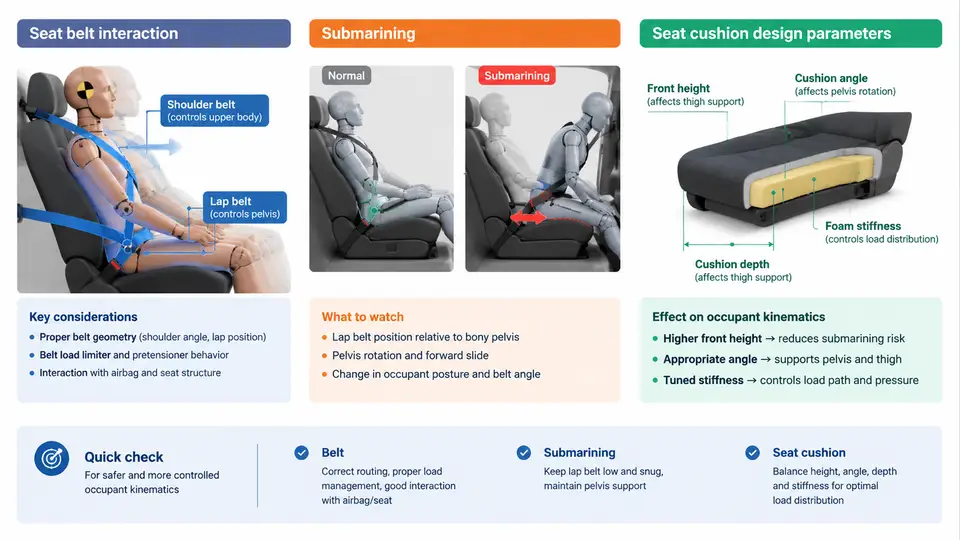
In a frontal crash, the restraint system does not simply "hold" the occupant in place. It manages a controlled deceleration of the occupant's body over a defined distance and time, distributing restraint forces across the strongest skeletal structures. The seat belt, seat structure, and seat cushion together form a coupled system, and the occupant's motion relative to that system — the kinematics — determines whether the restraint performs as intended or produces injurious loading. This section examines the frontal-impact kinematic sequence, the mechanics of belt–pelvis interaction, the submarining failure mode, and the cushion design parameters that govern the outcome.
The Frontal Impact Kinematic Sequence
Consider a 50th-percentile male Hybrid III ATD in the driver seat of a vehicle undergoing a 56 km/h full-frontal rigid barrier impact. The vehicle decelerates from 56 km/h to zero in roughly 90–120 ms, while the occupant continues forward under inertia until the restraint system arrests the motion. The sequence unfolds in distinct phases:
- 0–30 ms — Free travel and belt take-up: The occupant moves forward relative to the seat. Lap and shoulder belt slack (from webbing stretch, retractor spool-out, and initial fit) is consumed. The occupant's pelvis begins to slide forward on the cushion.
- 30–70 ms — Belt loading and pelvis engagement: The lap belt tensions and loads the anterior superior iliac spine (ASIS) region. The shoulder belt loads the clavicle and sternum. The pelvis rotates forward (anterior tilt) as the upper torso pitches forward.
- 70–120 ms — Peak restraint and torso flexion: Peak belt forces occur. The torso flexes at the hip and spine. The head accelerates forward and downward, and the knees may contact the knee bolster.
- 120–200 ms — Rebound and settling: The occupant rebounds into the seat as belt forces decay.
The critical design objective is to keep the lap belt anchored on the pelvis — specifically across the ASIS — throughout the loading phase. If the pelvis slides under the lap belt instead, the belt migrates into the abdomen, producing submarining.
Belt–Pelvis Interaction Mechanics
The lap belt restrains the pelvis through a combination of friction and geometric engagement. The belt path is defined by the anchor points (outboard anchor, buckle stalk, and the seat cushion's side bolsters or belt routing slots). The belt's angle relative to the horizontal — the lap belt angle — is a primary parameter. A typical target is 45°–65° from horizontal in side view, measured from the ASIS to the anchor. Too shallow an angle allows the pelvis to slide forward under the belt; too steep an angle concentrates load on the iliac crest and can cause the belt to ride up into the abdomen.
Friction between the webbing and the occupant's clothing also matters. A coefficient of friction below roughly 0.2 (e.g., smooth synthetic clothing) significantly increases submarining risk because the belt can slide over the pelvis rather than engaging it. This is why belt geometry and cushion contour must work together: the cushion's rearward slope and the seat pan's angle create a "pocket" that resists forward pelvis migration even before the belt fully tensions.
Submarining: Mechanism and Consequences
Submarining occurs when the pelvis translates forward and downward beneath the lap belt, allowing the belt to load the soft abdominal cavity rather than the pelvic bone. The consequences are severe: abdominal organ compression, spinal flexion injury, and in extreme cases, the occupant sliding entirely out from under the belt (the "jackknife" or ejection-like path).
Submarining is driven by three interacting factors:
- Seat cushion geometry: A cushion that is too flat or slopes downward toward the front reduces the pelvic pocket and encourages forward slide.
- Belt geometry: A lap belt anchored too far forward or too low, or routed too far from the body, allows the pelvis to escape.
- Occupant and posture factors: Slouched posture, reclined seat back angle, and low friction clothing all increase risk.
Seat Cushion Design Parameters
The seat cushion is an active restraint element in frontal impacts. Its geometry and stiffness determine how the pelvis is captured and how load is transferred. Key parameters include:
| Parameter | Typical Target / Range | Effect on Kinematics |
|---|---|---|
| Cushion angle (seat pan) | 5°–15° rearward slope | Creates a pelvic pocket; resists forward slide |
| Cushion front edge height | 20–40 mm above rear | Forms a "bucket" that limits forward pelvis travel |
| Cushion stiffness (ILD) | 150–250 N (25% compression) | Controls pelvis sink-in and rebound; too soft allows bottoming out |
| Side bolster height | 30–60 mm above cushion surface | Lateral containment; also affects belt routing |
| Belt routing slot position | At or slightly behind ASIS | Defines lap belt angle and engagement point |
These parameters are not independent. A stiffer cushion with a pronounced rearward slope can compensate for a slightly shallow belt angle, while a soft, flat cushion demands a steeper belt angle and higher friction to prevent submarining. In practice, cushion design is validated through sled testing with instrumented ATDs and, increasingly, through finite element simulation using human body models such as THUMS or GHBMC.
Practical Validation Example
Suppose a seat development team is evaluating a new cushion foam formulation for a mid-size SUV. The baseline cushion uses a 180 N ILD foam with a 10° rearward slope. Sled tests at 56 km/h show acceptable pelvis excursion but marginal submarining margin — the lap belt migrates approximately 15 mm below the ASIS at peak load. The team wants to improve the margin without increasing belt force on the chest.
A practical iteration is to increase the rearward cushion slope to 13° and raise the front edge by 15 mm, creating a deeper pelvic pocket. The foam ILD is increased to 210 N to reduce sink-in. The lap belt anchor is moved 20 mm rearward to steepen the belt angle from 48° to 54°. The expected observable changes in the next sled test are:
- Reduced forward pelvis excursion (measured by pelvic accelerometer integration and high-speed video).
- Lap belt load cell peak increases slightly (5–10%), but shoulder belt load remains unchanged.
- Belt migration below ASIS reduced to less than 5 mm.
If the belt migration persists, the next troubleshooting step is to examine the belt routing slot position and the occupant's initial posture. A slot too far forward or a slouched posture can defeat even a well-designed cushion. In that case, the fix may be a belt positioning feature or a seat back angle adjustment rather than further cushion changes.
The diagram contrasts the two outcomes. On the left, the lap belt engages the ASIS with a 48° belt angle and a 10° rearward cushion slope; the pelvis is captured. On the right, a flat cushion and a shallow belt angle allow the pelvis to slide forward and downward, the belt migrates into the abdomen, and the ASIS ends up above the belt path — the defining signature of submarining.
Design Integration and Verification
Seat cushion parameters cannot be optimized in isolation. The lap belt angle, anchor positions, cushion contour, and foam stiffness must be tuned as a system. A practical development sequence is:
- Define the target lap belt angle (typically 45°–65°) and the ASIS engagement point from the seat package drawing.
- Set the cushion rearward slope and front edge height to create a pelvic pocket that complements the belt angle.
- Select foam ILD to control sink-in; validate that the pelvis does not bottom out the cushion under peak load.
- Run sled tests with an instrumented ATD, measuring pelvis excursion, belt migration, and belt loads.
- If submarining margin is insufficient, iterate on cushion geometry first (lower cost), then belt routing, then foam stiffness.
Verification criteria typically include: lap belt migration below ASIS less than 10 mm, pelvis forward excursion within the occupant packaging target, and no belt loading of the abdominal region. High-speed video at 1000 fps is essential for observing the transient belt–pelvis relationship, since post-test static inspection can be misleading.
Understanding these kinematic and design relationships allows the seat engineer to make informed trade-offs early in development, reducing reliance on late-stage sled test iterations and improving occupant safety performance in frontal impacts.