4. Roof strength standards and regulations
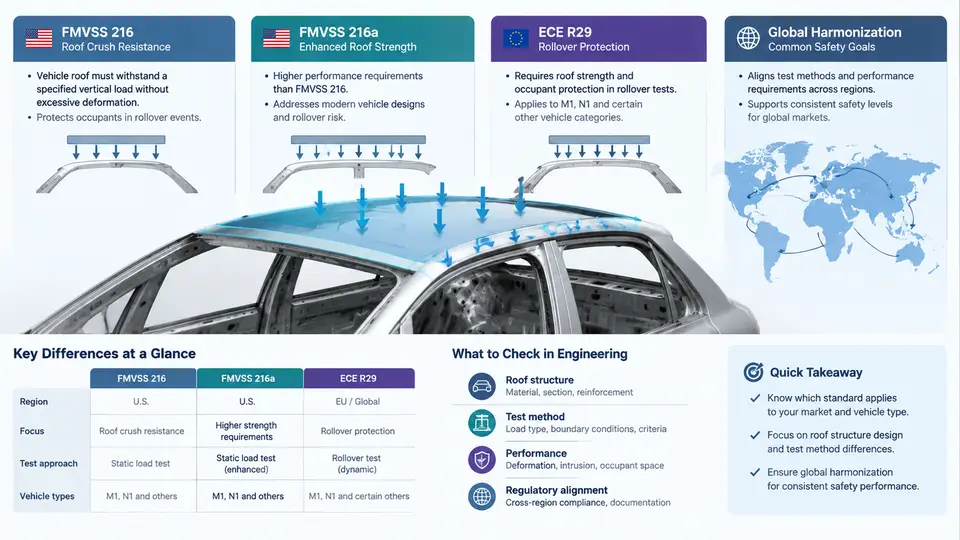
Roof strength regulation is the legal backbone of rollover occupant protection. A vehicle body can be engineered with excellent materials and sophisticated CAE models, but unless it satisfies the applicable regulatory test, it cannot be sold in the target market. This chapter examines the three principal roof strength standards — U.S. FMVSS 216 and its strengthened successor FMVSS 216a, and UN ECE Regulation No. 29 — and then looks at the ongoing effort to harmonize them under the UN Global Technical Regulation framework. Understanding the differences in loading geometry, force levels, and pass/fail criteria is essential for any engineer designing a roof structure that must satisfy multiple markets.
FMVSS 216: The Original Quasi-Static Roof Crush Test
Federal Motor Vehicle Safety Standard 216, first issued by NHTSA in 1971 and effective from 1973, was the world's first mandatory roof crush resistance standard. It applies to passenger cars and multipurpose passenger vehicles with a GVWR of 2,722 kg (6,000 lb) or less. The test procedure is deceptively simple: a rigid rectangular platen, 762 mm wide by 1,829 mm long, is positioned at a forward longitudinal angle of 5° and a lateral roll angle of 25°, then pushed downward against the roof rail at a constant rate not exceeding 13 mm/s until a target force is reached or the platen travels 127 mm (5 inches).
The original force requirement was modest: the roof structure must withstand a force equal to 1.5 times the unloaded vehicle weight (UVW), or 22,240 N (5,000 lb), whichever is less. Critically, the standard only required the roof to reach this force — it did not require the structure to sustain it through a specified amount of deformation. This "peak force only" criterion meant a roof could pass by momentarily resisting the load and then collapsing, which real-world rollover data showed was inadequate. The platen's 25° roll angle also concentrated load on one side of the roof, leaving the opposite side largely untested.
FMVSS 216a: The Strengthened Amendment
After decades of rollover injury research and congressional pressure, NHTSA issued the final rule for FMVSS 216a in 2009, with a phase-in schedule from September 2012 to September 2016. The amendment fundamentally changed both the force level and the pass/fail criterion.
The force requirement was raised to 2.5 times UVW (or 3.0 times UVW for vehicles already meeting 2.5×, depending on the compliance option chosen), with a cap of 22,240 N on each side. More importantly, the standard introduced a strength-to-weight ratio (SWR) requirement: the roof must sustain a force of at least 2.5 × UVW through a platen travel of 127 mm, not merely peak at that value. This "sustained crush" criterion ensures the roof has genuine energy-absorbing capacity rather than a brittle peak.
FMVSS 216a also requires testing on both sides of the roof — the driver's side and the passenger's side — because rollovers can occur in either direction. The platen geometry and angles remain the same as the original standard (5° pitch, 25° roll), but the test must be repeated with the platen positioned on each side. A vehicle passes only if both sides meet the force and travel requirements.
- Force target: 2.5 × UVW (or 3.0 × UVW under the alternative compliance path), capped at 22,240 N per side
- Platen travel: 127 mm (5 in) minimum sustained
- Platen dimensions: 762 mm × 1,829 mm
- Loading angles: 5° pitch, 25° roll
- Test sides: both driver and passenger sides
- Phase-in: 2012–2016 model years
ECE R29: The European Approach
UN ECE Regulation No. 29, first adopted in 1970 and substantially revised in 1992 (R29.02) and again in 2010 (R29.03), takes a different philosophical approach. Rather than a quasi-static platen test, ECE R29 is primarily a dynamic impact test using a rigid pendulum or a moving deformable barrier.
In the R29.02 version, a 1,270 kg pendulum with a flat impact face is swung into the roof at a specified velocity, simulating the impact of a vehicle roof against the ground during a rollover. The test is performed at both the front and rear of the roof. The pass/fail criterion is based on survival space: after impact, the deformed roof must not intrude into a defined survival zone around the occupant's head position. There is no explicit force requirement; instead, the structure must absorb the impact energy while maintaining a minimum clearance.
R29.03, adopted in 2010, added a quasi-static roof crush test similar in concept to FMVSS 216 but with different parameters: a force of at least 1.5 × UVW applied through a platen, with the requirement that the roof withstand this force without the platen penetrating the survival space. The dynamic pendulum test remains as an alternative or additional requirement depending on vehicle category.
| Parameter | FMVSS 216 (original) | FMVSS 216a | ECE R29.02 | ECE R29.03 |
|---|---|---|---|---|
| Test type | Quasi-static platen | Quasi-static platen | Dynamic pendulum | Dynamic + quasi-static |
| Force level | 1.5 × UVW (max 22,240 N) | 2.5 × UVW (max 22,240 N/side) | No explicit force | 1.5 × UVW (quasi-static) |
| Pass criterion | Peak force only | Sustained through 127 mm | Survival space maintained | Survival space + force |
| Test sides | One side | Both sides | Front and rear | Front and rear + both sides |
| Platen angle | 5° pitch, 25° roll | 5° pitch, 25° roll | Pendulum arc | Pendulum + platen |
Global Harmonization Efforts
The existence of two fundamentally different regulatory philosophies — the U.S. quasi-static force-based approach and the European dynamic survival-space approach — creates significant compliance burden for global automakers. A vehicle designed to pass FMVSS 216a may not automatically satisfy ECE R29, and vice versa, because the loading conditions and failure criteria differ.
Under the 1998 UN Agreement on Global Technical Regulations, a working party (GRSP) began developing a harmonized roof strength GTR. The goal was to create a single test procedure that could be accepted in all major markets. However, progress has been slow because the two regions have different priorities: the U.S. focuses on force capacity as a proxy for structural integrity, while Europe emphasizes occupant survival space under realistic dynamic loading.
A significant step came with the UN GTR No. 9 on pedestrian safety, but roof strength harmonization remains incomplete. In practice, many automakers now design to the more stringent of the two standards for each market, and some vehicles are tested to both FMVSS 216a and ECE R29.03 to demonstrate global compliance. The trend in newer regulations, particularly in China (GB 26134) and other emerging markets, is to adopt elements of both approaches, further complicating the landscape.
Practical Implications for Roof Design
For an engineer developing a vehicle for global markets, the practical consequence of this regulatory patchwork is that the roof structure must be designed to the most demanding combination of requirements. In most cases, FMVSS 216a's 2.5 × UVW sustained force requirement is the governing structural load, because it demands higher force capacity than ECE R29.03's 1.5 × UVW quasi-static test. However, ECE R29.02's dynamic pendulum test imposes a different kind of demand: the roof must absorb impact energy without allowing the pendulum to intrude into the survival space, which may require specific crush initiators or energy-absorbing structures that a pure force-based design might not include.
A common design strategy is to first size the roof pillars and roof rails to meet FMVSS 216a's force and travel targets, then verify through dynamic simulation or physical testing that the same structure maintains survival space under ECE R29.02 pendulum impact. If the dynamic test reveals excessive intrusion, local reinforcements or modified crush modes are added without compromising the quasi-static force capacity. This iterative approach — quasi-static sizing followed by dynamic verification — is now standard practice in body-in-white engineering.
Summary
FMVSS 216a and ECE R29 represent two distinct regulatory philosophies for roof strength: the U.S. standard emphasizes sustained force capacity through a quasi-static platen test, while the European regulation prioritizes occupant survival space under dynamic impact. The original FMVSS 216 was a weak standard by modern measures, and its 216a amendment significantly raised both the force level and the pass/fail rigor. Global harmonization efforts under the UN GTR framework aim to unify these approaches, but progress remains slow due to fundamental differences in test methodology and acceptance criteria. In practice, automakers design to the more stringent requirements of each market, often combining quasi-static sizing with dynamic verification to achieve global compliance.