1. Rear impact and whiplash protection engi
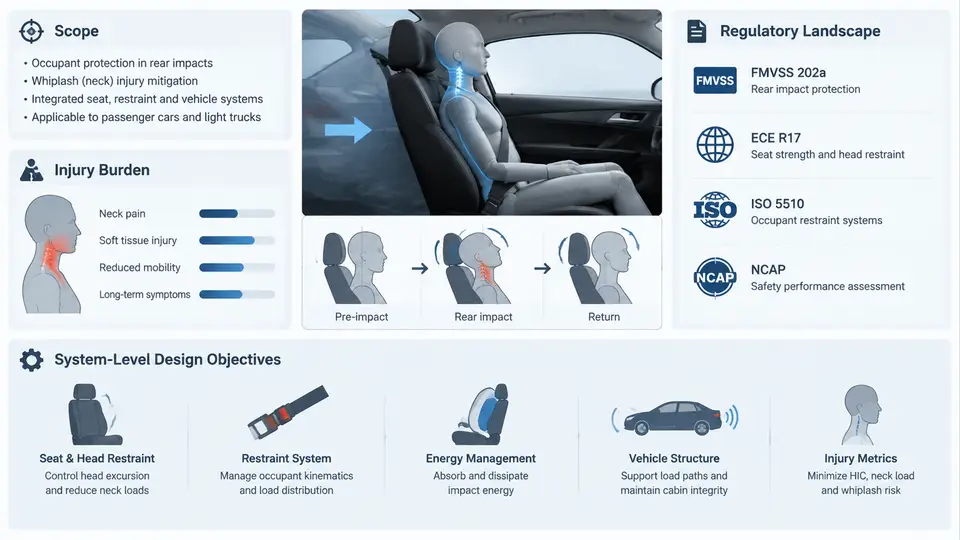
Rear impacts are the most frequent crash mode in real-world traffic, yet they are also the most under-engineered relative to their injury cost. A rear impact occurs when a following vehicle strikes the rear of a subject vehicle, producing a short-duration forward acceleration pulse on the struck vehicle. The occupant, restrained only by the seat and head restraint, does not accelerate with the vehicle instantaneously: the torso is pushed forward by the seatback while the head lags behind, creating a differential motion between the head and the upper torso. This relative motion is the mechanical origin of whiplash injury. Whiplash protection engineering is therefore the discipline of managing that differential motion through seat structure, head restraint geometry, energy absorption, and, increasingly, active and adaptive restraint systems.
1.1 Course Scope and Engineering Boundaries
This course addresses rear impact and whiplash protection as a system-level engineering problem, spanning four interacting domains:
- Crash pulse and vehicle response — the acceleration-time history applied to the struck vehicle, its dependence on bullet vehicle mass, stiffness, closing speed, and bumper engagement height.
- Occupant kinematics — the coupled motion of pelvis, torso, neck, and head under the pulse, including seatback deflection and head restraint contact timing.
- Injury biomechanics — the neck injury criteria used to quantify risk, principally NIC (Neck Injury Criterion), Nkm, and the more recent NICmax and neck force/moment corridors.
- Restraint system design — seat frame, recliner, head restraint geometry and stiffness, energy-absorbing recliners, and active head restraint deployment logic.
The scope deliberately excludes frontal and side impact restraint design except where shared hardware (seat structure, belt anchorage) creates coupling. The engineering objective is not to eliminate all occupant motion — that is physically impossible in a rear impact — but to shape the motion so that neck loading stays below injury thresholds across the widest practical range of impact severities and occupant sizes.
1.2 Injury Burden and the Whiplash Problem
Whiplash-associated disorders (WAD) are classified by the Quebec Task Force scale from Grade 0 (no symptoms) to Grade IV (fracture or dislocation). The vast majority of real-world rear impact injuries are WAD I–II: neck pain, stiffness, and musculoskeletal signs without neurological deficit. These injuries are rarely life-threatening, but they carry disproportionate societal cost because they are common, frequently lead to long-term symptoms, and generate significant insurance and litigation burden.
Epidemiological data consistently show that the risk of WAD is strongly dependent on impact severity, but not linearly. Below a delta-v of roughly 10–15 km/h, injury risk is low; between 15 and 30 km/h, risk rises steeply; above 30 km/h, structural damage and more severe injury mechanisms dominate. This non-linearity is why rear impact protection is often described as a "low-to-medium severity" problem: the engineering target is the broad band of everyday collisions, not the extreme tail of high-speed crashes.
1.3 Regulatory and Consumer-Test Landscape
Rear impact protection is governed by a patchwork of regulations and consumer test protocols. The most influential are:
| Framework | Region | Focus | Key Metric |
|---|---|---|---|
| FMVSS 202a | United States | Head restraint geometry and strength | Backset, height, static strength |
| ECE R17 | Europe / UN | Seat strength and head restraint | Energy absorption, backset |
| Euro NCAP whiplash | Europe | Dynamic sled test, front and rear seats | NIC, seatback deflection, head restraint geometry |
| IIHS rear crash | United States | Dynamic sled, geometric rating | Head restraint geometry, NIC, torso acceleration |
| China NCAP | China | Whiplash sled test | NIC, head restraint position |
FMVSS 202a is a static geometric and strength requirement: it specifies a minimum head restraint height and a maximum backset (the horizontal distance between the back of the head and the front of the restraint) of 55 mm, measured with a standardized head form. ECE R17 adds seat strength and energy absorption requirements. Euro NCAP and IIHS go further by requiring dynamic sled tests that measure neck injury criteria on a BioRID or RID3D dummy.
The practical consequence for engineers is that a seat must satisfy both static geometry rules and dynamic injury-metric thresholds. A head restraint that is geometrically compliant but too soft or too far rearward will fail the dynamic test; a restraint that is dynamically effective but positioned too low will fail the static check. The design space is therefore constrained from two directions simultaneously.
1.4 System-Level Design Objectives
From a system perspective, the rear impact protection problem can be decomposed into four design objectives, each with its own physical mechanism and measurable target:
- Minimize head-to-torso relative motion. The primary objective is to reduce the differential acceleration that drives neck loading. This is achieved by early head restraint contact (low backset), adequate restraint stiffness, and seatback geometry that supports the torso without excessive rearward deflection.
- Control seatback deflection. A seatback that deflects too much allows the torso to rotate rearward, increasing the head-torso differential. A seatback that is too stiff transmits higher forces to the occupant. The target is a controlled, progressive deflection that absorbs energy while limiting peak torso acceleration.
- Manage energy absorption. Energy-absorbing recliners and deformable seat structures convert kinetic energy into plastic deformation, reducing the peak acceleration transmitted to the occupant. The design must balance energy absorption against structural integrity in other crash modes.
- Adapt to occupant size and position. The same seat must protect a 5th percentile female and a 95th percentile male, in upright and reclined postures. Active head restraints and adjustable geometry are the primary tools for this objective.
1.5 From Objectives to Engineering Practice
The four objectives are not independent. Reducing backset improves head restraint contact timing but may conflict with comfort and rearward visibility requirements. Increasing seatback stiffness reduces deflection but raises torso acceleration. Adding energy absorption in the recliner reduces peak forces but may compromise seat strength in frontal impacts. The engineering task is therefore a multi-objective optimization under regulatory and packaging constraints.
A practical starting point is to define a target crash pulse and a target occupant response. For a typical Euro NCAP whiplash test, the sled pulse is a nominal delta-v of 16 km/h with a peak acceleration of approximately 10 g. The BioRID II dummy is seated in a standard posture, and the measured NIC must remain below the threshold defined by the protocol. The engineer then iterates on head restraint position, seatback stiffness, and recliner energy absorption until the NIC time history stays within the corridor.
1.6 What This Course Will Cover
The remaining chapters build on this foundation. We will examine crash pulse characterization and its variability across bullet vehicle types; occupant kinematics and the biomechanics of neck injury; the full set of injury criteria and their limitations; seat structure and head restraint design; energy-absorbing recliner mechanisms; active head restraint systems and deployment logic; sled testing and dummy instrumentation; simulation methods including MADYMO and LS-DYNA; and finally, integration and validation across the full range of occupant sizes and impact severities. Each chapter will combine the underlying physics with the practical engineering methods used in industry.
The central message of this first chapter is that rear impact protection is a system problem. No single component — not the head restraint, not the seatback, not the recliner — can solve it alone. The design objectives are clear, the regulatory constraints are defined, and the injury burden is well documented. The engineering challenge is to balance them.