4. Material selection for intrusion resista
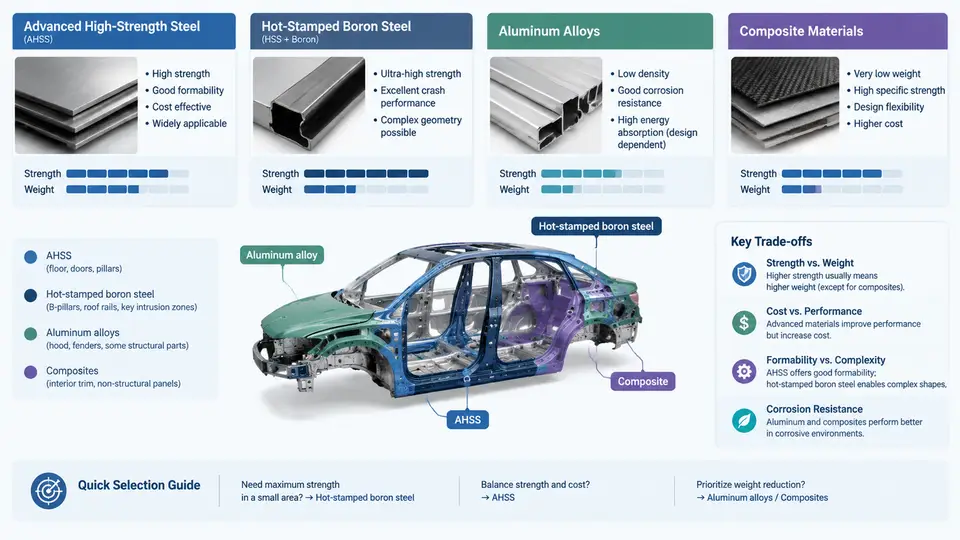
Passenger compartment intrusion is governed less by how much material a body structure contains than by how intelligently that material is distributed. A door beam, B-pillar, rocker, and floor cross-member each face different loading modes, strain rates, and packaging constraints, so a single "best" material does not exist. This chapter examines the four material families that dominate modern intrusion-resistant design — advanced high-strength steel (AHSS), hot-stamped boron steel, aluminum alloys, and fiber-reinforced composites — and explains how to select among them using strength, ductility, mass, manufacturability, and cost as competing criteria.
Strength, Ductility, and the Energy Balance
Intrusion resistance depends on two coupled properties. Yield and ultimate strength determine how much force a member can transmit before it deforms or fails. Ductility — measured by total elongation and the strain-hardening exponent n — determines how much energy the member absorbs through plastic deformation before fracture. A material that is very strong but brittle will resist initial intrusion, then crack and lose load-carrying capacity abruptly. A material that is ductile but weak will absorb energy smoothly but allow large deformation.
The practical metric is specific energy absorption (SEA), the energy absorbed per unit mass:
SEA = ∫F·ds / m    [kJ/kg]

where F = axial or bending force, s = deformation distance, m = mass of the member
For a given intrusion budget (the maximum displacement allowed before the occupant is endangered), the designer wants the highest possible force sustained over that displacement at the lowest mass. This is why AHSS and hot-stamped boron steel dominate the safety cage while aluminum and composites compete in specific niches.
Advanced High-Strength Steel (AHSS)
AHSS covers a family of multiphase steels with tensile strengths from roughly 500 to 1200 MPa. The most relevant grades for intrusion resistance are dual-phase (DP), complex-phase (CP), and transformation-induced plasticity (TRIP) steels. DP steels, such as DP600 and DP780, combine a ferrite matrix with martensite islands, giving a good balance of strength and formability. They are commonly used for door intrusion beams, bumper reinforcements, and seat cross-members.
Key selection parameters for AHSS:
- Grade designation: the number indicates minimum tensile strength in MPa (e.g., DP780 = 780 MPa).
- Total elongation: typically 14–25% for DP grades, allowing cold forming of complex geometries.
- Hole expansion ratio (HER): a formability indicator for edge stretching; critical when the part has trimmed flanges or bolt holes.
- Springback: increases with strength, requiring compensation in die design or the use of draw beads.
A typical door beam made from DP780 with a 1.4 mm wall thickness and a closed-hat section can sustain a three-point bending force of approximately 8–12 kN over 150 mm of deflection in a quasi-static test. Under dynamic impact at 5 m/s, the force rises due to strain-rate sensitivity, but the failure mode remains ductile tearing rather than brittle fracture.
Hot-Stamped Boron Steel
Hot-stamped boron steel, often designated 22MnB5 or Usibor 1500, achieves tensile strengths of 1500–2000 MPa after the hot-stamping process. The blank is austenitized at approximately 900–950 °C, then simultaneously formed and quenched in a cooled die at a cooling rate above 27 °C/s. This produces a fully martensitic microstructure with very high strength but limited elongation (typically 5–8%).
The trade-off is clear: boron steel provides the highest strength per unit thickness, enabling thin-gauge B-pillars and roof rails that resist intrusion with minimal mass. However, its low ductility means it absorbs less energy through plastic deformation and is susceptible to edge cracking if the trimmed edge quality is poor. To mitigate this, laser trimming or fine blanking is preferred over conventional shearing, and the material is often used in a tailored approach — a ductile patch or a softer zone (tailored tempering) is introduced in regions where energy absorption is more important than peak strength.
Typical application: a B-pillar outer made from 22MnB5 at 1.2 mm thickness can achieve a peak bending force exceeding 20 kN, but its intrusion resistance is complemented by a DP780 inner panel that provides ductile energy absorption and prevents catastrophic fracture.
Aluminum Alloys
Aluminum alloys, particularly 6000-series (e.g., 6061-T6) and 7000-series (e.g., 7075-T6), offer high specific strength and excellent corrosion resistance. Their density is roughly one-third that of steel, so a given mass of aluminum can be thicker, which helps in bending stiffness. However, aluminum has a lower modulus of elasticity (about 70 GPa vs. 210 GPa for steel), meaning it deflects more under the same load unless the section is redesigned.
For intrusion resistance, aluminum is most effective in extruded rockers, crash boxes, and door beams where multi-cell cross-sections can be produced. A 6061-T6 extrusion with a 2.5 mm wall and a multi-cell profile can absorb 15–25 kJ/kg in axial crushing, comparable to some AHSS grades. The challenges are:
- Lower melting point and thermal softening: aluminum loses strength rapidly above 150 °C, which matters near exhaust or battery thermal management systems.
- Joining: spot welding is difficult; self-piercing rivets, friction stir welding, or adhesive bonding are required, adding process complexity.
- Cost: raw material and fabrication costs are typically higher than steel on a per-part basis, though mass savings can offset this in battery-electric vehicles.
Composite Trade-offs
Fiber-reinforced composites — carbon fiber (CFRP) and glass fiber (GFRP) — offer the highest specific strength and stiffness. A CFRP door beam can be 40–50% lighter than an equivalent steel beam while matching its intrusion resistance. The energy absorption mechanism is different: composites absorb energy through fiber fracture, matrix cracking, and delamination, which can be tailored by fiber orientation and layup sequence.
However, composites present significant trade-offs:
- Anisotropy: strength is directional; a layup optimized for bending may be weak in torsion or crush.
- Strain-rate sensitivity: some composites become more brittle at high strain rates, reducing energy absorption in impact compared to quasi-static tests.
- Manufacturing cycle time: thermoset composites require long cure cycles; thermoplastic composites can be faster but need high-temperature tooling.
- Cost and repair: material cost is high, and damage assessment and repair are more complex than for metals.
Composites are therefore used selectively — in high-performance or electric vehicles where mass reduction justifies cost — rather than as a general replacement for steel in the safety cage.
Selection Framework and Example
The following SVG summarizes the decision logic for a B-pillar reinforcement, mapping material options against intrusion resistance, mass, and manufacturing feasibility.
To make this concrete, consider a mid-size electric sedan with a 1.5 mm DP780 B-pillar inner and a 1.2 mm 22MnB5 outer. The inner panel provides ductile energy absorption and a controlled folding mode; the outer panel provides high peak force to resist intrusion from a pole or barrier. The combined mass is approximately 4.2 kg. Replacing the outer with a 2.0 mm aluminum extrusion would reduce mass by about 1.1 kg but lower peak force by roughly 30%, requiring a thicker or multi-cell design that erodes the mass benefit. Replacing both with a CFRP layup could save 2.5 kg but would increase cost by a factor of three and complicate repair.
In summary, material selection for intrusion resistance is a multi-objective optimization. The designer must balance peak force, energy absorption, mass, packaging space, joining method, corrosion, and cost. The most effective safety cages use a mixed-material strategy: boron steel for high-strength intrusion barriers, AHSS for ductile energy-absorbing members, aluminum for mass-sensitive closures and structures, and composites for targeted lightweighting where the performance case is strong.