1. Passenger compartment intrusion fundamen
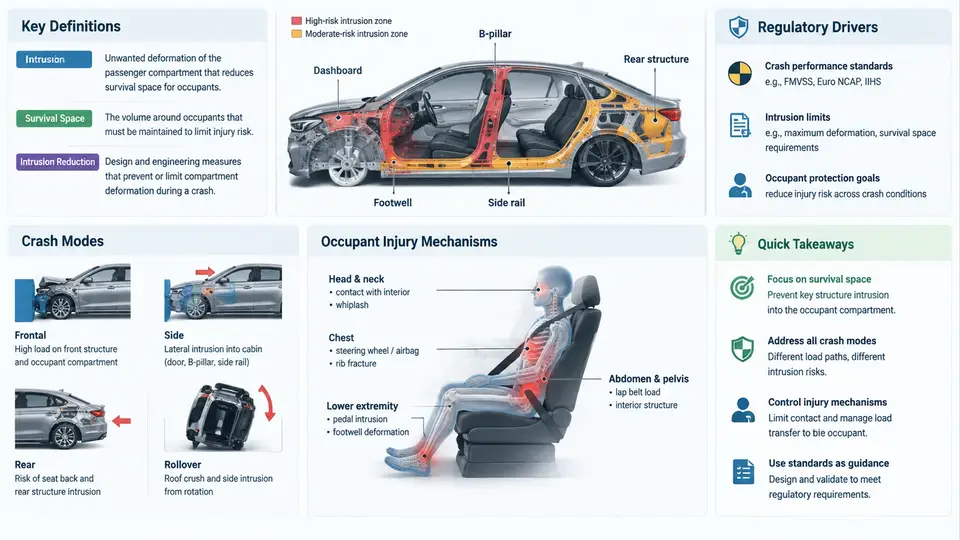
Passenger compartment intrusion is the displacement of the occupant survival space caused by deformation of the body structure during a crash. In engineering terms, it is measured as the reduction of the residual space between the occupant seating reference point and the deformed surfaces of the occupant cell — the floor pan, toe board, dash panel, A-pillar, roof rail, door aperture, and seat mounting structure. When intrusion exceeds the available clearance, the restraint system can no longer manage occupant motion, and injury risk rises sharply even if the airbags and seat belts deploy correctly.
It is important to separate intrusion from two related but distinct concepts. Occupant cell deformation describes how the safety cage itself changes shape; intrusion describes how that deformation reduces the space available to the occupant. A vehicle may deform substantially at the front crush zone while showing almost no intrusion into the passenger compartment — that is the intended behaviour of a well-designed energy-absorbing structure. Conversely, a relatively small amount of dash panel or door intrusion can be far more dangerous than a large crush depth, because it directly contacts the occupant's lower extremities, chest, or head.
Regulatory and Rating Drivers
Intrusion limits are not arbitrary. They are derived from regulatory test procedures and consumer rating programmes that define measurable acceptance criteria:
- FMVSS 208 (US) — frontal occupant crash protection, including unbelted and belted test conditions, with limits on chest deflection and head injury criteria (HIC).
- FMVSS 214 (US) — side impact protection, specifying dynamic pole and barrier tests and a maximum dynamic door intrusion into the occupant space.
- FMVSS 216a (US) — roof crush resistance, requiring the roof to withstand a multiple of vehicle weight without exceeding a defined intrusion limit.
- ECE R94 / R95 (Europe) — frontal and side impact requirements with comparable intrusion and injury criteria.
- Euro NCAP / C-NCAP / IIHS — rating programmes that add offset deformable barrier, small overlap, side pole, and roof strength tests, often with stricter intrusion thresholds than regulation.
These standards translate into design targets. A typical frontal offset requirement might limit dash panel intrusion to a defined value at the driver footwell, while a side impact requirement limits door trim intrusion at the occupant's chest and pelvis. The exact numbers vary by programme and vehicle class, but the engineering principle is consistent: intrusion must be controlled so that the restraint system retains enough space to work.
Crash Modes and Their Intrusion Signatures
Different crash modes produce characteristic intrusion patterns, and understanding these patterns is the first step in designing countermeasures.
| Crash Mode | Primary Load Path | Typical Intrusion Location | Dominant Injury Mechanism |
|---|---|---|---|
| Full frontal | Front rails, bumper beam, cradle | Toe board, dash panel, footwell | Lower extremity, pelvis, chest |
| Offset frontal (40% ODB) | Loaded-side rail, hinge pillar, rocker | A-pillar, door aperture, dash panel offset | Lower extremity, chest, head (via A-pillar) |
| Small overlap (25%) | Wheel, suspension, hinge pillar, rocker | Front wheel well, A-pillar, door hinge area | Lower extremity, hip, chest, head |
| Side impact (MDB / pole) | Door beam, B-pillar, rocker, floor cross members | Door trim, B-pillar, seat, floor | Chest, abdomen, pelvis, head |
| Roof crush / rollover | A/B/C-pillars, roof rails, roof bows | Roof, header, side glass aperture | Head, neck, spine |
| Rear impact | Rear rails, floor, rear cross member | Rear floor, seat back, rear door aperture | Neck (whiplash), spine, head |
In a full frontal crash, the front rails and cradle absorb energy and the remaining load is distributed into the dash panel and floor. If the dash panel intrudes rearward, it pushes the pedals and toe board into the driver's footwell, causing ankle and tibia fractures. In an offset frontal crash, the loaded side of the vehicle receives most of the energy, and the A-pillar and door aperture can deform inward, reducing the space between the occupant's chest and the door trim. In a small overlap crash, the wheel and suspension are driven rearward into the hinge pillar and rocker, often producing severe intrusion at the door hinge area and a corresponding risk of lower extremity and pelvic injury.
Side impacts are particularly challenging because the available crush space between the door outer panel and the occupant is small — typically 100–200 mm in a passenger car. The door beam, B-pillar, and rocker must absorb energy while limiting intrusion into the occupant space. A pole impact concentrates the load on a small area, making it even harder to control intrusion without adding significant mass.
Occupant Injury Mechanisms
Intrusion causes injury through three primary mechanisms:
- Direct contact — the deformed structure physically strikes the occupant. This is common in side impacts where the door trim intrudes into the chest or pelvis, and in frontal impacts where the dash panel or pedals contact the lower extremities.
- Restraint system degradation — intrusion changes the geometry between the occupant and the restraint system. If the seat moves or the dash panel intrudes, the belt may not engage the pelvis correctly, allowing the occupant to submarine or to load the chest through the ribs rather than the stronger pelvic structure.
- Occupant kinematics alteration — intrusion can redirect the occupant's motion, increasing the relative velocity between the occupant and the interior surfaces. For example, a deformed A-pillar can become a hard contact point for the head even when the airbag deploys.
The injury criteria used to quantify these effects include HIC (head injury criterion), chest deflection and viscous criterion (VC), and lower extremity indices such as tibia index and femur force. Intrusion limits are set so that these criteria remain below threshold values in the specified test conditions.
Engineering Implications
The practical consequence of these fundamentals is that intrusion control must be addressed at the earliest stage of body-in-white design. The load paths must be continuous from the front rails through the cradle, dash panel, and rocker to the rear structure. The occupant cell must be stiff enough to resist deformation, while the crush zones must absorb energy without transferring excessive load into the cell. In side impact, the door beam, B-pillar, and rocker must work together to limit intrusion, and the seat structure must be designed to manage occupant motion when the door trim is displaced.
When evaluating a design, engineers typically use a combination of CAE simulation and physical testing. The key outputs are intrusion measurements at defined points — dash panel, toe board, door trim, B-pillar, roof rail — and the corresponding occupant injury criteria. If intrusion exceeds the target, the countermeasure may involve adding material to the rocker, redesigning the door beam, adding a dash panel reinforcement, or changing the load path through the cradle. The choice depends on which load path is overloaded and which intrusion location is driving the injury risk.
Understanding these fundamentals provides the basis for the rest of this course. The next sections will examine how load paths are designed, how materials and geometry are selected, and how intrusion performance is validated through testing and simulation.