1. Occupant head injury mechanisms in autom
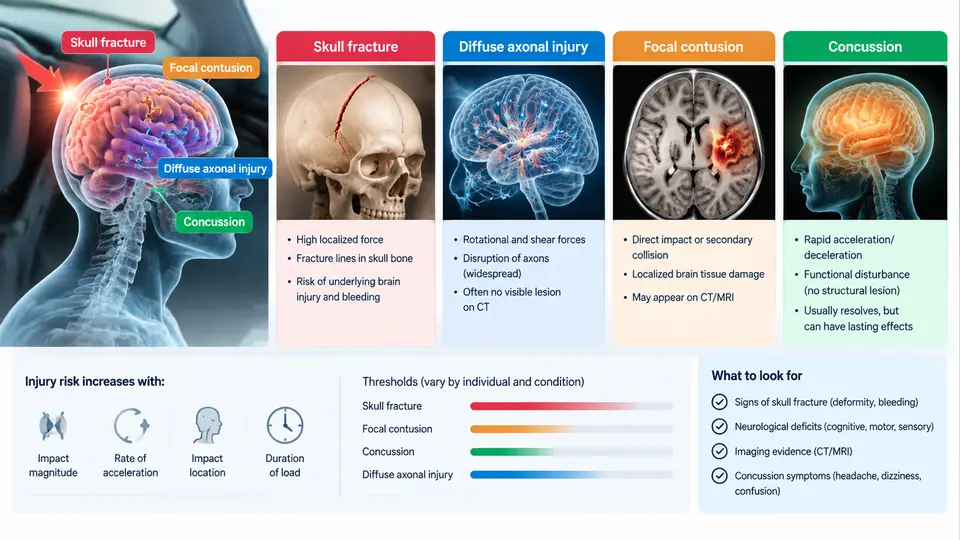
Head injury is the leading cause of fatality and severe disability in automotive crashes, and the interior surfaces surrounding an occupant — A-pillars, roof rails, header trim, sun visors, instrument panel, seat backs, and side glass — are the structures the head most often strikes. Designing effective protection requires understanding not just where the head hits, but how the resulting mechanical loading damages brain and skull tissue. This chapter establishes the four principal injury mechanisms, the physical quantities that drive them, and the tolerance thresholds used throughout the rest of the course.
From Contact Force to Tissue Response
When an occupant's head strikes an interior component, the interaction can be decomposed into two distinct phases. The contact phase lasts roughly 5–20 ms and is governed by the stiffness of the struck surface, the contact area, and the relative velocity. The inertial phase follows and lasts 50–200 ms, during which the brain moves relative to the skull under angular and linear acceleration, independent of whether contact occurred at all.
This distinction matters because the two phases produce different injuries. Contact loading produces skull fracture and focal cortical contusion. Inertial loading — particularly angular acceleration — produces diffuse axonal injury (DAI) and concussion. A single impact event frequently produces both, which is why real-world head injury is rarely a single clean mechanism.
Skull Fracture
Skull fracture occurs when local contact stress exceeds the bone's ultimate strength. The relevant quantity is not force alone but contact pressure — force divided by contact area. A blunt impact spread over 50 cm² may leave the skull intact, while the same energy concentrated on 5 cm² can produce a linear fracture.
Three fracture patterns are relevant to interior design:
- Linear fracture — crack propagating from the impact point; typically requires local force above roughly 4–6 kN in adult parietal bone.
- Depressed fracture — bone displaced inward, often from small-radius contactors such as grab handles or seat-frame edges; risks direct cortical compression.
- Basilar fracture — fracture at the skull base, frequently from mandibular or occipital loading; associated with high mortality.
The practical design implication is that interior surfaces should present large, compliant contact areas. Energy-absorbing trim with controlled crush — for example, a ribbed A-pillar cladding that deforms progressively — spreads load over time and area, reducing peak contact pressure below the fracture threshold.
Focal Contusion
Focal contusion is localized bruising of cortical tissue, most commonly at the coup site (directly under the impact) and the contrecoup site (diametrically opposite). Coup contusions arise from direct contact pressure and local skull deformation. Contrecoup contusions arise from brain motion within the skull: as the brain decelerates against the inner table, negative pressure and shear develop at the far pole.
Contusions are threshold phenomena. In cadaver and animal studies, cortical pressure differentials on the order of 100–200 kPa are associated with contusion onset, though the threshold depends strongly on loading rate and region. Clinically, contusions may expand over 24–72 hours due to edema and hemorrhage, so an initially minor contusion can become life-threatening.
Diffuse Axonal Injury
DAI is the most consequential injury for long-term outcome and the hardest to prevent. It results from shear strain in white matter tracts when the brain undergoes rapid angular acceleration. Because the brain has a very low shear modulus (on the order of a few kPa), even modest rotational loading produces strain at the interfaces between tissues of differing density — gray-white matter junctions, the corpus callosum, and the brainstem.
The critical loading parameter is angular acceleration, typically expressed in rad/s². Empirical tolerance corridors derived from primate and porcine studies suggest that angular accelerations in the range of 4,000–10,000 rad/s² sustained for 5–20 ms can produce DAI in humans, with the brainstem being most vulnerable. Linear acceleration alone, even at high magnitude, is a poor predictor of DAI.
Concussion Thresholds
Concussion is a functional rather than structural injury: no macroscopic tissue disruption is required. It is nonetheless driven by the same rotational kinematics as DAI, at lower magnitudes. The most widely used engineering correlate is the Head Injury Criterion (HIC), defined as:
HIC = max over t1,t2 of [ (1/(t2-t1)) * ∫ a(t) dt ]^2.5 * (t2-t1)

where a(t) is the resultant linear acceleration at the head CG
in g, and the integration window t2-t1 is limited to 36 ms.
HIC = 1000 corresponds approximately to a 15–20% risk of severe head injury (AIS 3+) in the abbreviated injury scale. For concussion specifically, HIC is a weak predictor; rotational metrics such as BRIC (Brain Injury Criterion) or peak angular acceleration are more appropriate. BRIC is defined as the maximum of the ratio of angular velocity to a critical angular velocity, taken separately for each axis.
In practice, interior head-impact testing per FMVSS 201U and Euro NCAP uses a free-motion headform (FMH) or a pedestrian headform launched at the interior surface, with HIC computed from the measured acceleration. A typical acceptance target is HIC ≤ 1000 over the tested zone, with many OEMs targeting HIC ≤ 700 for headliner and pillar trim.
Mechanism Summary and Design Levers
The table below consolidates the four mechanisms, their dominant loading parameters, and the interior design levers that influence each.
| Mechanism | Dominant Loading | Typical Threshold (example) | Interior Design Lever |
|---|---|---|---|
| Skull fracture | Contact pressure | ~4–6 kN local force | Large contact area, compliant crushable trim |
| Focal contusion | Contact pressure + brain–skull relative motion | ~100–200 kPa cortical pressure differential | Load spreading, avoid hard edges |
| Diffuse axonal injury | Angular acceleration | ~4,000–10,000 rad/s² for 5–20 ms | Limit rotational velocity change, symmetric geometry |
| Concussion | Angular velocity / acceleration | HIC ≈ 700–1000; BRIC-based limits | Combined linear + rotational mitigation |
Two engineering observations follow. First, no single countermeasure addresses all four mechanisms. A soft headliner reduces contact pressure and HIC but does little for DAI if the head is already rotating. Second, the interior geometry determines the loading mode: a flat, broad surface tends to produce linear acceleration, while an angled or offset surface converts the same impact into rotation. This is why A-pillar and roof-rail geometry receives disproportionate attention in head-protection design.
Practical Implications for Interior Design
Three actionable conclusions emerge from the mechanism review. First, characterize the contact surface before selecting padding: measure or simulate the effective contact area and stiffness of each head-strike zone, because the same foam thickness behaves very differently against a 5 cm² grab-handle edge versus a 50 cm² headliner panel. Second, evaluate rotational metrics alongside HIC in any head-impact CAE or sled test, since HIC alone will not reveal DAI or concussion risk. Third, treat geometry as a primary countermeasure: eliminating sharp transitions, recessing hard points, and avoiding asymmetric protrusions reduces both contact pressure and the rotational impulse imparted to the head.
These four mechanisms — skull fracture, focal contusion, diffuse axonal injury, and concussion — form the analytical foundation for every subsequent chapter, from material selection to regulatory test procedures.