1. Frontal crash safety engineering overvie
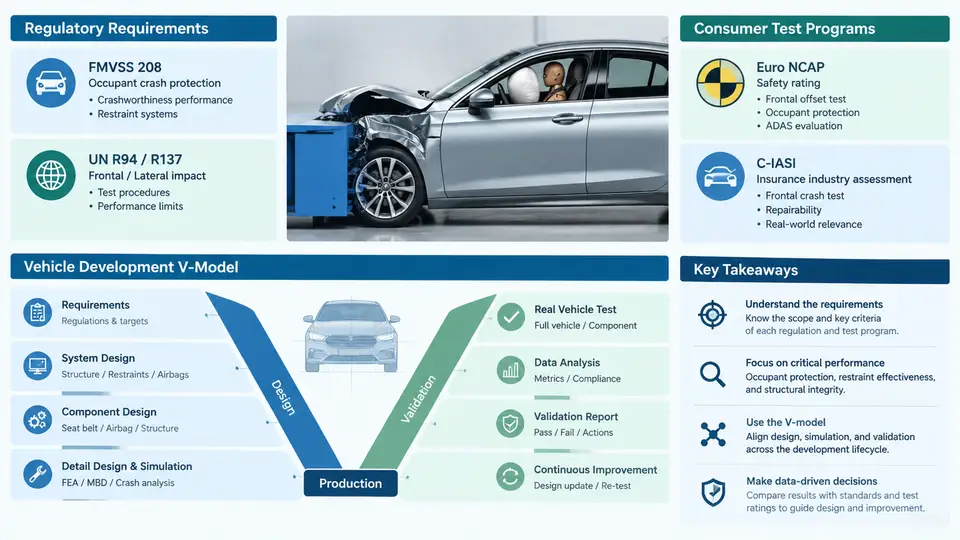
Frontal crash safety engineering sits at the intersection of regulation, consumer rating, and vehicle architecture. Before a single CAE mesh is generated or a sled test is scheduled, the engineering team must understand which requirements the vehicle must satisfy, how those requirements are evaluated, and where they fit in the development timeline. This chapter establishes that landscape and positions it within the vehicle development V-model.
The Two-Tier Requirement System
Frontal crash requirements come from two distinct sources that differ in legal force, test severity, and engineering consequence.
Homologation regulations are mandatory. A vehicle cannot be sold in a given market without demonstrating compliance. In the United States, FMVSS 208 (Occupant Crash Protection) governs frontal impact, specifying barrier tests, dummy types, injury criteria, and occupant positioning. It includes both unbelted and belted test configurations, a characteristic unique to the US market. In Europe and many UN-ECE contracting countries, UN Regulation No. 94 (R94) covers frontal impact protection, while UN Regulation No. 137 (R137) addresses frontal impact with a focus on restraint system performance and, in its later amendments, advanced restraint systems and occupant classification. R94 and R137 are type-approval regulations: a designated technical service witnesses the tests, and the approval is granted per vehicle type.
Consumer test programs are voluntary but commercially decisive. Euro NCAP publishes star ratings that directly influence purchase behavior in Europe. Its frontal test suite has evolved from a single 64 km/h offset deformable barrier (ODB) test to a multi-scenario assessment including mobile progressive deformable barrier (MPDB) and full-width rigid barrier (FWRB) tests, with additional attention to compatibility and structural interaction. C-IASI (China Insurance Automotive Safety Index) applies a similar philosophy in the Chinese market, with its 25% small overlap rigid barrier test and 50 km/h side impact among its most demanding protocols. Consumer programs typically use stricter injury thresholds and add assessment of structural deformation, restraint performance, and post-crash safety.
| Program | Type | Key Frontal Tests | Primary Consequence |
|---|---|---|---|
| FMVSS 208 | Mandatory (US) | Full frontal rigid barrier, 56 km/h; offset deformable barrier | Legal sale requirement |
| UN R94 | Mandatory (UN-ECE) | 40% ODB at 64 km/h | Type approval |
| UN R137 | Mandatory (UN-ECE) | Full frontal rigid barrier at 50 km/h; restraint system assessment | Type approval, advanced restraints |
| Euro NCAP | Consumer | MPDB, FWRB, far-side occupant protection | Star rating, market perception |
| C-IASI | Consumer | 25% small overlap, 50 km/h side impact | Insurance rating, repair cost |
The practical implication is that a global vehicle program must satisfy multiple, sometimes conflicting, requirements. A restraint system tuned for FMVSS 208 unbelted occupants may not be optimal for Euro NCAP belted occupants. The engineering response is not to compromise but to design a system with sufficient adaptive capacity—load limiters, pretensioners, and occupant classification—to meet each regime.
Reading the Test Protocols as Engineering Specifications
Each protocol defines a set of boundary conditions that translate directly into design targets. Consider the 40% offset deformable barrier test under UN R94. The vehicle travels at 64 km/h into a deformable barrier with 40% overlap on the driver side. The barrier face is honeycomb with defined crush strength. The key measurements are:
- Occupant injury criteria: HIC 15 (head injury criterion), chest deflection, chest acceleration (3 ms clip), femur axial force, and knee displacement.
- Structural performance: intrusion into the occupant compartment, particularly at the A-pillar, dash panel, and footwell.
- Restraint performance: airbag deployment timing, belt force limiting, and seat integrity.
For a mid-size sedan, a typical target set might be HIC 15 < 700, chest deflection < 50 mm, and dash panel intrusion < 150 mm. These are not arbitrary; they are derived from the regulation's pass/fail thresholds with a safety margin to account for production variation and test repeatability.
The engineering workflow begins with these targets. The body-in-white (BIW) structure must absorb energy through controlled deformation of the front longitudinal rails, while the occupant compartment remains rigid. The restraint system must manage occupant kinematics within the available survival space. These two subsystems are developed in parallel and then integrated.
The Vehicle Development V-Model
Frontal crash safety is not a late-stage validation activity. It is embedded in the V-model from concept to production. The left side of the V represents decomposition and design; the right side represents integration and verification.
At the top left, the vehicle-level requirements are defined: target markets, regulatory regimes, consumer rating goals, and internal safety targets. These flow down to system-level requirements: front-end structure crashworthiness, restraint system performance, and occupant packaging. At the bottom of the V, component-level design and CAE simulation occur: rail crush simulations, airbag deployment models, and sled test correlations.
As the V ascends on the right side, verification occurs at each level. Component tests (e.g., rail crush, airbag static deployment) verify subsystem performance. Sled tests verify restraint system integration. Full vehicle crash tests verify the complete system against regulatory and consumer protocols. Each level of verification must correlate with the level above it; a sled test that does not represent the full vehicle's deceleration pulse is of limited value.
The V-model is not a waterfall. Feedback from full vehicle tests routinely sends engineers back to component-level CAE to refine material models, update rail trigger geometries, or adjust airbag venting. The goal is to converge on a design that meets all requirements with margin, before the first physical prototype is built.
Practical Engineering Implications
Three practical consequences follow from this landscape.
First, requirement traceability is essential. Every design decision—rail thickness, trigger bead location, airbag volume, belt load limiter force—should trace back to a specific requirement from a specific protocol. When a test fails, the engineer can quickly identify which requirement is at risk and which design parameter to adjust.
Second, test correlation is a continuous activity. CAE models must be validated against physical tests at every level. A common failure mode is a CAE model that predicts acceptable intrusion but a physical test that shows excessive dash panel movement. The root cause is often a material model that does not capture strain-rate sensitivity or a joint model that is too stiff. Regular correlation workshops—comparing CAE and test results side by side—are standard practice in mature safety organizations.
Third, the regulatory and consumer landscape is not static. Euro NCAP updates its protocols roughly every two years. C-IASI continues to expand its test matrix. FMVSS 208 has seen proposed updates for advanced restraint systems. A vehicle program that targets only today's requirements will be obsolete before production. The engineering team must anticipate future requirements and design in sufficient margin.
Key Takeaways
- Frontal crash safety is governed by two tiers: mandatory regulations (FMVSS 208, UN R94/R137) and consumer programs (Euro NCAP, C-IASI).
- Each protocol defines specific boundary conditions—barrier type, speed, overlap, dummy, and injury criteria—that translate directly into design targets.
- The V-model embeds safety engineering from concept through validation, with CAE and physical testing correlated at every level.
- Requirement traceability, continuous test correlation, and anticipation of future protocols are the hallmarks of a mature safety engineering process.