4. Electrical hazards in crash events
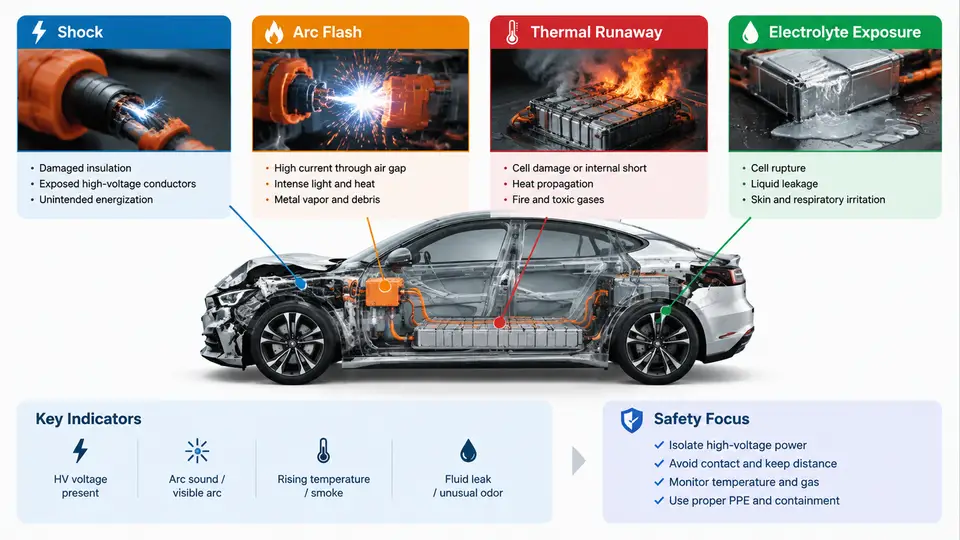
A crash does not simply damage a vehicle; it can convert a nominally safe high-voltage (HV) system into several simultaneous, interacting hazards. The 400 V or 800 V DC bus that powers the traction motor is normally isolated, interlocked, and monitored. After a collision, that protection architecture may be compromised by deformation, severed cables, coolant intrusion, or a battery module that has been mechanically crushed. This section examines the four dominant electrical hazard mechanisms — electric shock, arc flash, thermal runaway, and electrolyte exposure — as distinct physical processes, and then shows how they overlap in a real crash scenario.
Electric Shock: The DC Bus as an Exposure Source
Electric shock occurs when a conductive path forms between a live HV conductor and a person, allowing current to flow through the body. In an EV, the relevant source is the DC bus linking the battery pack, the inverter, the DC/DC converter, the on-board charger, and the HVAC compressor. Under normal operation, the high-voltage interlock loop (HVIL) and the battery management system (BMS) keep the contactors open whenever the vehicle is off or a fault is detected. In a crash, the contactors may weld closed, the HVIL circuit may be severed while the contactors remain energized, or a deformed busbar may contact the chassis.
The severity of a shock depends on current magnitude, path through the body, and duration. IEC 60479-1 provides the classic thresholds: roughly 0.5 mA is the perception threshold for AC, 10 mA can cause involuntary muscle contraction (the "let-go" threshold), and 30 mA sustained across the heart can induce ventricular fibrillation. For DC, the thresholds are somewhat higher, but at 400 V the available current through a dry-skin contact can still be lethal. The critical engineering point is that voltage alone does not determine injury — the current path and contact duration do. A technician wearing Class 0 insulating gloves (rated 1,000 V) and using a CAT III 1000 V meter is protected; a first responder touching a severed orange HV cable with a bare hand is not.
Arc Flash: When Air Becomes a Conductor
Arc flash is a distinct hazard from shock. It occurs when a high-energy electrical fault ionizes air between two conductors, creating a plasma arc that sustains current flow through the air gap. In an EV crash, arc flash can be initiated by a severed HV cable whose conductors remain close enough to strike an arc, by a crushed busbar contacting a grounded chassis, or by a battery module terminal shorting against a deformed enclosure.
The energy released in an arc flash is a function of available fault current and arc duration. A 400 V pack with an internal resistance of, say, 50 mΩ can deliver a prospective fault current of 8,000 A. If the arc persists for 100 ms before the fuse clears, the incident energy at a 300 mm working distance can exceed 10 cal/cm² — well above the 1.2 cal/cm² threshold for a second-degree burn. The arc also produces ultraviolet radiation, molten metal droplets, and a pressure wave. This is why HV battery packs use fast-acting fuses and pyrotechnic disconnects: the goal is to clear the fault in milliseconds, not seconds.
Thermal Runaway: The Self-Sustaining Failure
Thermal runaway is the most consequential crash-induced battery hazard. It begins when a lithium-ion cell is subjected to mechanical abuse — penetration, crush, or high-speed impact — that causes an internal short circuit. The short heats the cell, which triggers exothermic decomposition of the solid electrolyte interphase (SEI) layer at around 80–120 °C. Above roughly 130–150 °C, the separator melts, allowing direct contact between the anode and cathode and a massive internal short. The cell then enters a self-heating regime where the reaction rate increases with temperature, releasing more heat than can be dissipated.
The progression is typically staged: cell venting (electrolyte vapor and gas release) at 150–200 °C, cell casing rupture, and propagation to adjacent cells through direct contact, hot gas impingement, or radiant heat. A single 21700 cell contains roughly 18 Wh of energy; a 100 kWh pack contains over 5,000 such cells. Propagation can turn a localized cell failure into a pack-level fire within minutes. The key observable indicators are a sweet, solvent-like odor (electrolyte vapor), white or gray venting smoke, and a rapid temperature rise that cannot be explained by external heating.
Electrolyte Exposure: Chemical and Thermal Burns
Lithium-ion electrolyte is typically a solution of lithium hexafluorophosphate (LiPF₆) in a mixture of organic carbonates such as ethylene carbonate (EC), dimethyl carbonate (DMC), and ethyl methyl carbonate (EMC). LiPF₆ is moisture-sensitive: it reacts with water to form hydrogen fluoride (HF), a highly toxic and corrosive gas, along with phosphoryl fluoride (POF₃). The organic carbonates are flammable and can cause skin and eye irritation. In a crash, electrolyte can be released as a liquid aerosol from a ruptured cell, as a vapor from a venting cell, or as a residue on damaged pack surfaces.
Exposure routes are dermal, ocular, and inhalation. HF is particularly dangerous because it penetrates tissue and binds calcium and magnesium ions, causing systemic hypocalcemia and cardiac arrhythmia even from a small burn area. First aid for HF exposure requires immediate flushing with water and application of calcium gluconate gel, followed by urgent medical evaluation. For this reason, crash-scene responders should treat any venting or damaged battery as a potential HF source and use appropriate respiratory protection.
How the Hazards Interact
These four mechanisms are not independent. A crushed module can simultaneously create an internal short (thermal runaway), rupture the cell casing (electrolyte release), and expose live busbars (shock and arc flash). The venting gas from a runaway cell is a mixture of flammable organic carbonates and hydrogen, which can be ignited by an arc from a severed cable. HF formed when electrolyte contacts moisture in the air or on the skin adds a toxic inhalation hazard to an already dangerous scene. This is why crash-scene protocols for EVs emphasize a layered approach: secure the scene, establish an exclusion zone, verify de-energization, and monitor for thermal runaway indicators even after the vehicle appears stable.
Key Takeaways
- Shock requires a complete circuit through the body; current magnitude and path determine injury, not voltage alone. IEC 60479-1 thresholds provide the reference framework.
- Arc flash is a plasma discharge that can deliver incident energy exceeding 10 cal/cm² in under 100 ms; fast fuses and pyrotechnic disconnects are the primary mitigation.
- Thermal runaway is a self-sustaining exothermic chain starting with SEI decomposition at 80–120 °C and separator melt at 130–150 °C, propagating cell-to-cell within minutes.
- Electrolyte exposure involves flammable organic carbonates and moisture-sensitive LiPF₆, which forms toxic HF; treatment requires immediate flushing and calcium gluconate gel.
- The four hazards interact and cascade; effective crash safety design and response must address them as a coupled system, not as isolated failure modes.