1. Crash sled testing fundamentals
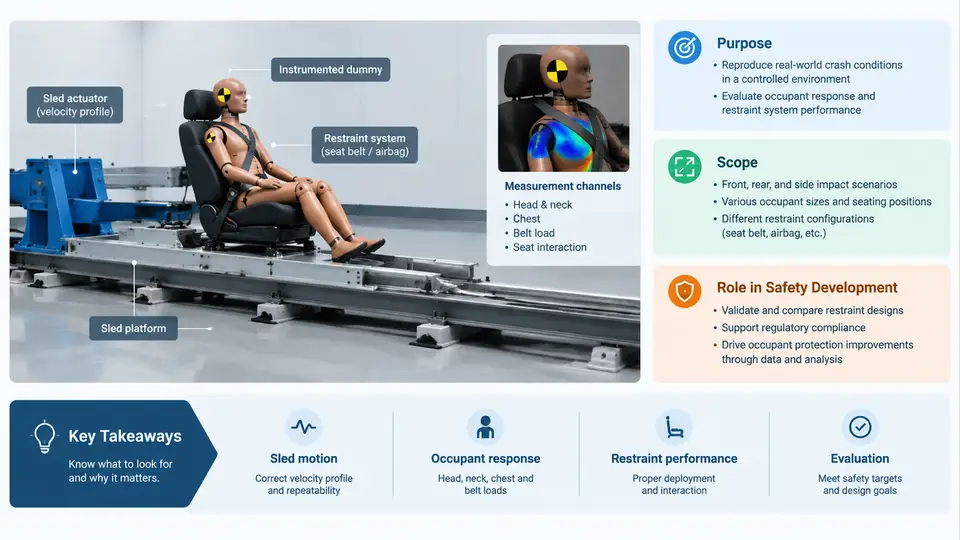
A crash sled is a ground-based dynamic test rig that reproduces the deceleration or acceleration pulse of a real vehicle crash without destroying a full vehicle body. The test article — a body-in-white buck, a seat, a steering column, an instrument panel, or a complete occupant compartment — is mounted on a carriage that is accelerated or decelerated along a straight rail. Because the pulse is programmable and the surrounding structure is controlled, the sled isolates the restraint system as the variable under investigation. This isolation is the central reason sled testing exists: it converts an expensive, noisy, one-shot vehicle crash into a repeatable experiment on the occupant restraint chain.
Why the Sled Exists in the Development Process
A full-vehicle frontal crash test consumes a complete vehicle, a test track or lab slot, and a set of instrumented dummies. It also couples many variables: body crush, engine intrusion, suspension behavior, and restraint deployment all interact. When an airbag fires late or a load limiter releases too early, the engineer cannot easily tell whether the root cause is the restraint calibration or the vehicle structure. The sled removes that ambiguity. The pulse is prescribed, the buck is rigid or deliberately crushable, and the restraint hardware is the dominant variable.
The practical consequence is iteration speed. A restraint calibration — airbag vent size, tether length, seat belt load limiter force, pretensioner stroke, anchor position — can be evaluated in a sled test within days, whereas a full-vehicle program may allow only a handful of builds. Sled testing therefore sits early in the development cycle, screening concepts before a vehicle prototype exists, and continues late as a verification tool for restraint performance.
Scope: What a Sled Test Can and Cannot Represent
The sled reproduces the occupant environment, not the whole crash event. Its scope includes:
- Restraint system performance: belt geometry, pretensioner and load limiter behavior, airbag deployment timing and pressure, knee bolster interaction, seat structure and deformation.
- Occupant kinematics: head, chest, pelvis, and lower-extremity excursion, measured with instrumented dummies and high-speed video.
- Injury criteria evaluation: HIC, chest deflection, chest acceleration (3 ms clip), femur load, and neck injury metrics compared against regulatory or internal targets.
- Out-of-position and robustness studies: small occupants, reclined postures, and deployment variability.
What it does not represent is equally important. A rigid sled buck has no engine intrusion, no pedal or toe-pan movement, and no steering column collapse driven by body deformation. A sled pulse is a one-dimensional approximation of a three-dimensional crash. Sled results therefore inform restraint design but never replace the final full-vehicle validation required by regulation and internal sign-off.
The Sled Pulse: The Primary Input
The deceleration pulse is the defining input of a sled test. It is typically derived from a full-vehicle crash accelerometer record measured at the occupant compartment (often the B-pillar or tunnel), then filtered and simplified into a sled pulse. The pulse is characterized by its peak deceleration, duration, and shape — for example, a frontal pulse might peak near 35–45 g and last 90–120 ms, while a side-impact pulse is shorter and more severe.
Sleds generate the pulse in two ways. A deceleration sled accelerates the carriage to a target velocity and then stops it with a programmable braking system — hydraulic, pneumatic, or a combination — so the test article experiences a deceleration pulse. An acceleration sled drives the carriage forward with a programmed acceleration profile, often used for rear-impact and some side-impact simulations. The choice depends on the crash mode being represented.
Pulse fidelity matters because restraint timing is pulse-dependent. A pretensioner that fires at 15 ms and an airbag that reaches full inflation at 30 ms are tuned to a specific pulse. If the sled pulse is too aggressive, the dummy loads earlier and harder; if too soft, the restraint may appear to over-perform. Engineers therefore verify the measured sled pulse against the target corridor before accepting a test as valid.
From Pulse to Occupant Response: The Measurement Chain
The sled test produces a chain of measurements that must be interpreted together. The figure below shows the signal and data flow from the prescribed pulse through the restraint system to the occupant response and the final injury assessment.
Each channel answers a different question. Carriage accelerometers confirm the pulse was delivered as intended. Dummy accelerometers and load cells quantify occupant loading. Belt load cells and airbag pressure sensors reveal how the restraint system shared that load. High-speed video shows the sequence and any anomalous interaction — a belt slipping off the shoulder, an airbag contacting the chin, or a knee missing the bolster. Injury criteria are computed from the dummy channels, but the video and restraint channels explain why a criterion was high or low.
Reading a Sled Result: A Worked Example
Consider a frontal sled test of a driver restraint system with a 50th-percentile male dummy, a target pulse peaking at 40 g over 100 ms, and a target velocity change of 56 km/h. Suppose the measured chest deflection is 42 mm against an internal target of 40 mm, while HIC is 480 (well below the 700 target) and femur loads are low. The chest result is the outlier.
The engineer examines the belt load channel. If the shoulder belt load peaks early and stays high, the load limiter may be releasing too late or at too high a force, transferring excessive energy into the chest. If the airbag pressure rises slowly, the belt may be carrying more of the load than intended. The fix is not guessed — it is derived from the channel that deviates. Reducing the load limiter force from, say, 4.0 kN to 3.5 kN and re-running the sled test would show whether chest deflection falls while HIC and excursion remain acceptable. This is the calibration loop shown in the figure.
Where Sled Testing Sits in the Safety Development Cycle
Sled testing occupies the middle of the occupant safety development cycle. Concept phase uses component and sub-system sled tests to select restraint architecture. Development phase uses sled tests to calibrate airbag and belt parameters against injury targets. Verification phase uses sled tests to confirm robustness across occupant sizes, seating positions, and pulse severities. Full-vehicle crash tests then validate the integrated system, and regulatory compliance tests confirm the final configuration.
The value of the sled is that it makes the restraint system observable and adjustable. By fixing the pulse and the surrounding structure, it turns occupant protection into a controlled experiment — one where a change in a single parameter produces a measurable change in occupant response. That is the foundation on which the rest of this course builds.