4. Occupant injury criteria and biomechanic
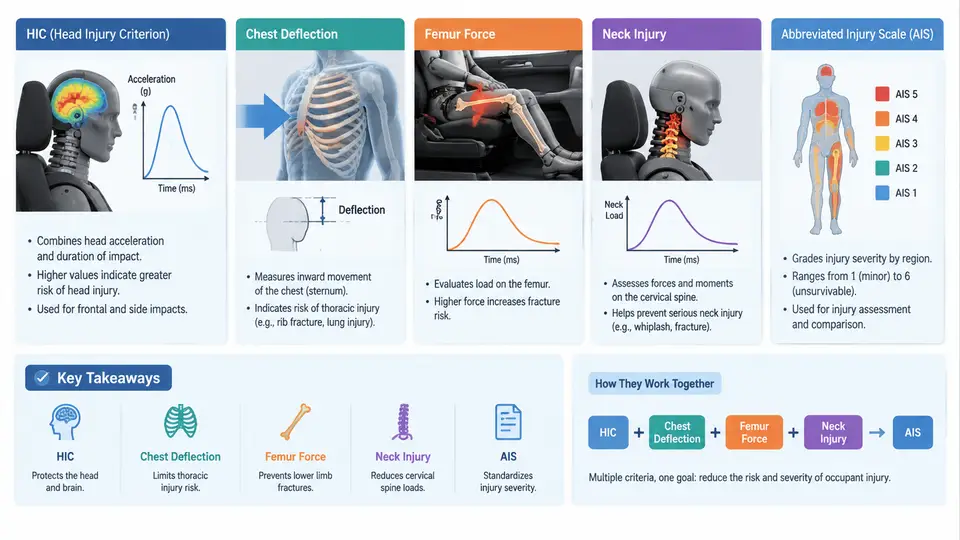
Crash safety target setting only becomes actionable when it is expressed in measurable injury metrics. A vehicle body can be stiff, a restraint system can deploy on time, and a sled test can look visually acceptable, yet the occupant may still exceed a biomechanical threshold that correlates with real-world injury. This chapter defines the principal occupant injury criteria used in frontal and side impact development — HIC, chest deflection, femur force, neck injury criteria, and the Abbreviated Injury Scale (AIS) — and explains how they are computed, what limits are typically applied, and how they are used to judge whether a design meets its targets.
From Physical Response to Injury Risk
Every injury criterion follows the same logic: a measured physical quantity (acceleration, force, deflection, moment) is transformed into a scalar index, and that index is mapped to a probability of injury at a given AIS level. The transformation is derived from cadaver, animal, and volunteer testing, plus field accident data. The resulting thresholds are statistical, not absolute — a value at the limit does not guarantee injury, and a value below it does not guarantee safety. This is why targets are usually set with margin below the regulatory or consumer-test limit.
The Abbreviated Injury Scale is the common language that ties all criteria together. AIS ranks injury severity from 1 (minor) to 6 (currently untreatable), with AIS 3 generally considered "serious." Development targets are frequently written as "no occupant exceeding AIS 3," and criteria limits are chosen because they correspond to a defined probability of AIS 3+ injury. Two derived metrics are widely used: MAIS (Maximum AIS over all body regions for one occupant) and ISS (Injury Severity Score, combining the three most severely injured regions).
Head Injury: HIC and HIC15
The Head Injury Criterion is defined as:
HIC = [ (1/(t2 - t1)) * ∫ a(t) dt ]^2.5 * (t2 - t1)
      with a(t) in g, time in seconds,
      and (t2 - t1) ≤ 15 ms for HIC15
The integral is the average resultant head acceleration over the window, and the 2.5 exponent reflects the nonlinear relationship between acceleration and brain injury. The window length is critical: HIC36 (36 ms) was the original FMVSS 208 limit of 1000, while HIC15 is now the standard for both FMVSS 208 and Euro NCAP, also limited to 1000. Because a shorter window captures sharper peaks, HIC15 is more sensitive to hard contact and is harder to pass than HIC36 for the same pulse.
In practice, HIC is computed from a triaxial accelerometer at the head center of gravity of the Hybrid III or THOR dummy. The resultant acceleration is filtered per SAE J211 Channel Frequency Class 600, then the algorithm searches all window lengths up to 15 ms for the maximum. A common development target is HIC15 ≤ 700 for a 64 km/h offset deformable barrier test, leaving margin for production variation. Typical failure symptoms include a sharp spike from steering wheel or A-pillar contact, or a late secondary peak from rebound into the seat. Troubleshooting usually focuses on airbag venting, tether geometry, and column stroke rather than on the head itself.
Chest Injury: Deflection and Viscous Criterion
Thoracic injury in frontal impact is dominated by chest deflection. A potentiometer or IR-TRACC sensor measures the sternum-to-spine displacement, and the peak value is compared to a limit. For the Hybrid III 50th percentile male, FMVSS 208 allows 63 mm of chest deflection; Euro NCAP applies a lower limit, and many OEMs target 40–50 mm. Deflection is strongly influenced by belt geometry, pretensioner force, load limiter threshold, and airbag pressure.
Because soft tissue is rate-sensitive, the Viscous Criterion (VC) combines deflection and velocity:
VC = max [ (d(t) / C) * v(t) ]
     where d = deflection, C = chest depth,
     v = deflection velocity, evaluated over any 3 ms window
VC is expressed in m/s and is typically limited to 1.0 m/s. A restraint that allows rapid chest compression — for example, an over-aggressive load limiter — can pass deflection but fail VC. This is why load limiter force level and belt payout are tuned together, not independently.
Femur Force and Knee Loading
Femur force is measured axially through the dummy's femur load cell. The FMVSS 208 limit is 10 kN per femur, and the criterion is intended to prevent femoral shaft fracture. In practice, femur force is a useful diagnostic for knee bolster performance and for occupant kinematics: excessive force usually indicates the knee is loading the bolster too early or at a poor angle, or that the lower extremity is being driven into the instrument panel. A common target is ≤ 8 kN to preserve margin. Because femur force is a direct force measurement, it is less sensitive to filtering choices than HIC, but the load cell must be zeroed and calibrated before each test.
Neck Injury: Nij and NIC
Neck injury is assessed with the Nij criterion, which combines axial force and bending moment:
Nij = (Fz / Fzc) + (My / Myc)
      where Fzc and Myc are critical values
      that depend on occupant size and load direction
Nij is evaluated in tension-extension, tension-flexion, compression-extension, and compression-flexion quadrants, each with its own critical values. The limit is Nij ≤ 1.0. In frontal impact, the dominant mode is usually tension-extension or compression-flexion depending on head contact and airbag interaction. A related metric, NIC (Neck Injury Criterion), is used in some side impact protocols. Neck injury often becomes the limiting criterion when the head is well controlled but the torso is restrained too abruptly, producing a large relative motion between head and chest.
Putting the Criteria Together
The following SVG summarizes how each measured signal maps to its criterion and limit, and how the criteria relate to AIS.
Reading the Results and Judging Compliance
After a sled or full-vehicle test, each criterion is computed from filtered channel data and compared against the target. A practical workflow is:
- Verify channel calibration and zero offsets; a drifting femur or neck load cell invalidates the result.
- Apply SAE J211 filtering — CFC 600 for head acceleration, CFC 180 for chest deflection, CFC 600 for neck and femur forces.
- Compute each criterion over its specified window and record the peak.
- Compare against both the regulatory limit and the internal target; flag any criterion above 90% of the target for review.
- If a criterion fails, trace it back to the physical cause: contact point, restraint timing, or structural intrusion.
Practical Example: Frontal 64 km/h ODB Assessment
Consider a mid-size sedan in a 64 km/h offset deformable barrier test with a Hybrid III 50th percentile male driver. Suppose the measured channels yield: head resultant peak 72 g with a 12 ms window producing HIC15 = 620; chest deflection 48 mm with VC = 0.82 m/s; left femur 6.4 kN, right femur 5.1 kN; upper neck tension 3.2 kN with My = 38 N·m giving Nij = 0.78. All criteria are below the regulatory limits and below the internal targets of HIC15 ≤ 700, deflection ≤ 50 mm, VC ≤ 0.9 m/s, femur ≤ 8 kN, Nij ≤ 0.85. The design passes, but the chest deflection at 48 mm is close to the 50 mm target, so the load limiter force level would be reviewed before sign-off. This is the normal outcome of a criteria review: not just pass/fail, but a ranking of which criteria carry the least margin and therefore drive the next design iteration.
These criteria are the bridge between the physical crash event and the injury outcome that regulations and consumers actually care about. Setting targets means choosing limits with margin, and development means tuning structure and restraints until every criterion sits comfortably inside those limits across the full range of test conditions and occupant sizes.