1. Course overview
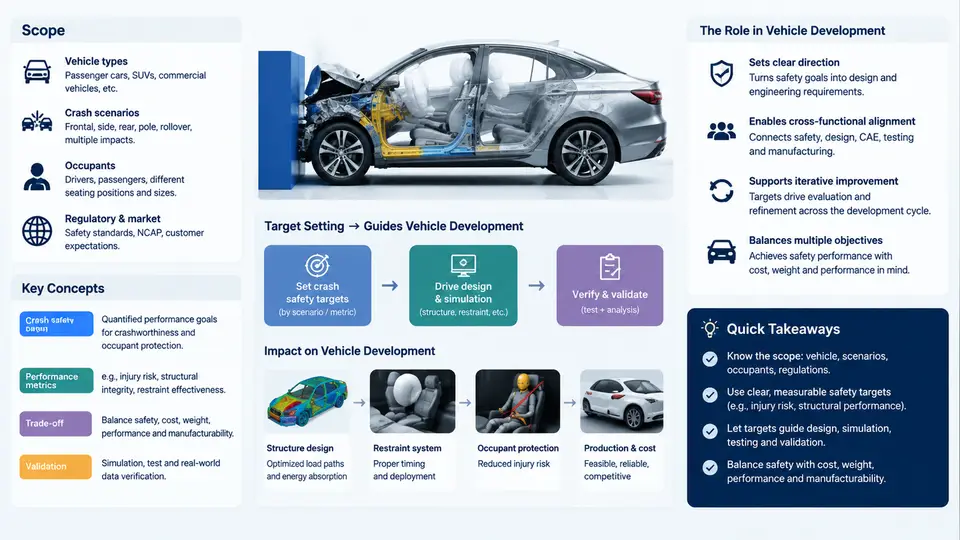
Automotive crash safety is not a single performance attribute; it is a portfolio of requirements that must be satisfied simultaneously across occupant protection, pedestrian protection, structural integrity, restraint performance, and post-crash safety. This course addresses the engineering discipline that sits before detailed design and CAE iteration: crash safety target setting — the process of translating regulatory requirements, consumer-test expectations, corporate brand positioning, and vehicle architecture constraints into quantified, verifiable engineering targets that guide the entire vehicle development program.
The scope of the course spans the full target-setting lifecycle: understanding the regulatory and consumer landscape, decomposing system-level targets into subsystem and component budgets, allocating targets across body structure, restraint systems, and energy-absorbing components, validating targets through CAE and physical testing, and managing target changes through the development timeline. By the end, you should be able to construct a defensible crash safety target cascade for a new vehicle program and defend it in a design review.
Why Target Setting Is a Distinct Engineering Discipline
A common misconception is that crash safety performance is simply "whatever the simulation produces." In practice, a vehicle program that begins CAE without a target hierarchy will iterate indefinitely, because there is no objective function to converge toward. Target setting converts ambiguous stakeholder expectations into measurable engineering quantities — peak deceleration limits, intrusion thresholds, restraint force windows, and timing budgets — that can be allocated, tracked, and verified.
Consider a concrete example. A program decides that the new mid-size SUV must achieve a 5-star Euro NCAP rating and meet FMVSS 208 and UN R94/R95 requirements. These are outcome-level goals. Target setting translates them into statements such as: "Frontal ODB (40% overlap, 64 km/h) occupant compartment intrusion at the brake pedal shall not exceed 100 mm," or "B-pillar peak deceleration during side MDB impact shall remain below 60 g at the lower measurement point." These are the quantities engineers can design against.
The Target Hierarchy: From Vehicle to Component
Crash safety targets are organized as a cascade. At the top are vehicle-level targets derived from regulation and rating. These decompose into system-level targets for the body-in-white (BIW), restraint system, steering column, seats, and fuel system. System targets further decompose into component and joint targets — for example, a front rail crush initiator force level, a spot-weld peel strength, or a seatbelt load-limiter force threshold.
The decomposition is not arbitrary. Each level must be traceable upward (does this component target support the system target?) and downward (can this system target be achieved with available components?). A target that cannot be traced to a requirement is waste; a requirement with no allocated target is a program risk.
Key Concepts You Will Use Throughout the Course
- Load path: The route by which crash energy travels from the impact point through the structure to the occupant. Target setting must ensure load paths are defined and continuous before component targets are allocated.
- Energy management: The balance between structural deformation (crush) and occupant restraint. A stiffer front end reduces intrusion but raises deceleration; a softer front end does the opposite. Targets must balance both.
- Intrusion vs. deceleration trade-off: The fundamental conflict in frontal crash design. Target setting quantifies acceptable limits for both, rather than optimizing one at the expense of the other.
- Timing budget: The sequence of events in a crash — airbag deployment, belt load limiting, column stroke — must occur within a window measured in milliseconds. Targets include timing tolerances.
- Correlation factor: The ratio between CAE-predicted and physical-test-measured values. Target setting uses historical correlation factors to set CAE targets that will produce the desired physical result.
- Target book: The controlled document that records every target, its source requirement, its verification method, and its current status. This is the single source of truth for the program.
How Target Setting Fits the Vehicle Development Timeline
Target setting begins during the concept phase, before the first CAD surface is frozen. At this stage, targets are derived from benchmarking, regulatory forecasts, and architecture studies. They are necessarily approximate but must be directionally correct.
During detailed design, targets are refined as CAE models mature. The target book is updated with correlation factors from previous programs. Component targets are released to suppliers.
During prototype and validation testing, targets are verified. Any deviation triggers a formal change process: either the design is modified, or the target is renegotiated with justification. Uncontrolled target drift is one of the most common causes of late-stage safety performance shortfalls.
What You Will Be Able to Do After This Course
By the end of the 30 chapters, you will be able to:
- Interpret regulatory and consumer-test requirements and convert them into internal engineering targets with appropriate margin.
- Construct a target cascade from vehicle level to component level, ensuring traceability in both directions.
- Apply correlation factors and statistical tolerances to set CAE targets that predict physical test outcomes.
- Facilitate target negotiation between structural, restraint, and attribute teams using quantified trade-off data.
- Maintain a target book through the development lifecycle and manage change requests with engineering evidence.
The remaining chapters will move from this overview into specific crash modes — frontal, side, rear, rollover, and pedestrian — and then into the methods, tools, and governance that make target setting effective. Each chapter builds on the cascade concept introduced here: requirements at the top, quantified targets in the middle, and verifiable component specifications at the bottom.