1. Crashworthiness optimization landscape
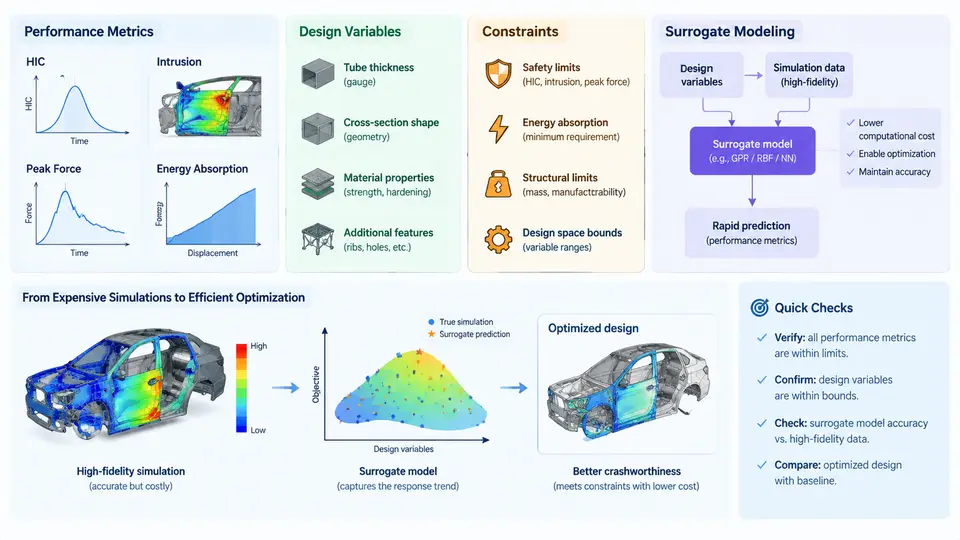
Crashworthiness optimization sits at the intersection of structural mechanics, occupant safety regulation, and computational design. Before any surrogate model is trained or any optimizer is invoked, an engineer must define what is being optimized, which quantities measure success, what can be changed, and which limits must never be violated. This chapter establishes that landscape and explains why surrogate modeling has become the enabling technology for design-space exploration in crash engineering.
Performance Metrics: The Objective Space
Crashworthiness is inherently multi-objective. A frontal impact event produces several competing responses that must be balanced simultaneously:
- HIC (Head Injury Criterion) — a scalar derived from the resultant head acceleration–time history, defined as HIC = max[(t₂ − t₁)(1/(t₂ − t₁) ∫ a dt)^2.5]. Regulatory thresholds typically sit near HIC 700–1000 depending on the load case and market. HIC is highly sensitive to short-duration acceleration spikes, so it responds strongly to changes in restraint tuning and front-end stiffness.
- Intrusion — the maximum residual deformation of the occupant compartment, measured in millimeters at defined reference points (e.g., dash panel, toe board, steering column). It is a displacement-based metric and correlates directly with injury risk from structural collapse.
- Peak force — the maximum contact force transmitted through the structure or measured on a barrier load cell. Excessive peak force drives occupant deceleration and can trigger component failure; too low a peak force may indicate insufficient energy management.
- Energy absorption (EA) — the integral of force over displacement, EA = ∫ F ds, representing the total kinetic energy dissipated by plastic deformation, fracture, and friction. Specific energy absorption (SEA = EA / mass) is the mass-normalized counterpart used in lightweight design.
These four metrics are not independent. Increasing front-rail thickness raises EA and lowers intrusion, but it also raises peak force and can worsen HIC through a harsher deceleration pulse. This coupling is precisely why crashworthiness is treated as a constrained multi-objective problem rather than a single-metric minimization.
Design Variables and Constraints
Design variables in a typical vehicle front-end study fall into three families:
| Family | Examples | Typical range |
|---|---|---|
| Geometric | Rail wall thickness, crash-box length, trigger bead depth | 1.2–3.0 mm, 80–200 mm, 0–8 mm |
| Material | Yield strength, hardening exponent, strain-rate coefficient | 280–980 MPa, 0.05–0.25, 0.001–0.05 |
| Topological | Number and position of internal ribs, foam density | 2–6 ribs, 40–120 kg/m³ |
Constraints are equally structured. They include regulatory limits (HIC ≤ 1000, intrusion ≤ 150 mm), manufacturing limits (minimum draw radius, weld access), and packaging limits (available crush distance). In optimization terms, the feasible region is the intersection of all constraint surfaces, and it is often narrow and non-convex.
Why Surrogate Modeling Is Necessary
A single high-fidelity explicit dynamic simulation of a full frontal impact — typically LS-DYNA or Radioss with 2–5 million elements — requires 4–20 CPU-hours on a modern cluster. A design-of-experiments study with 10 variables at 3 levels each would demand 3¹⁰ ≈ 59,000 runs if performed exhaustively. Even a sparse Latin hypercube of 200 samples consumes thousands of core-hours, and a genetic algorithm with 50 generations × 100 individuals would require 5,000 evaluations. Direct simulation-driven optimization is therefore computationally prohibitive.
Surrogate modeling replaces the expensive simulation with a cheap mathematical approximation. A response surface or Kriging model trained on 100–300 carefully sampled simulations can predict HIC, intrusion, peak force, and EA in milliseconds, enabling:
- Rapid design-space exploration and sensitivity analysis
- Multi-objective evolutionary optimization with thousands of evaluations
- Uncertainty quantification and robust design under material scatter
- Real-time trade-off visualization for decision makers
Workflow Overview
The standard surrogate-based crashworthiness workflow proceeds through five stages: (1) define metrics, variables, and constraints; (2) sample the design space using DOE; (3) run high-fidelity simulations; (4) fit and validate surrogate models; (5) optimize on the surrogate and verify the optimum. The SVG below maps this workflow with the specific data and decisions that flow between stages.
Practical Considerations for the First Study
When setting up an initial surrogate study, three decisions dominate the outcome quality. First, variable screening: use a screening DOE (e.g., Plackett–Burman or Morris) to eliminate variables with negligible effect before committing to a large sampling plan. Second, sampling density: a rule of thumb is 10–15 samples per active variable for Kriging; fewer than 10 per variable risks poor cross-validation R². Third, constraint handling: constraints should be modeled as separate surrogate responses (e.g., a classifier for feasible/infeasible) rather than folded into the objective, so that the optimizer can navigate the feasible boundary explicitly.
With this landscape established — metrics defined, variables bounded, constraints enumerated, and the surrogate workflow mapped — the next step is to examine how each response is extracted from simulation output and how sampling strategies are chosen to maximize information per CPU-hour.