1. Airbag deployment data landscape
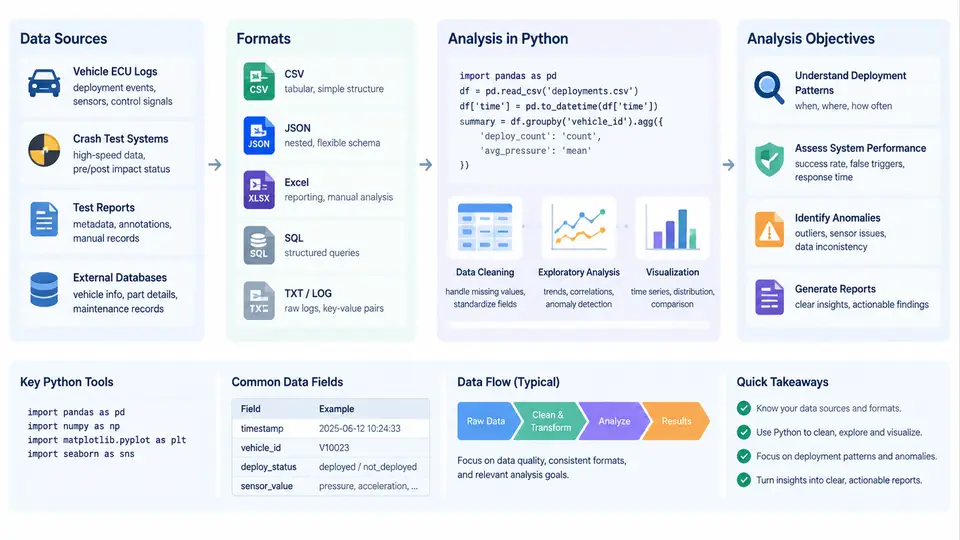
Airbag deployment analysis sits at the intersection of crash-test engineering, sensor telemetry, and data engineering. Before any Python script can compute a deployment verdict, the analyst must understand where the data originates, how it is encoded, and what questions the analysis is expected to answer. This chapter maps that landscape: the physical and logical sources of airbag data, the file formats you will encounter in a typical restraint-system workflow, and the concrete analysis objectives that Python is expected to serve.
Where Airbag Deployment Data Comes From
Airbag deployment data is not a single stream. It is assembled from several independent acquisition systems, each with its own sampling behavior and clock domain. In a typical frontal or side-impact test, the following sources contribute:
- Crash-test accelerometers and the ACU (Airbag Control Unit): The ACU samples internal and remote accelerometers, performs crash discrimination, and issues the deployment command. Its internal log records the decision timeline, arming status, and squib firing commands.
- High-speed video and event cameras: Frame-stamped imagery of bag inflation, used to correlate the physical deployment with the electrical command.
- Occupant and bag pressure sensors: Pressure traces inside the inflator or bag, plus seat-track and belt-load sensors that influence suppression logic.
- Vehicle bus logs (CAN / CAN FD / FlexRay): Broadcast frames carrying airbag status, warning-lamp state, and diagnostic trouble codes.
- Bench and HiL rigs: When a full vehicle is unavailable, a hardware-in-the-loop rig replays recorded crash pulses into a real ACU and captures its response.
Each source has a different time base. Accelerometer channels may be sampled at 10–20 kHz, CAN frames arrive at 1–10 ms intervals, and video runs at 1,000–10,000 fps. A central task in Python is therefore time alignment: bringing all channels onto a common reference, usually the ACU's trigger or the first significant acceleration event.
Formats You Will Actually Parse
Airbag data arrives in a small number of recurring formats. Recognizing them early determines your parsing strategy.
| Format | Typical Origin | Python Handling |
|---|---|---|
| MDF4 (.mf4) | Vector/ETAS loggers, ACU bench tools | asammdf, mdfreader |
| CSV / TSV | Exported channel dumps, lab spreadsheets | pandas.read_csv |
| BLF / ASC | CAN and CAN FD bus captures | python-can with BLF/ASC readers |
| HDF5 (.h5) | Consolidated multi-rate test archives | h5py, pandas.HDFStore |
| Binary DBC-decoded frames | Raw bus payloads plus a DBC database | cantools + python-can |
| Video (MP4 / raw) | High-speed cameras | opencv-python, imageio |
MDF4 is the de facto standard for measurement data because it stores channel groups, units, and comments alongside the samples. A single .mf4 file may contain dozens of channels at different sampling rates, so the first Python step is usually to enumerate channels and their metadata rather than to load everything blindly.
from asammdf import MDF

mdf = MDF("crash_2024_0173.mf4")
for ch in mdf.channels_db:
    print(ch)
# Example output (illustrative):
# ACC_X_ACU, ACC_Y_ACU, ACC_X_B_PILLAR, SQUIB_CMD_DRIVER,
# SQUIB_CMD_PASSENGER, ARMED, CRASH_DETECTED, VEH_SPEED_CAN
The channel names above are representative of a real naming convention, but the exact set depends on the test configuration. Always confirm units and polarity from the file metadata before interpreting a trace.
Analysis Objectives
Once the data is loaded, the analysis is driven by a small set of engineering questions. These objectives shape every downstream script:
- Did deployment occur, and when? Determine the time of the squib command relative to the crash trigger, and compare it against the required deployment window (often expressed as a time-after-trigger band).
- Was the decision correct? Verify that the ACU fired for a valid crash and suppressed for a non-deploy event, using the recorded arming and discrimination flags.
- How did the physical event evolve? Correlate acceleration, pressure, and video to characterize inflation timing and bag performance.
- Are there anomalies? Detect missing frames, out-of-range values, clock drift, or inconsistent channel counts that indicate a logging fault rather than a vehicle fault.
- Can the result be reproduced and reported? Produce a deterministic, versioned report so that a reviewer can re-run the same analysis on the same file and obtain the same verdict.
These objectives are not independent. A timing question (objective 1) depends on correct time alignment, which depends on anomaly detection (objective 4). A robust Python pipeline therefore treats them as a sequence of verifiable stages rather than a single monolithic script.
A Reference Data Flow
The diagram below shows how the sources, formats, and objectives connect in a typical Python analysis pipeline. It is a data-flow view, not a step-by-step procedure: the emphasis is on which artifact feeds which stage and where the analysis objectives are evaluated.
The dashed feedback path is deliberate: a failed timing check often reveals a logging or alignment problem rather than a restraint-system fault, so the verdict stage must be able to send the analyst back to the anomaly stage with a specific channel and time window to re-examine.
Practical Considerations Before Writing Code
Three habits prevent most downstream errors. First, never assume a fixed channel list. Enumerate channels from the file and fail loudly if an expected channel is missing, rather than silently producing a partial result. Second, record units and polarity at load time. An acceleration channel stored in g versus m/s² changes every threshold comparison. Third, keep the raw file immutable. All cleaning, resampling, and alignment should produce new in-memory or derived artifacts, so that any result can be traced back to the original recording.
With this landscape established, the remaining chapters can focus on the mechanics: parsing each format, aligning clocks, computing timing metrics, and packaging the verdict into a reproducible report. The key takeaway from this chapter is that airbag deployment analysis is a multi-source, multi-rate data problem, and Python's role is to make that heterogeneity explicit and controllable rather than hidden inside a single opaque script.