1. Introduction to human body models in occ
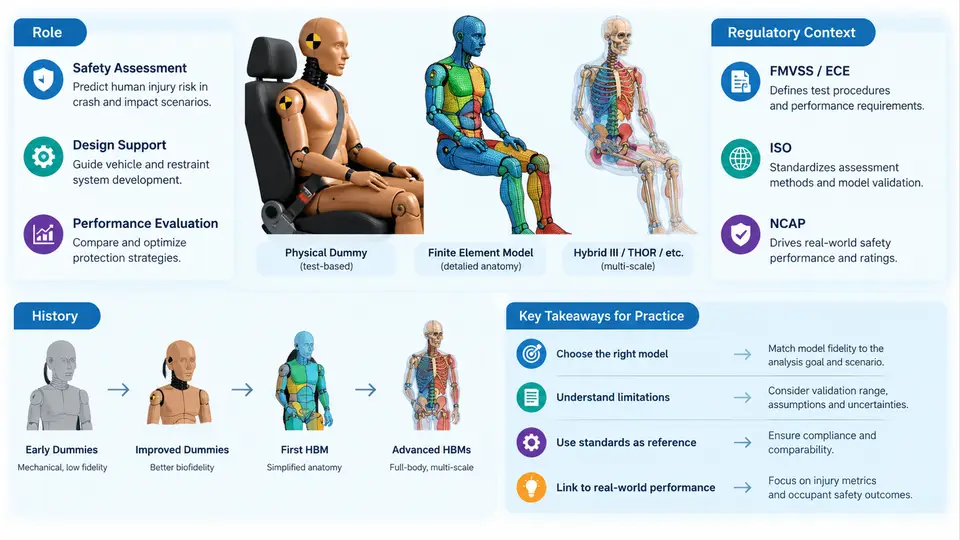
What a Human Body Model Is — and What It Is Not
In occupant protection engineering, a Human Body Model (HBM) is a computational or physical representation of the human body that predicts its kinematic response and injury outcome under crash loading. The term covers two distinct families of tools that are often confused:
- Physical ATDs (Anthropomorphic Test Devices) — instrumented mechanical surrogates such as the Hybrid III 50th percentile male, the THOR-50M, or the Q-series child dummies. They output measurable channels (accelerations, forces, moments, deflections) that map to regulatory injury criteria.
- Digital HBMs — finite element (FE) or multibody models of human anatomy, such as THUMS, GHBMC, SAFER HBM, or the VIVA+ open-source family. They output the same physical channels plus internal tissue-level quantities: strain, stress, and strain rate in brain, liver, aorta, or rib cortical bone.
The critical distinction is that an ATD is a measurement instrument calibrated to correlate with injury risk, whereas a digital HBM is a predictive biomechanical model whose validity depends on the constitutive laws, mesh resolution, and material parameters assigned to each tissue. An HBM is not a crash test dummy rendered in software; it is a numerical hypothesis about how living tissue deforms and fails.
Why Occupant Protection Needs HBMs
ATDs were designed around a narrow population: the 50th percentile male, and later the 5th percentile female and a set of child sizes. Real occupants span a far wider range of stature, mass, age, bone quality, and body composition. A 78-year-old female with osteoporotic ribs and a 22-year-old male athlete can experience the same belt loading and sustain very different injuries. ATDs cannot represent this variability because their structure is fixed.
HBMs address three limitations that ATDs cannot:
- Population variability. Model geometry and material properties can be morphed to match a target stature, BMI, age, or bone mineral density, producing a subject-specific model rather than a percentile surrogate.
- Internal injury prediction. ATDs measure external boundary conditions. HBMs predict where and how tissue fails — diffuse axonal injury from brain strain, aortic rupture from vessel wall stress, rib fracture from cortical bone strain.
- Design-space exploration. Once validated, an HBM can be run across hundreds of crash pulse and restraint configurations before a single physical prototype is built, shifting restraint tuning earlier in the vehicle development cycle.
A Short History of the Field
The lineage runs from cadaveric testing through mechanical surrogates to numerical anatomy:
| Era | Milestone | Significance |
|---|---|---|
| 1960s–1970s | Hybrid I / Hybrid II / Hybrid III ATD development | Established repeatable, instrumented surrogates and the frontal impact test protocol. |
| 1980s–1990s | Early FE head and thorax models; cadaveric impact corridors | Provided the material properties and validation data that later HBMs depend on. |
| 2000s | THUMS, GHBMC, and SAFER HBM released | Full-body FE models with organ-level detail became commercially and academically available. |
| 2010s–present | Open-source VIVA+ / PIPER; morphed population libraries | Lowered entry barriers and enabled large-scale population studies. |
Each generation inherited the validation burden of the previous one. Modern HBMs are only as credible as the cadaveric and volunteer data used to calibrate their tissue properties and the PMHS (post-mortem human subject) tests used to validate their whole-body response.
Regulatory and Assessment Context
HBMs currently occupy a supporting rather than a primary role in regulation. Frontal and side impact regulations (FMVSS 208, UN R94/R95, and the Euro NCAP and C-NCAP consumer protocols) are still written around ATD-based criteria: HIC15, Nij, chest deflection, and femur force. HBMs appear in three places:
- Virtual testing frameworks. Euro NCAP and UN informal working groups have developed virtual testing procedures where a validated HBM may supplement or, in specific load cases, substitute for a physical test.
- Research and pre-regulatory assessment. NHTSA, Transport Canada, and the European Commission fund HBM studies to evaluate injury mechanisms not captured by ATD criteria, such as brain strain in oblique loading.
- OEM internal development. Most major vehicle manufacturers run HBMs as a design tool long before a regulatory test is performed, using them to rank restraint concepts.
How the Pieces Fit Together
The diagram below shows the relationship between the physical and digital branches of the field, and where each feeds into regulation and design. Read it left to right: the data sources on the left supply the material properties and validation corridors that make the models on the right credible.
What This Means in Practice
When you open an HBM in LS-DYNA or PAM-CRASH, you are not looking at a validated predictor of injury. You are looking at a model that has been validated for a specific set of load cases, boundary conditions, and output metrics. Before using it, establish four things:
- Which model version and which validation matrix. A model validated for frontal sled pulses may not be validated for lateral or oblique loading.
- Which output channels map to your injury question. If you care about rib fracture, you need cortical bone strain output, not just chest deflection.
- Which population the model represents. A 50th percentile male model morphed to a 5th percentile female changes mass distribution and geometry; confirm the morphing was validated.
- Which criteria and thresholds apply. Strain-based thresholds differ between tissues and between research groups; cite the source.
The rest of this course builds on this foundation: model architecture and material laws, positioning and boundary conditions, validation methodology, population morphing, and the practical workflow of running an HBM study from setup to injury interpretation.