4. Retractor fundamentals
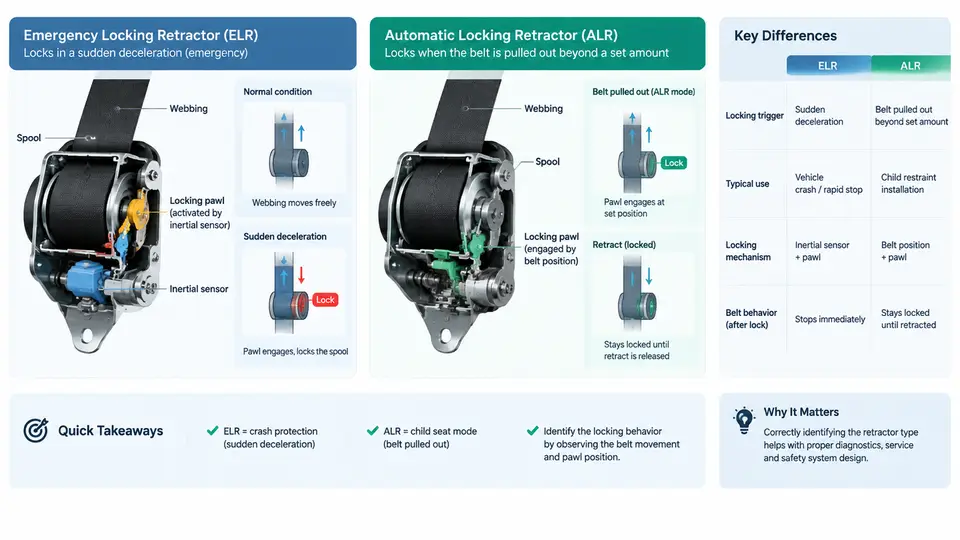
The retractor is the energy-management and stowage core of a three-point seatbelt system. It must do two contradictory things well: pay webbing out freely enough for an occupant to move and buckle up comfortably, yet lock instantly when the vehicle decelerates or the occupant loads the belt. Two dominant mechanisms solve this problem — the Emergency Locking Retractor (ELR) and the Automatic Locking Retractor (ALR). Understanding how each senses and reacts is essential before specifying, tuning, or diagnosing a restraint system.
What the Retractor Must Achieve
Every retractor shares a common architecture: a spool carrying wound webbing, a rewind spring that retracts slack, a locking pawl that engages ratchet teeth on the spool or a locking plate, and a sensing element that triggers the pawl. The difference between ELR and ALR lies almost entirely in what triggers locking and how long the lock persists.
- ELR: locks only during a crash or hard maneuver, then releases when the event ends. Normal movement is unrestricted.
- ALR: locks continuously once webbing is pulled out past a threshold, converting the belt into a fixed-length restraint. It releases only when webbing is fully retracted.
Most modern front outboard retractors are dual-mode (ELR/ALR switchable): they behave as ELR during normal use but switch to ALR when webbing is withdrawn to the end of travel — the classic behavior used to secure a child restraint.
Emergency Locking Retractor: Two Independent Sensors
An ELR relies on two parallel sensing paths, either of which can fire the locking pawl. This redundancy is deliberate: a vehicle-sensing trigger catches crash deceleration, while a webbing-sensing trigger catches rapid occupant movement.
Vehicle sensor (G-sensor / inertia sensor). A pendulum or ball-in-cage sits in a shallow seat. Under longitudinal or lateral deceleration above a threshold — typically on the order of 0.3–0.45 g for the vehicle-sensing element — the mass tips out of its seat and displaces a pilot lever. That lever releases the locking pawl into the ratchet teeth. Because the sensor responds to acceleration, it locks even if the occupant is not moving relative to the belt.
Webbing sensor (web-sensitive / spool-speed sensor). A centrifugally actuated flyweight or an inertia disc is coupled to the spool. When webbing is extracted rapidly — above roughly 1.0–1.5 m/s of web speed — centrifugal force throws the flyweight outward, tripping the same pawl. This catches the case where the occupant pitches forward faster than the vehicle decelerates, or where the belt is yanked.
Once the pawl engages, the spool is locked to the retractor frame, and further webbing payout is prevented. Load then transfers through the webbing, tongue, buckle, and anchor points. When the event ends and the pawl is released (by spring return or by the sensor mass reseating), the belt retracts normally.
Automatic Locking Retractor: Continuous Locking
An ALR adds a mechanism that latches the spool once a defined length of webbing has been withdrawn. The common implementation is a switchable pawl or locking bar actuated by spool rotation count. Pull the webbing out to (or near) the end of its travel, and a cam or lever drops the ALR pawl into engagement. From that point the spool can retract but cannot pay out — the belt becomes a one-way ratchet.
The practical consequence: to secure a child restraint, the installer pulls the belt fully out until it clicks into ALR mode, routes it through the child seat, and lets it retract. The retractor takes up slack but refuses to give it back, holding the child seat firmly. To release, the belt must be unbuckled and allowed to retract completely, which resets the ALR pawl.
| Characteristic | ELR | ALR |
|---|---|---|
| Lock trigger | Deceleration (G-sensor) or rapid web pull (web sensor) | Webbing withdrawn past a length threshold |
| Lock duration | Transient — only during the event | Continuous until full retraction |
| Normal occupant freedom | Full | None once engaged |
| Typical use | Adult seating positions | Child restraint installation |
| Release method | Automatic after event | Full retraction of webbing |
How the Two Modes Interact in a Dual-Mode Retractor
In a dual-mode unit, the ELR sensing elements remain active at all times. The ALR pawl is an additional layer. This means a belt in ALR mode is still crash-protected: if a collision occurs while the belt is locked in ALR, the ELR pawl engages as well, and the load path is identical. The ALR simply prevents payout during the pre-crash phase.
Designers must manage a subtlety: the ALR engagement threshold must be high enough that ordinary occupant reach does not accidentally trigger it, yet low enough that a child seat can be installed without excessive effort. A typical threshold is reached when roughly 75–90% of the webbing is extracted, though this varies by spool diameter and webbing length.
Practical Verification and Diagnosis
When validating a retractor on the bench or in a vehicle, the two modes are checked separately. For ELR, technicians use a deceleration sled or a hand-operated pull test: a sharp tug on the webbing should lock the spool within a few centimeters of payout. A slow, steady pull should not lock. For the G-sensor path, a tilt or acceleration fixture confirms the pendulum releases at the specified threshold.
For ALR, the check is simpler: pull the webbing out slowly to the end of travel, listen for the audible click of the ALR pawl, then release. The belt should retract but resist any attempt to pull it back out. If the belt pays out freely after full extraction, the ALR cam or pawl is stuck or the spool was not rotated far enough to trip it. If the belt locks during normal reach, the ALR threshold is set too low or the pawl is not resetting on retraction.
Design and Specification Notes
When writing a retractor specification, the following parameters should be defined explicitly rather than left to the supplier's default:
- ELR G-sensor threshold: the deceleration level at which the vehicle sensor trips, with tolerance band.
- ELR web-sensor threshold: the webbing extraction speed that trips the centrifugal element.
- ALR engagement point: the percentage of webbing travel at which the ALR pawl latches.
- ALR release condition: the retraction state that resets the pawl (typically full retraction).
- Locking distance: maximum webbing payout after trigger before the spool is fully locked — a key crash-performance parameter.
These values interact with occupant size, seating position, and the child restraint interface. A retractor tuned for a large adult may require more webbing travel to reach ALR, which can make child seat installation awkward. Conversely, a low ALR threshold improves child seat security but risks nuisance locking during normal occupant movement. The engineering task is to find the window that satisfies both, then verify it with the tests described above.
In summary, the ELR protects the occupant by locking only when a crash or sudden motion demands it, preserving comfort and freedom at all other times. The ALR sacrifices that freedom deliberately, converting the belt into a fixed restraint for child seat installation. Dual-mode retractors combine both, and the engineer's job is to specify and verify the thresholds that let each mode do its job without interfering with the other.