4. Occupant biomechanics and injury criteri
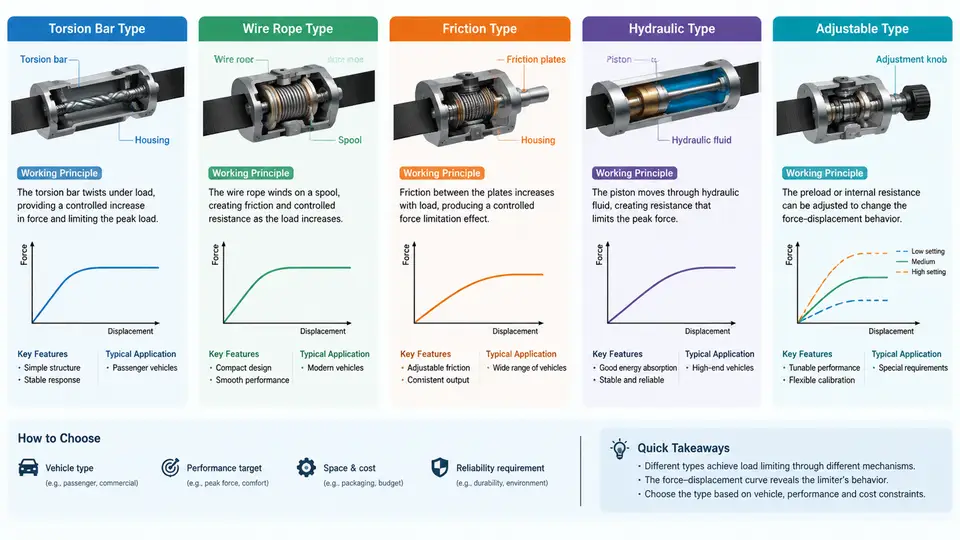
A load limiter is only as good as the injury criteria used to judge it. The restraint engineer's task is not simply to cap the shoulder belt force at some convenient value, but to shape the force–deflection response so that the occupant's chest, head, and pelvis stay inside defensible biomechanical corridors. This section establishes the four criteria that dominate load limiter work — chest deflection, rib fracture risk, HIC, and chest acceleration — and explains how each one responds when the limiter force level is changed.
Why the Chest Is the Limiting Structure
In a frontal crash, the shoulder belt concentrates its load over the sternum and the underlying rib cage. The spine and pelvis tolerate far higher accelerations than the thorax, so the chest becomes the governing structure for belt force. Two mechanisms matter:
- Rib deflection — the sternum is displaced rearward relative to the spine, bending the ribs. Beyond roughly 20–25% of the chest's initial depth, rib fracture probability rises steeply.
- Viscous loading — the product of deflection velocity and compression. A fast, shallow deflection can be as injurious as a slow, deep one, which is why soft, early force limiting is generally preferable to a late, abrupt plateau.
This is the physical reason a load limiter exists: it trades a controlled increase in occupant forward excursion for a reduction in peak belt force and therefore peak chest compression.
The Four Governing Criteria
| Criterion | Physical quantity | Typical reference limit | Response to a lower limiter force |
|---|---|---|---|
| Chest deflection | Peak sternum-to-spine displacement, mm or % of chest depth | ≈ 63 mm (Hybrid III 50th); ≈ 22% compression | Decreases monotonically |
| Rib fracture risk | Age- and deflection-dependent probability | AIS 3+ probability kept low | Decreases, but with diminishing returns |
| HIC | Resultant head acceleration integral over 15 ms | HIC15 = 700 (FMVSS 208) | Decreases until head contact occurs, then rises |
| Chest acceleration | Peak resultant acceleration at the sternum | ≈ 60 g (3 ms clip) | Decreases with limiter force |
Note the non-monotonic behaviour of HIC. Lowering the limiter force reduces chest loading but increases forward excursion, which brings the head closer to the steering wheel, instrument panel, or an airbag that has already begun to deflate. The optimum is therefore an interior point, not an endpoint.
How the Criteria Are Computed
Chest deflection is measured with a chest potentiometer or IR-TRACC in the crash dummy. The raw signal is the sternum displacement relative to the spine; it is normalised by the chest depth measured before the test:
compression_pct = (deflection_mm / chest_depth_mm) * 100

# Example (illustrative values, not measured data)
deflection_mm  = 52.0
chest_depth_mm = 240.0
compression_pct = 52.0 / 240.0 * 100   # = 21.7 %
HIC is computed from the resultant head acceleration a(t) in g over any window of duration T, with the standard 15 ms window:
HIC = max over t1,t2 of [ (t2 - t1) * ( 1/(t2-t1) * ∫ a(t) dt )^2.5 ]
      with t2 - t1 <= 15 ms
Chest acceleration is filtered per SAE J211 channel class (CFC 180 for the chest, CFC 1000 for the head) before the 3 ms clip is taken. Filtering is not cosmetic: an unfiltered signal will overstate the peak and mislead the calibration.
Reading the Trade-off Graphically
The figure below shows how the four criteria move as the limiter force is swept from a stiff setting to a soft one. The chest-related curves fall monotonically; HIC passes through a minimum. The usable design window is the overlap where all four criteria remain below their limits.
From Criteria to a Limiter Setting
A practical calibration loop proceeds as follows. Start from a baseline plateau force, for example 4.0 kN, and run a sled matrix at 56 km/h with the 50th-percentile Hybrid III. Extract the four criteria. If chest deflection exceeds 63 mm, reduce the plateau in 0.5 kN steps. If HIC climbs above 700 because the head is reaching the wheel, do not simply stiffen the belt — instead consider a progressive limiter, a higher initial force followed by a lower plateau, or a switchable limiter that responds to occupant size.
Two failure symptoms are worth memorising. First, chest deflection improves while HIC worsens: the limiter is too soft for the available ride-down distance, and the fix is a two-stage force profile rather than a single plateau. Second, both chest deflection and HIC stay flat as force is reduced: the belt is bottoming out on the retractor or the pretensioner has already consumed the slack, so the limiter is no longer the controlling element.
With these four criteria understood and their trade-offs mapped, the next step is to translate them into a concrete force–deflection target for the limiter element itself.