4. Regulatory and consumer rating requireme
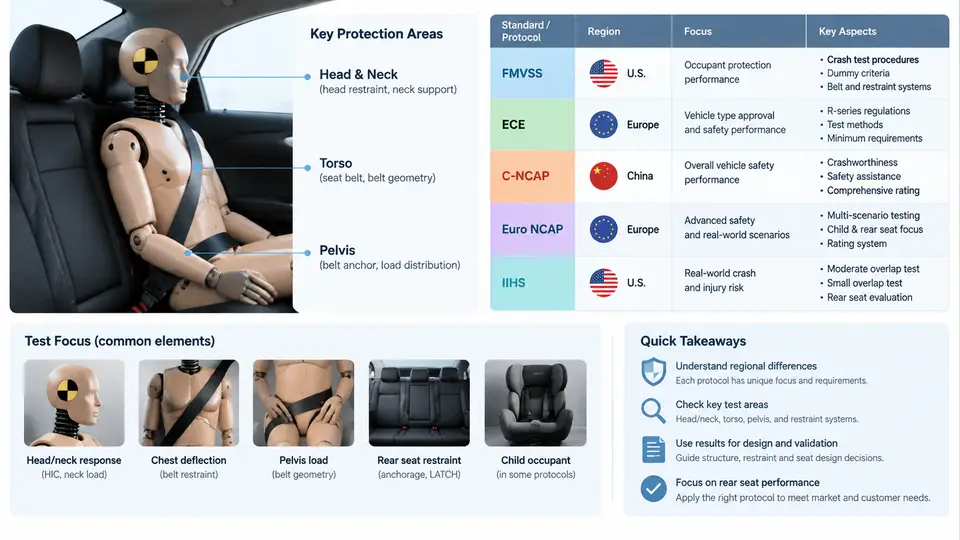
Rear seat occupant protection is governed by two parallel systems: mandatory regulations that set a legal minimum, and consumer rating programs that push manufacturers beyond that minimum. For an engineer working on rear seat restraint systems, understanding both is essential because they define the test matrix, the injury criteria, and the pass/fail thresholds that shape every design decision. This chapter maps the five most influential protocols — FMVSS, ECE, C-NCAP, Euro NCAP, and IIHS — and explains how they differ in scope, loading conditions, and evaluation criteria for rear occupants.
Mandatory Regulations: FMVSS and ECE
FMVSS 208 (Federal Motor Vehicle Safety Standard 208) is the primary U.S. regulation for occupant crash protection. It requires frontal impact testing at 56 km/h into a rigid barrier, with belted and unbelted test configurations. For rear seats, the key requirement is that occupants must not exceed specified injury thresholds, and the seat must remain structurally intact. FMVSS 208 also mandates that rear seating positions be equipped with lap/shoulder belts and that child restraint anchorage systems (LATCH) be provided at designated positions.
FMVSS 207 governs seat anchorage strength, requiring that each seat assembly withstand a 20×g static load applied horizontally and a 20×g load applied vertically. FMVSS 225 specifies LATCH anchorage geometry and strength, with lower anchorages required to withstand 11 kN and tether anchorages 15 kN. These structural requirements are particularly relevant to rear seats because they determine how the seat transfers crash loads into the body structure.
ECE R94 (Economic Commission for Europe Regulation 94) is the European equivalent for frontal impact, testing at 56 km/h into a deformable barrier with 40% overlap. ECE R95 covers side impact at 50 km/h with a deformable moving barrier. Unlike FMVSS, ECE regulations require the use of a 50th percentile male Hybrid III dummy in the driver position and a 5th percentile female dummy in the passenger position, with rear seat evaluation typically using the 5th percentile female or child dummies depending on the test configuration.
Consumer Rating Programs: Euro NCAP, C-NCAP, and IIHS
Consumer rating programs are voluntary but carry enormous market weight. They typically use more severe or more diverse test conditions than regulations and provide star ratings that directly influence purchase decisions.
Euro NCAP evaluates rear seat protection through its frontal offset test (50 km/h, 50% overlap into deformable barrier), side impact test (60 km/h moving deformable barrier), and far-side impact test. Since 2020, Euro NCAP has placed increased emphasis on rear occupant protection, including the use of the 5th percentile female dummy in the rear seat and the Q-series child dummies. The assessment includes head, neck, chest, and pelvis injury criteria, with particular attention to submarining — the tendency of the occupant to slide under the lap belt.
C-NCAP (China New Car Assessment Program) has evolved significantly. The 2021 version introduced a 50 km/h frontal 100% overlap rigid barrier test and a 64 km/h frontal 40% overlap deformable barrier test, both evaluating rear seat occupants. C-NCAP uses the Hybrid III 50th percentile male in the driver seat and the 5th percentile female in the rear seat for frontal tests. Side impact testing is conducted at 60 km/h with a moving deformable barrier. C-NCAP also includes a whiplash test and a child restraint evaluation, both of which affect rear seat scores.
IIHS (Insurance Institute for Highway Safety) is known for its stringent evaluations. The moderate overlap frontal test (64 km/h, 40% overlap) and the side impact test (60 km/h, 1,500 kg moving barrier) both include rear occupant assessment. IIHS introduced a updated side impact test in 2021 with a heavier barrier (1,900 kg) and higher speed (60 km/h), significantly increasing the load on rear seat structures. IIHS also conducts a rear seat evaluation in its frontal tests, using a 5th percentile female dummy in the rear seat and measuring head, neck, chest, and femur loads.
Comparative Test Matrix and Injury Criteria
The following table summarizes the key differences in rear seat evaluation across the five protocols:
| Protocol | Test Type | Speed (km/h) | Rear Dummy | Key Injury Criteria |
|---|---|---|---|---|
| FMVSS 208 | Frontal rigid barrier | 56 | Hybrid III 5th female | HIC, chest deflection, femur load |
| ECE R94 | Frontal offset deformable | 56 | Hybrid III 5th female | HIC, chest deflection, femur load |
| Euro NCAP | Frontal offset + side | 50 / 60 | Q-series child / 5th female | HIC, neck tension, chest compression, submarining |
| C-NCAP | Frontal 100% + 40% offset | 50 / 64 | Hybrid III 5th female | HIC, chest deflection, femur load |
| IIHS | Moderate overlap + side | 64 / 60 | Hybrid III 5th female | HIC, neck injury, chest deflection, femur load |
Injury criteria are not arbitrary — they are derived from biomechanical research. HIC (Head Injury Criterion) is calculated as:
HIC = (t2 - t1) * [ (1/(t2-t1)) * ∫ a(t) dt ]^2.5where a(t) is the resultant head acceleration in g, and t1 and t2 are the times bounding the interval that maximizes HIC. The threshold for a 50% risk of AIS 3+ head injury is approximately HIC = 700 for a 15 ms interval. Chest deflection limits are typically 50 mm for the 5th percentile female, and femur load limits are 3.8 kN for axial compression.
Engineering Implications for Rear Seat Design
The differences between these protocols create a complex design space. A rear seat that performs well in FMVSS 208 (unbelted occupant) may not perform optimally in Euro NCAP (belted occupant with submarining evaluation). The key design levers are:
- Seat cushion geometry: The angle and stiffness of the cushion affect submarining risk. A higher cushion angle (more reclined) reduces submarining but may increase chest deflection.
- Belt geometry: The lap belt anchor position and the buckle stalk length determine belt fit. A lap belt that sits too high on the abdomen increases submarining risk; too low increases pelvis loading.
- Seat structure: The seat frame and recliner must withstand the loads from both belted and unbelted occupants. FMVSS 207 requires 20×g static loads, but dynamic tests can produce higher forces.
- Head restraint: Rear head restraints must be positioned to limit head excursion and neck injury. Euro NCAP and IIHS both evaluate whiplash protection.
Visualizing the Protocol Landscape
The following SVG maps the five protocols by their test type, speed, and rear occupant focus, helping you see at a glance which conditions are most demanding for rear seat design.
The matrix reveals a clear trend: consumer rating programs are increasingly demanding for rear occupants, with IIHS and Euro NCAP pushing speeds and barrier masses higher than regulatory minimums. For rear seat engineers, the practical takeaway is to design for the most severe consumer protocol while ensuring regulatory compliance — a strategy that future-proofs the design against further tightening of standards.