4. Injury biomechanics for OOP
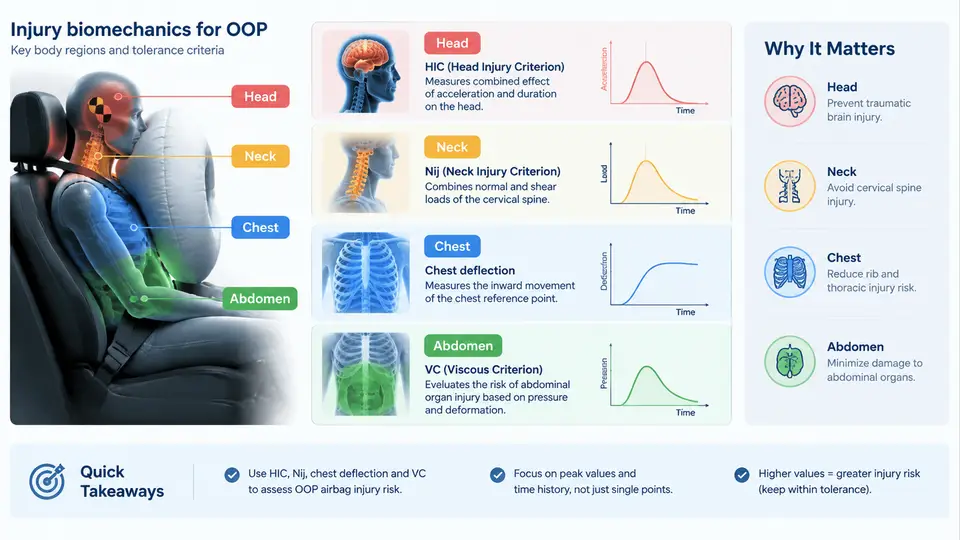
Out-of-position (OOP) occupant protection is fundamentally a tolerance problem. When an occupant sits close to or against an airbag module, the deploying cushion can strike the head, neck, chest, or abdomen before the occupant has been displaced rearward by the restraint system. The injury risk in this scenario is governed not by crash pulse severity alone, but by the local mechanical loading delivered by the inflating bag. To engineer against that risk, we need quantitative tolerance criteria that translate physical loading into a normalized injury metric. This chapter covers the four criteria most frequently used in OOP assessment: HIC for head, Nij for neck, chest deflection for thorax, and viscous criterion (VC) for soft tissue and abdominal loading.
Head: HIC and HIC15
The Head Injury Criterion (HIC) is defined as:
HIC = max over t1,t2 of [ (1/(t2-t1)) * ∫ a(t) dt ]^2.5 * (t2-t1)
where a(t) is the resultant head CG acceleration in g,
and t2 - t1 is the integration window in seconds.
For OOP airbag loading, the relevant variant is HIC15, which constrains the integration window to 15 ms. This is critical because airbag deployment produces a short, high-magnitude acceleration pulse — often 100–250 g over 5–15 ms — that a 36 ms HIC window would artificially dilute. The FMVSS 208 OOP test protocol and most OEM specifications therefore use HIC15 with a limit of 700 for the 50th-percentile male dummy in near-module positions. A typical deployment pulse might show peak resultant acceleration of 180 g at 8 ms, with the 15 ms window capturing the full energy transfer. If HIC15 exceeds 700, the countermeasure is usually to reduce bag aggressiveness through venting, tethering, or adaptive deployment pressure.
Neck: Nij and Its Four Load Channels
Neck injury in OOP loading is dominated by combined axial and bending loads. The Nij criterion normalizes four load channels against their respective tolerances:
Nij = Fz / Fzc + My / Myc

where Fz  = axial force (tension or compression)
      My  = bending moment (flexion or extension)
      Fzc = critical axial force (e.g., 4.0 kN tension, 4.0 kN compression)
      Myc = critical moment (e.g., 57 Nm extension, 88 Nm flexion)
The subscript "ij" denotes that the index is computed for each of four combinations: tension-extension (Nte), tension-flexion (Ntf), compression-extension (Nce), and compression-flexion (Ncf). The critical values are dummy-specific; for the THOR dummy, for example, Fzc is approximately 3.6 kN in tension and 4.0 kN in compression, while Myc is 57 Nm in extension and 88 Nm in flexion. A Nij value of 1.0 indicates the combined load reaches the tolerance boundary. In OOP airbag loading, the neck typically experiences compression-flexion (Ncf) as the deploying bag pushes the head rearward while the torso remains constrained. A practical acceptance limit for OOP is Nij ≤ 1.0, though some OEMs apply a safety factor of 0.8.
Chest: Deflection and the VC Criterion
Thoracic injury under airbag loading is driven by both compression and the rate of compression. The two primary metrics are:
- Chest deflection — the peak sternum-to-spine displacement, typically measured in millimeters. For the 50th-percentile male, the accepted tolerance is 63 mm (approximately 40% of chest depth). For the 5th-percentile female, the limit scales to roughly 50 mm.
- Viscous Criterion (VC) — the product of instantaneous chest compression velocity and the normalized compression (deformation divided by original chest depth):
VC = V(t) * C(t) = [dD(t)/dt] * [D(t) / D_original]

where D(t) = chest deflection at time t
      D_original = initial chest depth (e.g., 230 mm for 50th male)
      V(t) = deflection velocity in m/s
      C(t) = normalized compression (dimensionless)

Typical OOP limit: VC ≤ 1.0 m/s
The VC criterion captures the rate-dependent behavior of soft tissue: a slow compression to 40% may be survivable, but the same compression at high velocity can cause rib fracture and pulmonary contusion. In OOP airbag loading, the chest is often struck by the bag before the seatbelt has engaged, producing a sharp deflection pulse. A typical deployment might produce 45 mm deflection at 6 m/s velocity, yielding VC = (6 m/s) × (45/230) = 1.17 m/s — exceeding the 1.0 m/s limit. This is why OOP chest loading is often the binding constraint in airbag tuning.
Abdomen: VC and the Need for Localized Assessment
Abdominal injury in OOP is less standardized than head or chest, but the VC criterion is frequently applied to the abdominal region using local compression measurements. The abdomen lacks the rib cage protection of the thorax, so the same VC limit of 1.0 m/s is often applied, though some research suggests a lower threshold of 0.8 m/s for liver and spleen loading. In practice, OOP abdominal assessment uses pressure sensors or deflection gauges placed on the dummy's abdomen, and the VC is computed from the local compression signal. Because the abdomen is not a single homogeneous structure, the location of the sensor matters: a sensor placed over the liver will show different loading than one over the spleen or intestine.
Applying the Criteria: A Worked Example
Consider a 50th-percentile male dummy positioned 150 mm from the driver airbag module, with the head directly in the deployment path. A baseline airbag deployment produces the following measured responses:
| Metric | Measured Value | Tolerance | Status |
|---|---|---|---|
| HIC15 | 820 | ≤ 700 | Fail |
| Nij (Ncf) | 0.92 | ≤ 1.0 | Pass (marginal) |
| Chest deflection | 52 mm | ≤ 63 mm | Pass |
| VC | 1.25 m/s | ≤ 1.0 m/s | Fail |
The HIC15 and VC failures indicate that the bag is too aggressive in the early deployment phase. A common countermeasure is to add a tether or increase vent area to reduce the initial pressure spike. After modification, the same test might yield HIC15 = 640, Nij = 0.88, chest deflection = 48 mm, and VC = 0.92 m/s — all within limits. Note that the neck load decreased slightly because the softer bag reduced the head rearward acceleration, which in turn reduced the compression-flexion moment. This illustrates the coupled nature of the criteria.
Practical Considerations for OOP Testing
When applying these criteria in a test environment, several practical points matter:
- Dummy selection: The 5th-percentile female dummy is often more critical for OOP because smaller occupants sit closer to the module and have lower tolerance thresholds. Always check both 5th female and 50th male.
- Filtering: HIC and Nij require low-pass filtering (typically CFC 1000 for HIC, CFC 600 for neck loads) to remove sensor noise. Unfiltered data can produce artificially high peaks.
- Time alignment: The integration window for HIC15 must be aligned to the actual pulse onset. A misalignment of even 2 ms can change HIC by 15–20%.
- VC computation: The deflection signal must be differentiated carefully; numerical differentiation amplifies noise. Use a Savitzky-Golay filter or similar before computing velocity.
Visual Summary of the Four Criteria
The diagram above maps each body region to its primary tolerance criterion and shows the load path from the deploying airbag. The bottom bar emphasizes the coupled nature of the problem: a design change that improves one metric can degrade another, so OOP tuning requires iterative multi-criteria evaluation rather than single-metric optimization.
Summary of Tolerance Limits
| Criterion | Body Region | Typical Limit | Key Input |
|---|---|---|---|
| HIC15 | Head | ≤ 700 | Resultant head CG acceleration |
| Nij | Neck | ≤ 1.0 | Axial force + bending moment |
| Chest deflection | Thorax | ≤ 63 mm (50th male) | Sternum-to-spine displacement |
| VC | Thorax / Abdomen | ≤ 1.0 m/s | Compression velocity × normalized compression |
These four criteria form the quantitative backbone of OOP safety engineering. They are not arbitrary numbers — each is derived from biomechanical research correlating measurable dummy responses to real-world injury outcomes. Mastering their application means understanding not just the formulas, but the physical meaning of each term, the conditions under which each criterion is most relevant, and the ways in which they interact. In the next chapter, we will apply these criteria to actual OOP test configurations and explore how airbag design parameters influence each metric.