1. Out-of-position (OOP) airbag safety engi
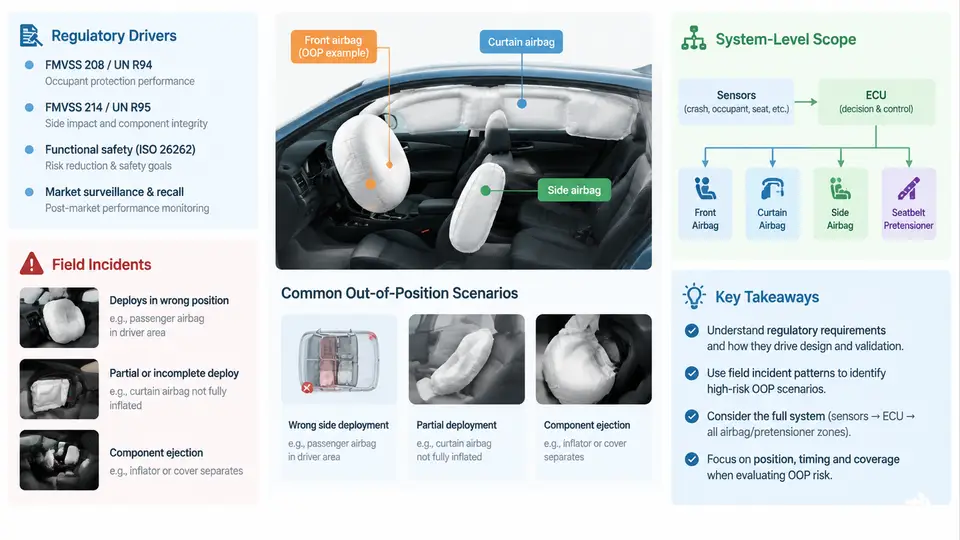
An airbag is a pyrotechnic restraint device that must decide, within a few milliseconds, whether a human body is close enough to the deploying cushion to be injured by it. That single sentence defines the entire discipline of out-of-position (OOP) airbag safety engineering. The occupant is not seated in the nominal design posture; the head, neck, or chest is inside the deployment corridor of an inflating airbag. The restraint that saves lives in a 50 km/h frontal crash can, in that geometry, deliver a fatal neck injury or traumatic brain injury at low or even zero vehicle speed.
This chapter establishes the three forces that created the discipline — regulation, field incidents, and the resulting system-level scope — and defines the engineering vocabulary used throughout the rest of the course.
1. What "Out-of-Position" Actually Means
OOP is a geometric and temporal condition, not a severity condition. An occupant is out of position when any body region occupies space that the deploying airbag module will sweep through during the first tens of milliseconds of inflation. Typical OOP postures include:
- Frontal OOP: torso pitched forward toward the steering wheel or instrument panel, head within 0–150 mm of the module cover.
- Lateral / inboard lean: head or thorax displaced toward the side airbag or the door trim.
- Child in a rear-facing CRS on the front passenger seat: the CRS shell sits directly in the passenger frontal airbag's deployment path.
- Small-stature occupants seated extremely close: the "tracked-forward, reclined" posture that places the chest at the module cover.
Two reference conventions are used consistently in this course. First, vehicle coordinates follow ISO 4130: X forward, Y to the vehicle's right, Z upward, origin at the vehicle datum. Second, occupant-to-module distance is measured along the deployment axis of the module, positive away from the module cover. When a different reference is used (for example, a sled coordinate system), it is stated explicitly.
2. Regulatory Drivers
OOP requirements did not emerge from crash statistics alone; they were written into law after specific, well-documented injuries. The regulatory architecture has three layers.
| Layer | Instrument | What it forces the engineer to do |
|---|---|---|
| Occupant protection baseline | FMVSS 208 (US), UN R94/R95 (EU), GB 11551 (China) | Meet injury criteria in nominal postures; FMVSS 208 additionally mandates suppression/deactivation logic for certain OOP and child-presence cases. |
| OOP-specific test procedures | FMVSS 208 S19/S21/S23/S25; UN R94 Annex 8; Euro NCAP OOP protocols | Demonstrate that a deploying airbag does not exceed injury thresholds on instrumented OOP dummies at defined positions and times. |
| Occupant classification & suppression | FMVSS 208 S20/S22/S27; occupant classification system (OCS) requirements | Detect and suppress or de-power the frontal passenger airbag for children, small occupants, and empty seats. |
The critical engineering consequence is that OOP compliance is not a single test. It is a matrix: multiple dummy types (Hybrid III 3-year-old, 6-year-old, 5th percentile female, 50th percentile male), multiple positions (against the module, 150 mm back, leaning inboard, leaning outboard), multiple deployment times (airbag firing at the moment of contact versus after the occupant has moved), and multiple temperatures (hot, ambient, cold) that change inflator output.
3. Field Incidents That Shaped the Discipline
The regulatory text exists because real people were injured. Three incident classes drove the field:
- Low-speed and stationary deployments. Drivers leaning forward to adjust a radio or reach a pedal, with the airbag firing at near-zero delta-v, sustained fatal basilar skull fractures and cervical spine injuries. The airbag's stored energy, not crash energy, was the injury mechanism.
- Rear-facing child restraints on the front passenger seat. The CRS shell was struck by the deploying cushion, producing severe head and neck injuries to the child. This directly produced the FMVSS 208 suppression requirements and the universal warning label.
- Aggressive inflators and module cover fragmentation. In the Takata field experience, long-term propellant degradation raised internal pressure and caused housing rupture and metal fragment ejection — an OOP-adjacent failure mode in which the module itself became the projectile.
Each class produced a distinct engineering response: inflator output shaping (dual-stage and adaptive inflators), module cover and tear-seam design, occupant sensing, and — most importantly — a system-level view in which the airbag, the seat, the belt, the sensor, and the occupant are treated as one coupled system.
4. System-Level Scope
OOP safety cannot be owned by the airbag module alone. The figure below shows the coupled system and the direction of influence between its elements.
The diagram makes the central point of this course explicit: the injury outcome is the product of a chain — occupant state, sensing decision, control decision, inflator output, cushion deployment — and every link can be tuned. OOP engineering is the practice of tuning that chain so that the worst-case occupant, in the worst-case posture, at the worst-case moment, stays below injury thresholds.
5. The Engineering Vocabulary
Four terms recur throughout the course and are defined here once:
- Deployment corridor: the volume swept by the cushion from cover rupture to full inflation. OOP severity is largely a function of how much of the occupant lies inside this corridor.
- Time-to-fire (TTF): the interval from crash detection to inflator initiation. In OOP, TTF determines whether the occupant is still moving toward the module or has already reached it.
- Injury criteria: HIC15 for head, Nij for neck, and chest deflection/acceleration for thorax. OOP limits are typically stricter than nominal-posture limits because the loading is concentrated and the occupant is unconstrained.
- Suppression vs. de-powering: suppression disables the airbag entirely; de-powering fires only the first stage or a reduced output. Both are OOP countermeasures, chosen by occupant classification.
6. What This Course Covers
The remaining chapters move from this system view into the specific engineering work: occupant classification sensor design and validation, suppression and de-powering logic, inflator output shaping, cushion and module cover design, OOP test matrix execution with Hybrid III and THOR dummies, injury criteria calculation, sled and component test methods, and field-data feedback. Each chapter assumes the vocabulary and the coupled-system model established here.
The discipline's core tension — an airbag must be aggressive enough to save a belted occupant in a severe crash and gentle enough not to injure an unbelted occupant leaning into it — is the problem this course teaches you to solve.