1. Course overview
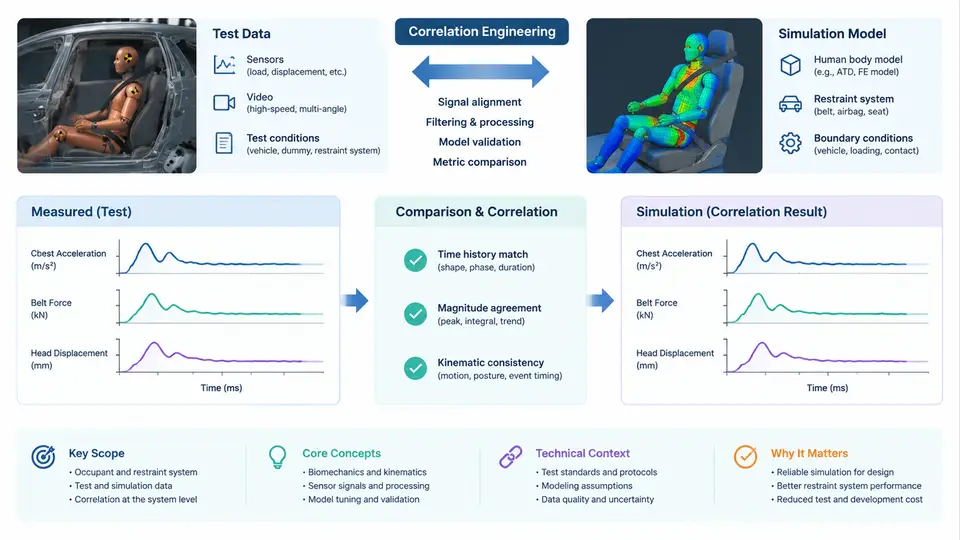
Occupant restraint test correlation engineering is the discipline of making a physical crash test and its corresponding numerical simulation agree closely enough that the simulation can be trusted for engineering decisions. In practice, this means taking a sled test, a full-vehicle barrier test, or a component-level impact test, building a CAE model of the same event, and then systematically adjusting the model — geometry, material cards, contact definitions, boundary conditions, and restraint parameters — until the predicted occupant responses match the measured responses within an agreed tolerance. The word correlation is deliberate: it is not merely "validation" in the abstract, but a quantitative, evidence-based reconciliation between two data sets that describe the same physical event.
The scope of the field spans three interacting domains. The first is the physical test domain: the test article (buck, sled, or full vehicle), the instrumentation (accelerometers, load cells, potentiometers, high-speed cameras, DTS/ISO-MME channels), and the restraint hardware (airbag modules, seat belt retractors and pretensioners, load limiters, seats, steering column). The second is the numerical domain: the finite element or multi-body model, its mesh, its material and failure models, its contact and friction definitions, and its solver settings. The third is the correlation methodology domain: the metrics, weighting schemes, filtering rules, and acceptance criteria that decide whether the two domains agree.
Why correlation is not the same as validation
Validation asks a binary question: does the model represent the physics correctly for its intended use? Correlation asks a continuous question: how close is the model to this specific test, and where does it deviate? A model can be validated in a regulatory sense yet still show poor correlation on a particular channel — for example, a belt force time history that peaks 15% too early. Correlation engineering exists precisely to close that gap. It is iterative, channel-by-channel, and evidence-driven. A useful mental model is a closed loop: test data feeds the model, the model produces responses, the responses are compared against the test using objective metrics, discrepancies are diagnosed, model parameters are adjusted, and the loop repeats until the acceptance criteria are met.
Key concepts and terminology
Several terms recur throughout this course and should be fixed early. Channel refers to a single measured or predicted signal, such as driver chest acceleration, passenger belt force, or seat track displacement. Filtering follows SAE J211 channel classes: CFC 60 for occupant accelerations, CFC 180 for belt forces, CFC 600 for some structural responses. Time zero must be defined consistently — typically the first contact or the trigger pulse — because a 5 ms offset can dominate a correlation score. COR (correlation factor) is a composite metric combining magnitude, phase, and shape agreement; ISO/TS 18571 provides a standardized formulation. Weighting assigns relative importance to channels, reflecting their influence on injury criteria such as HIC, chest deflection, and femur load.
Technical context: where correlation sits in the development cycle
Correlation engineering is not a one-time activity at the end of a program. It appears at multiple stages. During concept development, coarse correlation of a sled buck supports early restraint tuning. During design maturation, full-vehicle correlation supports airbag and belt parameter selection. During regulatory or consumer-test preparation, correlation supports pre-test prediction and post-test explanation. The same model may be correlated against multiple test configurations — frontal 56 km/h rigid barrier, 64 km/h ODB, side MDB, and rear impact — and each configuration stresses different model areas.
A practical correlation workflow typically proceeds as follows. First, the test data is reviewed for quality: sensor saturation, channel dropouts, and filter class are checked. Second, the model is run with the measured sled pulse or barrier velocity as input, not with an idealized pulse. Third, responses are extracted at the same physical locations as the test instrumentation. Fourth, objective metrics are computed per channel. Fifth, the largest contributors to error are diagnosed — often by examining whether the error is in timing, peak magnitude, or pulse shape. Sixth, targeted parameter changes are made, one family at a time, and the model is re-run. This loop continues until the weighted correlation meets the program target.
What a correlation engineer actually delivers
The deliverable is not just a model that "looks close." It is a documented, reproducible correlation package containing: the test data set with channel list and filter classes; the model version and solver deck; the comparison plots and objective metric table; the parameter change log; and a statement of residual discrepancies with their engineering significance. This package allows another engineer to reproduce the result and to judge whether the model is fit for a specific downstream use, such as predicting occupant response for a new belt geometry.
Common pitfalls at the outset
- Mismatched time zero. A few milliseconds of offset can reduce COR dramatically even when the physics is correct.
- Wrong filter class. Comparing a CFC 60 test channel against an unfiltered simulation output is meaningless.
- Ignoring boundary conditions. Using a nominal pulse instead of the measured pulse introduces error that no material tuning can fix.
- Over-tuning to one channel. Improving belt force correlation at the expense of chest acceleration is not progress.
- Undocumented changes. Without a change log, the correlation cannot be defended or repeated.
With these foundations established, the remainder of the course moves from data acquisition and signal processing, through model setup and material characterization, into objective metric computation, diagnosis strategies, and finally into full-vehicle and component case studies. Each chapter builds on the loop shown above, adding the specific techniques needed to make each stage rigorous and repeatable.