1. Course overview
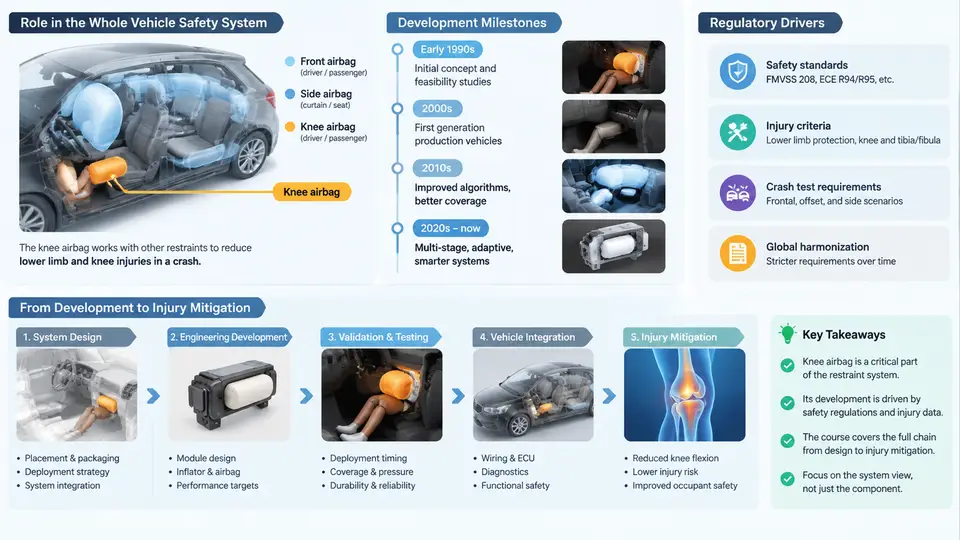
Knee airbags (KABs) occupy a distinctive position in occupant safety: they are small, relatively low-cost restraints that sit low in the instrument panel (IP) and deploy into the space between the occupant's knees and the lower IP structure. Their purpose is not to replace the frontal airbag or the seat belt, but to close a specific gap in the restraint system — the lower extremity and pelvis load path that neither the belt nor the frontal airbag controls well. This course treats knee airbag development as an end-to-end engineering discipline: from regulatory and consumer-rating drivers, through concept selection and CAE-driven design, to sled and vehicle validation, and finally to field-performance feedback and injury-mitigation trade-offs.
Why a Dedicated Knee Airbag Course
Knee airbags are frequently misunderstood as a simple "add-on" to the frontal restraint system. In practice, their design couples several disciplines that are usually taught separately: occupant kinematics, injury biomechanics of the lower extremity and pelvis, IP structural design, inflator and cushion packaging, and the sensing/decision logic that decides when the KAB fires. A design change in any one of these areas propagates into the others. For example, increasing cushion volume to better cover the knee may delay deployment timing, which in turn changes the interaction with the frontal airbag and the belt load limiter. This course is structured so that each chapter addresses one part of that coupled system while keeping the whole restraint architecture in view.
Scope of the Course
The course covers the following technical territory:
- Regulatory and rating context — FMVSS 208, FMVSS 208 occupant protection requirements, Euro NCAP and other consumer-rating lower-extremity and pelvis criteria, and how KAB performance is judged within them.
- Injury biomechanics — femur, tibia, knee joint, and pelvis injury mechanisms; the Abbreviated Injury Scale (AIS) and the injury criteria used to quantify risk (femur force, knee slider displacement, tibia index, pelvis acceleration).
- Restraint architecture — how the KAB interacts with the seat belt, belt pretensioner and load limiter, frontal airbag, and seat structure.
- Design and CAE — cushion geometry, venting, inflator selection, IP chute and door design, and the simulation workflow used to iterate before hardware exists.
- Validation — component, sled, and full-vehicle testing; instrumentation; and the pass/fail logic applied to each test.
- Field performance and continuous improvement — how real-world data and post-deployment inspection feed back into the next design iteration.
Core Concepts and Terminology
Before moving into detailed design work, it is worth fixing the vocabulary that the rest of the course uses consistently.
| Term | Meaning in this course |
|---|---|
| Knee airbag (KAB) | A pyrotechnic or hybrid inflatable restraint mounted in the lower IP or steering-column area, deploying rearward toward the occupant's knees and shins. |
| Occupant packaging | The geometric relationship between the occupant (as represented by an ATD or human body model) and the interior surfaces, including the KAB module location. |
| Load path | The route by which restraint forces are transmitted from the occupant into the vehicle structure — through the belt, the KAB, the seat, and the floor. |
| Injury criterion | A measurable quantity (force, acceleration, displacement, or a derived index) with a threshold above which injury risk is considered unacceptable. |
| Deployment timing | The time from the crash pulse trigger to full cushion inflation, expressed in milliseconds and referenced to the occupant's forward excursion. |
| ATD | Anthropomorphic Test Device — the instrumented dummy (e.g., Hybrid III 50th percentile male, THOR) used to measure occupant response in tests. |
Technical Context: Where the KAB Sits in the Restraint System
A knee airbag is one element of a coordinated restraint system. Its deployment must be timed relative to the frontal airbag and the belt, and its cushion pressure must be tuned so that it supports the lower extremity without driving the pelvis into an unfavorable position. The figure below shows the principal components and the load paths that the KAB is intended to influence.
The diagram makes one point explicit: the KAB is not an isolated device. It shares the occupant's lower-body load path with the belt and the seat, and its timing is coupled to the frontal airbag. Any development decision — cushion size, vent area, inflator output, or module position — must be evaluated against that shared load path.
How Development Actually Proceeds
In industry practice, knee airbag development follows a staged progression that this course mirrors. It begins with a requirements definition phase, where the target injury criteria and the occupant packaging envelope are fixed. This is followed by concept design, in which candidate cushion geometries and inflator classes are compared using CAE. The most promising concepts move to component and sled validation, where the cushion is fired against an instrumented ATD and the measured femur force, knee displacement, and tibia response are compared with the targets. Only after sled performance is stable does the design advance to full-vehicle validation, where the interaction with the complete interior and the crash pulse is confirmed. Finally, production and field monitoring close the loop.
What You Will Be Able to Do
By the end of this course, you should be able to read a restraint-system requirement set and identify which lower-extremity injury criteria are at risk; select a KAB concept and justify it with CAE evidence; set up and interpret a sled test for knee airbag performance; and diagnose common failure modes such as late deployment, cushion over-pressure, or unfavorable knee-to-IP contact. The chapters that follow build these capabilities in the same order that a real development program would use them.
The remainder of the course assumes familiarity with basic occupant safety terminology but does not assume prior knee airbag experience. Where a concept is introduced, it is defined in context and then used consistently in later chapters.