1. Course overview
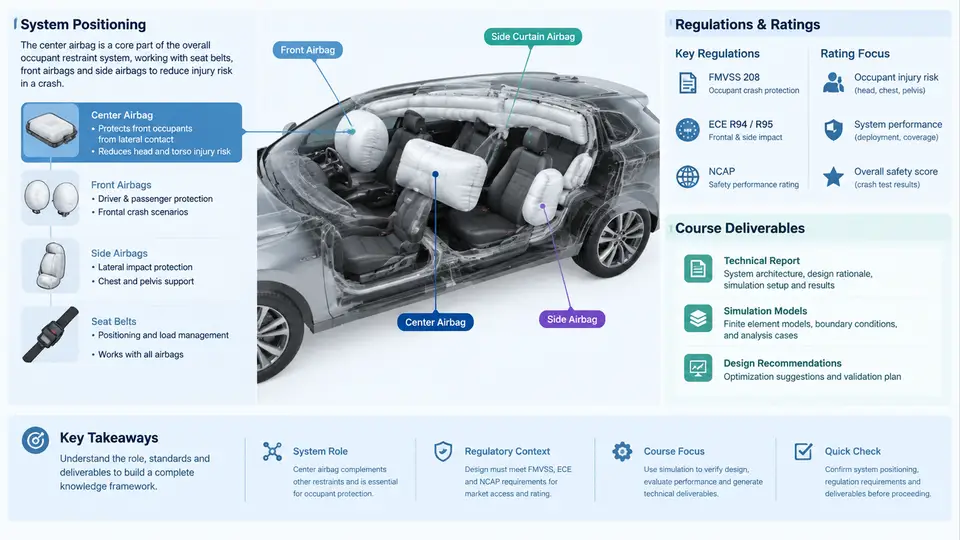
Modern occupant protection is no longer a single-airbag problem. A frontal airbag cushions the driver against the steering wheel, but in a side impact the occupant can still move laterally toward the center of the vehicle and strike the opposite seat, the center console, or another occupant. The center airbag — also called a far-side airbag — is the restraint device that fills that gap. This course treats the center airbag as a complete engineering object: how it is packaged, how it deploys, how it is validated in simulation, and how simulation results are judged against physical test evidence.
The scope of the course spans three connected domains. The first is restraint system architecture: where the center airbag sits, what triggers it, and how it interacts with seat belts, side airbags, and seat structures. The second is crash simulation: the finite element and multi-body models used to predict occupant kinematics and airbag deployment. The third is design validation: the regulatory and consumer-test procedures that define pass/fail, and the correlation work that makes simulation trustworthy. A center airbag program that ignores any one of these domains will either fail certification or produce a design that cannot be manufactured.
Why the Center Airbag Exists
Far-side impact is a distinct loading case. In a nearside impact, the struck-side airbag and the door structure absorb energy close to the occupant. In a far-side impact, the occupant is on the side away from the impact, so the struck-side restraint is on the opposite side of the body. The occupant's torso and head accelerate toward the vehicle centerline. Without a center airbag, the head can strike the opposite seat back or the center console, and the torso can load the spine in lateral bending. The center airbag deploys from the inboard side of the driver or passenger seat and creates a cushion between the two occupants or between the occupant and the center console.
This is why the center airbag is often described as a far-side restraint. Its job is not to absorb the primary impact energy — the struck-side structure and airbags do that — but to control the secondary motion that follows. That distinction drives every design decision: the center airbag is smaller, deploys later, and is tuned for a different occupant trajectory than a frontal airbag.
Core Concepts and Terminology
Before simulation work begins, the team must agree on a shared vocabulary. The following terms appear throughout the course and should be understood precisely.
- Far-side impact: an impact in which the occupant is seated on the side opposite the struck side. The center airbag is the primary far-side countermeasure.
- Deployment time (td): the interval from the crash pulse trigger to full airbag inflation. For center airbags this is typically in the 20–40 ms range, later than a frontal driver airbag because the occupant's lateral motion develops more slowly.
- Inflation pressure and venting: the internal pressure history and the vent area that control cushion stiffness. A center airbag must be stiff enough to arrest lateral motion but soft enough to avoid loading the neck.
- Occupant kinematics: the position, velocity, and acceleration of the head, chest, and pelvis over time. Simulation predicts these; sled and full-vehicle tests measure them.
- Injury criteria: quantitative measures such as HIC (Head Injury Criterion), Nij (neck injury criterion), and chest deflection. These are the pass/fail metrics.
- Correlation: the process of adjusting a simulation model until its predictions match physical test data within an accepted tolerance.
A common source of confusion is the sign convention for lateral motion. In this course, the vehicle coordinate system follows the standard SAE convention: x forward, y to the right, z upward. A far-side impact from the driver's side (left) therefore produces positive y motion of the driver toward the passenger side. All simulation plots and test data in this course use this convention unless stated otherwise.
The Simulation Workflow in Context
Crash simulation for center airbags is not a single model. It is a chain of models at different levels of detail, each answering a different question. The diagram below shows the relationship between the physical system, the simulation models, and the validation evidence.
The chain matters because each level has a different cost and a different purpose. A sled model runs in minutes and lets the engineer sweep inflator output and vent size. A full-vehicle model runs for hours and captures the interaction between the center airbag, the seat structure, and the vehicle body. The validation column is not optional: a simulation that has never been correlated against a physical test is a hypothesis, not evidence.
What This Course Delivers
By the end of the course, you should be able to do the following with confidence:
- Read a far-side crash pulse and explain how it drives occupant lateral motion.
- Build or modify a center airbag model in a crash solver, including the inflator, cushion, and vent definitions.
- Set up an occupant kinematics simulation with a validated ATD or human body model.
- Extract HIC, Nij, and chest deflection from simulation output and compare them against test data.
- Diagnose common correlation failures — late deployment, over-stiff cushion, vent blockage — and propose corrective parameter changes.
- Document a design validation package that a certification engineer can review.
How to Use the Simulation Results
Simulation output is only useful if you know what to look at. For a far-side center airbag study, the primary observables are:
| Observable | Typical target (example) | What it tells you |
|---|---|---|
| Head lateral excursion | < 150 mm toward centerline | Whether the head is contained by the cushion |
| HIC15 | < 700 (example threshold) | Head impact severity against cushion or opposite seat |
| Nij | < 1.0 (example threshold) | Neck tension/compression and bending load |
| Chest deflection | < 50 mm (example threshold) | Thoracic loading from belt and cushion |
| Cushion contact time | Within 10 ms of occupant arrival | Whether deployment timing matches occupant motion |
The numbers above are illustrative example thresholds for teaching purposes, not regulatory limits. Actual limits depend on the applicable regulation, consumer rating program, and OEM internal targets. The point is that each observable maps to a physical question, and the simulation must answer that question before the design is frozen.
Technical Context and Industry Drivers
The center airbag has moved from a niche feature to a mainstream requirement because far-side occupant protection is now explicitly addressed in consumer rating programs and regulatory discussions. This has three consequences for the design engineer. First, the validation burden is higher: a single sled test is no longer sufficient evidence. Second, the simulation must be correlated across multiple impact configurations, not just one. Third, the packaging space is tight — the center airbag must fit inside the seat inboard bolster without compromising seat comfort or adjustment range.
These constraints explain why the course spends significant time on both the physical design and the simulation methodology. A center airbag program is a negotiation between restraint performance, packaging, cost, and validation evidence. Simulation is the tool that makes that negotiation possible before hardware exists.
The remaining chapters build on this foundation. You will move from the crash pulse and occupant kinematics, through airbag modeling and deployment simulation, into correlation and validation. Each chapter adds a layer to the same system, so the concepts introduced here — far-side impact, deployment timing, injury criteria, and correlation — will reappear throughout the course.