1. Pedestrian protection simulation in LS-D
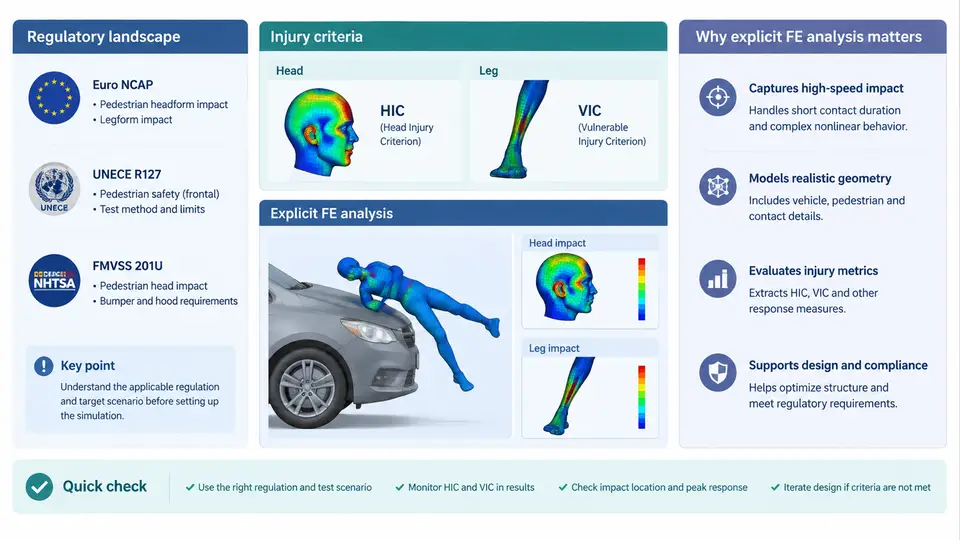
Pedestrian protection has evolved from a voluntary design aspiration into a globally regulated performance requirement. For engineers working in body structures, bumper systems, or CAE, understanding why explicit finite element analysis dominates this domain is as important as knowing how to build the model. This chapter establishes the regulatory framework, defines the injury criteria that simulations must predict, and explains why LS-DYNA's explicit solver is the industry-standard tool for head and leg impact assessment.
The Regulatory Landscape
Two regulatory families govern pedestrian protection worldwide, and they differ in both test procedures and acceptance thresholds.
UN Regulation No. 127 (UN-R127) is the primary international standard, adopted in the EU and many other markets. It defines two impactor types: a headform (adult and child variants) and a legform (upper leg and lower leg). The regulation specifies impact velocities, impact angles, target zones on the vehicle, and pass/fail criteria. UN-R127 has undergone successive amendments (Series 01, 02, 03) that progressively tightened requirements and expanded the test matrix.
Euro NCAP operates a complementary consumer-rating protocol that is more demanding than the regulation. Euro NCAP awards points based on measured injury values rather than simple pass/fail, and it has introduced advanced legform impactors (aPLI) and more aggressive head impact grids. A vehicle can pass UN-R127 yet score poorly in Euro NCAP, so most OEMs design to the stricter of the two.
Other regional standards exist — Japan's JNCAP, China's C-NCAP, and Korea's KNCAP — but they largely harmonize with UN-R127 and Euro NCAP methodologies. The practical consequence for simulation engineers is that a single validated LS-DYNA model can be adapted to multiple regulatory targets by adjusting impactor positioning, velocity, and evaluation criteria.
Injury Criteria: What the Simulation Must Predict
Injury criteria translate physical measurements into a normalized risk metric. Each criterion has a defined threshold; exceeding it constitutes a failure.
| Body Region | Impactor | Criterion | Typical Threshold |
|---|---|---|---|
| Head | Adult headform (4.5 kg) | HIC15 | ≤ 1000 (UN-R127); Euro NCAP scoring from 650 |
| Head | Child headform (3.5 kg) | HIC15 | ≤ 1000 (UN-R127); Euro NCAP scoring from 650 |
| Lower leg | Flexible legform | Tibia acceleration, knee bending angle, knee shear displacement | ≤ 150 g, ≤ 19°, ≤ 6 mm |
| Upper leg | Upper legform | Bending moment, force sum | ≤ 220 Nm, ≤ 5 kN |
The Head Injury Criterion (HIC) is the most widely recognized metric. It is computed from the resultant translational acceleration a(t) measured at the headform's center of gravity:
HIC = max over [t1, t2] of:
      (t2 - t1) * [ (1/(t2-t1)) * ∫ a(t) dt ]^2.5

where the integration window (t2 - t1) is limited to 15 ms
for HIC15, and a(t) is expressed in g.
In practice, LS-DYNA does not compute HIC internally. The engineer extracts the acceleration time history from a nodal or rigid-body accelerometer output and post-processes it in a tool such as LS-PrePost, HyperGraph, or a Python script. The 15 ms window means that a short, high-magnitude spike can be less damaging than a sustained moderate acceleration — a nuance that directly influences countermeasure design.
For the lower leg, the flexible legform impactor measures three quantities simultaneously: tibia acceleration (a surrogate for bone fracture risk), knee bending angle (ligament rupture risk), and knee shear displacement (joint dislocation risk). All three must pass; a design that satisfies acceleration but violates bending angle is still a failure.
Why Explicit Finite Element Analysis?
Pedestrian impact is a transient, highly nonlinear event lasting 20–50 ms. It involves large deformations, contact between the impactor and vehicle surfaces, material failure, and strain-rate-dependent behavior. Implicit solvers struggle with the contact convergence and element distortion characteristic of such events. LS-DYNA's explicit central-difference time integration scheme advances the solution one small time step at a time without assembling a global stiffness matrix, making it robust for impact problems.
The explicit method's stability limit is governed by the Courant condition: the time step must be smaller than the time for a stress wave to traverse the smallest element. For a typical steel element of 5 mm, this yields a time step on the order of 1 μs. A 30 ms simulation therefore requires roughly 30,000 time steps — computationally intensive but tractable with modern hardware and mass scaling where appropriate.
LS-DYNA offers several features specifically relevant to pedestrian protection:
- Rigid impactor models with prescribed initial velocity and mass, matching regulatory specifications.
- Automatic surface-to-surface contact for impactor-to-vehicle interaction.
- Material models such as *MAT_PLASTIC_KINEMATIC and *MAT_CRASHWORTHINESS that capture strain-rate effects in bumper fascia and hood materials.
- Accelerometer output via *DATABASE_HISTORY_NODE and rigid body output for direct HIC computation.
From Regulation to Simulation: The Workflow
A typical pedestrian protection simulation campaign follows a structured sequence. The vehicle model — trimmed to the relevant front-end components — is positioned according to the regulatory grid. The impactor is placed at the specified location, angle, and velocity. The simulation runs for 30–50 ms, and acceleration or force data is extracted for criterion evaluation.
The SVG below illustrates the relationship between the regulatory test setup, the LS-DYNA model components, and the injury criteria evaluation chain.
The feedback loop in the diagram is the essence of the engineering process: if any criterion fails, the design is modified — typically by adjusting hood inner panel geometry, adding energy-absorbing foam, or softening bumper fascia — and the simulation is repeated. Each iteration costs hours of computation, so accurate first-pass modeling and efficient solver settings are critical.
Key Takeaways for the Simulation Engineer
- UN-R127 and Euro NCAP define the test matrix; Euro NCAP is generally more stringent and should drive design targets.
- HIC15, tibia acceleration, knee bending angle, and knee shear displacement are the primary injury criteria; all must be evaluated simultaneously.
- LS-DYNA's explicit solver is the appropriate tool because pedestrian impact is a short-duration, large-deformation, contact-dominated event.
- Accurate impactor models and correct output requests (*DATABASE_HISTORY_NODE, *DATABASE_ABSTAT) are prerequisites for meaningful results.
- Post-processing — not the solver — computes HIC; the engineer must understand the 15 ms window and its implications for countermeasure design.
With this foundation, subsequent chapters will detail the specific modeling techniques for headform and legform impactors, material card selection for automotive plastics and steels, contact parameter tuning, and validation against physical test data.