4. Shell element formulations for thin-wall
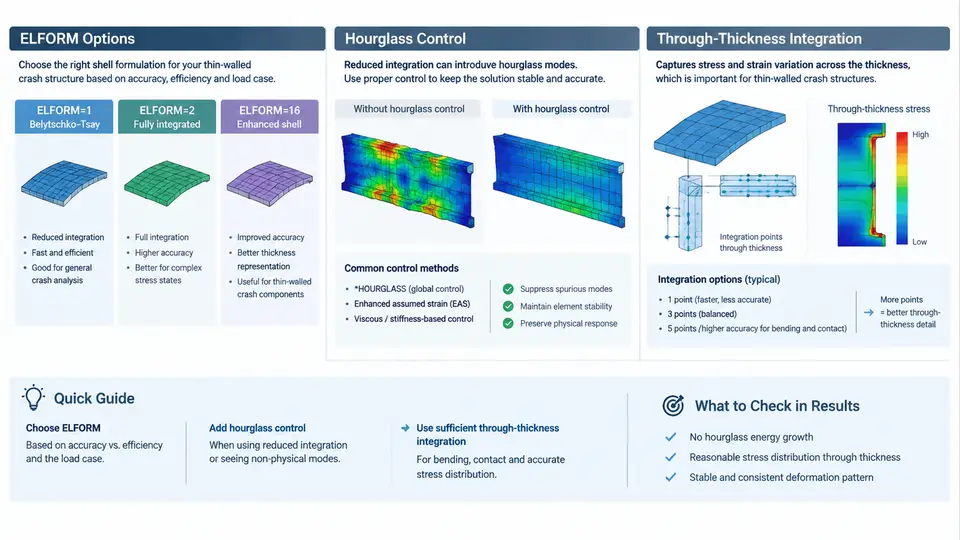
Thin-walled crash structures — bumper beams, crash boxes, front rails, and B-pillars — are almost always discretized with shell elements in LS-DYNA. The accuracy of the resulting force–displacement response, fold pattern, and energy absorption depends heavily on three coupled modeling decisions: the element formulation (ELFORM), the hourglass control strategy, and the number of through-thickness integration points (NIP). Getting these wrong produces either spurious stiffness, non-physical hourglass modes, or unstable post-buckling behavior. This section explains how each choice works and how to select values for typical crash-box geometries.
Why Shell Formulation Choice Matters in Crash
Crash boxes deform by progressive folding, which involves large rotations, membrane stretching, bending, and through-thickness plasticity. A shell formulation must therefore handle:
- Large rigid-body rotation without artificial stiffening (objective stress rate).
- Membrane–bending coupling that reproduces the local plastic hinge at each fold.
- Transverse shear behavior that remains stable when the element is heavily warped.
- Suppression of zero-energy modes (hourglassing) without adding excessive artificial stiffness.
LS-DYNA offers several shell formulations through the *SECTION_SHELL keyword. The most relevant for crash are ELFORM 2, 16, and 1, with ELFORM 2 being the workhorse for thin-walled energy absorbers.
ELFORM Options for Crash Structures
| ELFORM | Type | Typical Use in Crash | Notes |
|---|---|---|---|
| 2 | Belytschko–Tsay (default) | General thin-walled crash boxes, rails | Fast, robust, requires hourglass control |
| 16 | Fully integrated (4 in-plane IP) | Small, highly warped regions; validation runs | No hourglassing, but ~2–3× cost and shear locking risk |
| 1 | Hughes–Liu | Legacy models, thick shells | Seldom preferred for new crash models |
| -16 | Fully integrated with warping correction | Warped thin-walled sections | Improved accuracy over 16 for twisted geometry |
For a typical steel crash box (e.g., 350 × 120 × 2 mm wall, length 200 mm), ELFORM 2 with a well-tuned hourglass coefficient is the standard starting point. ELFORM 16 is reserved for local regions where warping is severe or where hourglass control cannot be tuned reliably.
Hourglass Control: Types and Coefficients
Reduced-integration shells (ELFORM 2) have a single in-plane integration point, which makes them efficient but susceptible to hourglass modes — zero-energy deformation patterns that produce no strain at the integration point. LS-DYNA provides hourglass control through *HOURGLASS and the IHQ parameter on *SECTION_SHELL.
- IHQ = 1 (standard viscous): Default. Adds viscous damping proportional to hourglass velocity. Good for most crash models.
- IHQ = 2 (Flanagan–Belytschko): Stiffness-based, better for quasi-static or springback.
- IHQ = 3 (stiffness): Adds artificial stiffness; can over-stiffen thin walls.
- IHQ = 4 (Puso): Improved for warped geometry.
- IHQ = 5, 6: Advanced formulations for specific cases.
The hourglass coefficient QM (default 0.1 for viscous, 0.05 for stiffness) controls the magnitude. For crash boxes, a common starting value is QM = 0.05–0.10 with IHQ = 1. If hourglass energy exceeds 5% of internal energy, increase QM or refine the mesh. If the structure becomes too stiff, reduce QM.
glstat and matsum. A well-behaved crash model keeps hourglass energy below 5% of total internal energy throughout the event.
Through-Thickness Integration (NIP)
The number of through-thickness integration points, NIP, determines how bending and plasticity through the wall thickness are resolved. For thin-walled crash structures:
- NIP = 1: Membrane-only; cannot capture bending. Never use for crash boxes.
- NIP = 2: Minimal bending; acceptable only for very thin, membrane-dominated parts.
- NIP = 3: Standard for most crash applications. Captures linear bending and first plastic hinge.
- NIP = 5: Recommended for accurate fold formation and springback in high-strength steels.
- NIP ≥ 7: Rarely needed; increases cost without proportional benefit for thin walls.
For a 2 mm thick crash box, NIP = 5 is a good balance. The through-thickness integration rule is set by NIP on *SECTION_SHELL, and the integration scheme (Gauss or Lobatto) is controlled by INT. Gauss is standard; Lobatto places points on the surfaces and is useful when surface strain is critical.
Practical Configuration Example
Consider a steel crash box modeled with ELFORM 2, NIP = 5, and IHQ = 1. The *SECTION_SHELL card would look like:
*SECTION_SHELL
$#  SECID    ELFORM      SHRF       NIP     PROPT     QR/IRID      ICOMP
         1         2       5/6         5         0         0         0
$#   T1        T2        T3        T4
       2.0       2.0       2.0       2.0
And the hourglass card:
*HOURGLASS
$#   HGID       IHQ        QM
         1         1       0.08
With this setup, a 200 mm long crash box impacted at 15 m/s should produce a progressive fold pattern with hourglass energy below 5% and a stable force–displacement curve. If hourglass energy spikes, reduce QM to 0.05 or refine the mesh to 3–4 mm element size. If the box folds too stiffly, check that NIP is not too low and that the material model includes appropriate hardening.
Interaction Between ELFORM, Hourglass, and NIP
These three parameters are not independent. A fully integrated formulation (ELFORM 16) eliminates hourglassing but may shear-lock; reduced integration (ELFORM 2) requires hourglass control but is faster. Increasing NIP improves bending accuracy but also increases the influence of hourglass modes because more integration points can participate in zero-energy patterns. The recommended workflow is:
- Start with ELFORM 2, NIP = 5, IHQ = 1, QM = 0.08.
- Run a short simulation (10–20 ms) and check hourglass energy.
- If hourglass energy > 5%, reduce QM or refine mesh.
- If fold pattern is inaccurate, increase NIP to 7 or switch to ELFORM 16 locally.
- Validate against experimental force–displacement data if available.
Key Takeaways
- ELFORM 2 is the default and most efficient choice for thin-walled crash structures; ELFORM 16 is a fallback for severe warping.
- Hourglass control (IHQ = 1, QM ≈ 0.08) is mandatory for reduced-integration shells; monitor hourglass energy and keep it below 5% of internal energy.
- NIP = 5 is the recommended through-thickness integration for crash boxes; NIP = 3 is a minimum, NIP = 7 for high-fidelity fold prediction.
- Always validate the combination against a short simulation before committing to a full crash run.