1. 点云数据读取与格式转换
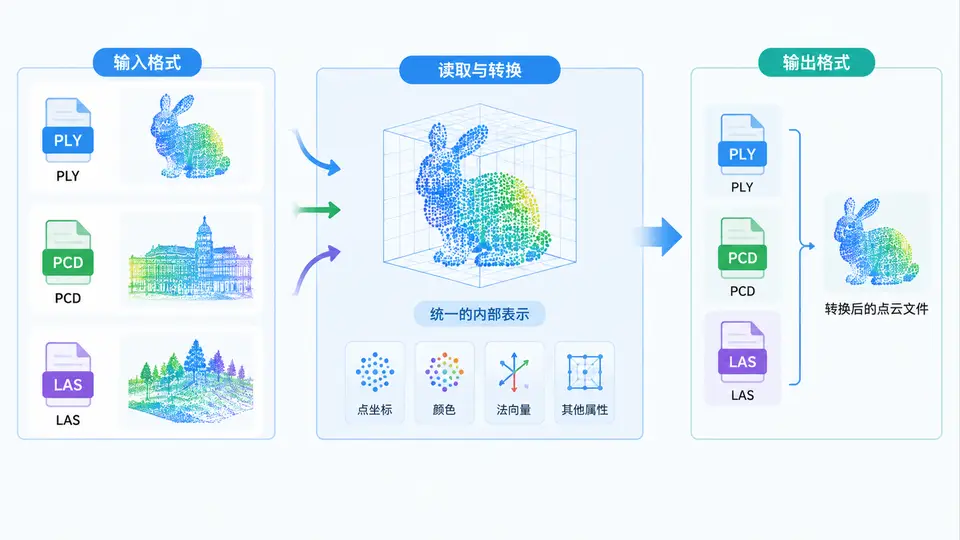
任务说明
本案例实现一个轻量级点云数据读取与格式转换工具,支持PLY、PCD、LAS三种格式的读取,并将点云统一转换为内部表示(XYZ坐标+强度值),随后可保存为PLY或PCD格式。通过该工具,用户可以在不同格式间转换点云数据,便于后续处理流程使用统一的数据结构。
环境依赖
需要安装Python 3.8+,以及以下库:
pip install numpy plyfile python-plyfile laspy完整实现代码
import numpy as np
import struct
from pathlib import Path

class PointCloud:
    """统一内部点云表示:xyz坐标 + 强度intensity"""
    def __init__(self, points, intensity=None):
        self.points = np.asarray(points, dtype=np.float64)
        if intensity is None:
            self.intensity = np.zeros(len(self.points), dtype=np.float32)
        else:
            self.intensity = np.asarray(intensity, dtype=np.float32)
        assert len(self.points) == len(self.intensity), "points与intensity长度不一致"

    @property
    def size(self):
        return len(self.points)

def read_ply(filepath):
    """读取PLY格式(仅支持vertex x,y,z,intensity字段的ASCII或binary_little_endian)"""
    from plyfile import PlyData
    plydata = PlyData.read(filepath)
    vertex = plydata['vertex']
    xyz = np.column_stack([vertex['x'], vertex['y'], vertex['z']])
    if 'intensity' in vertex.data.dtype.names:
        intensity = vertex['intensity']
    else:
        intensity = np.zeros(len(xyz), dtype=np.float32)
    return PointCloud(xyz, intensity)

def read_pcd(filepath):
    """读取PCD格式(支持ASCII和binary,字段包含x,y,z,intensity)"""
    with open(filepath, 'rb') as f:
        header = {}
        while True:
            line = f.readline().decode('ascii').strip()
            if not line or line.startswith('#'):
                continue
            if line == 'DATA ascii':
                header['DATA'] = 'ascii'
                break
            elif line == 'DATA binary':
                header['DATA'] = 'binary'
                break
            elif ' ' in line:
                key, _, val = line.partition(' ')
                header[key] = val
        fields = header['FIELDS'].split()
        sizes = [int(s) for s in header['SIZE'].split()]
        types = header['TYPE'].split()
        count = [int(c) for c in header['COUNT'].split()]
        n_points = int(header['POINTS'])
        # 解析字段索引
        xyz_idx = [fields.index(f) for f in ['x', 'y', 'z']]
        has_intensity = 'intensity' in fields
        inten_idx = fields.index('intensity') if has_intensity else None
        # 计算每点字节数
        point_size = sum(s * c for s, c in zip(sizes, count))
        if header['DATA'] == 'ascii':
            data = np.loadtxt(f, max_rows=n_points)
            xyz = data[:, xyz_idx]
            intensity = data[:, inten_idx] if has_intensity else np.zeros(n_points)
        else:
            raw = f.read(point_size * n_points)
            # 仅支持float32/float64的x,y,z和intensity
            dtype_map = {'F': {4: np.float32, 8: np.float64}, 'I': {4: np.int32, 8: np.int64}}
            offsets = []
            offset = 0
            for i, (sz, ty, cnt) in enumerate(zip(sizes, types, count)):
                if i in xyz_idx or i == inten_idx:
                    offsets.append((offset, dtype_map[ty][sz], cnt))
                offset += sz * cnt
            xyz = np.zeros((n_points, 3))
            intensity = np.zeros(n_points)
            for idx, (off, dt, cnt) in enumerate(offsets):
                col_data = np.frombuffer(raw, dtype=dt, count=n_points * cnt, offset=off).reshape(n_points, cnt)
                if idx < 3:
                    xyz[:, idx] = col_data[:, 0]
                else:
                    intensity[:] = col_data[:, 0]
        return PointCloud(xyz, intensity)

def read_las(filepath):
    """读取LAS格式(使用laspy库)"""
    import laspy
    las = laspy.read(filepath)
    xyz = np.column_stack([las.x, las.y, las.z])
    if hasattr(las, 'intensity') and las.intensity.size > 0:
        intensity = las.intensity.astype(np.float32)
    else:
        intensity = np.zeros(len(xyz), dtype=np.float32)
    return PointCloud(xyz, intensity)

def write_ply(pc, filepath):
    """保存为PLY格式(binary_little_endian,含intensity)"""
    from plyfile import PlyData, PlyElement
    dtype = [('x', 'f8'), ('y', 'f8'), ('z', 'f8'), ('intensity', 'f4')]
    arr = np.empty(pc.size, dtype=dtype)
    arr['x'] = pc.points[:, 0]
    arr['y'] = pc.points[:, 1]
    arr['z'] = pc.points[:, 2]
    arr['intensity'] = pc.intensity
    ply = PlyData([PlyElement.describe(arr, 'vertex')], text=False)
    ply.write(filepath)

def write_pcd(pc, filepath):
    """保存为PCD格式(binary,含intensity)"""
    with open(filepath, 'wb') as f:
        header = f"# .PCD v0.7 - Point Cloud Data file format\nVERSION 0.7\nFIELDS x y z intensity\nSIZE 8 8 8 4\nTYPE F F F F\nCOUNT 1 1 1 1\nWIDTH {pc.size}\nHEIGHT 1\nVIEWPOINT 0 0 0 1 0 0 0\nPOINTS {pc.size}\nDATA binary\n"
        f.write(header.encode('ascii'))
        # 按字段顺序写入
        for i in range(pc.size):
            f.write(struct.pack('fff f', *pc.points[i], pc.intensity[i]))

def convert_pointcloud(input_path, output_path):
    """主转换函数:读取任意支持格式,写入目标格式(由扩展名决定)"""
    in_path = Path(input_path)
    out_path = Path(output_path)
    suffix_in = in_path.suffix.lower()
    suffix_out = out_path.suffix.lower()
    # 读取
    if suffix_in == '.ply':
        pc = read_ply(in_path)
    elif suffix_in == '.pcd':
        pc = read_pcd(in_path)
    elif suffix_in == '.las':
        pc = read_las(in_path)
    else:
        raise ValueError(f"不支持的输入格式: {suffix_in}")
    # 写入
    if suffix_out == '.ply':
        write_ply(pc, out_path)
    elif suffix_out == '.pcd':
        write_pcd(pc, out_path)
    else:
        raise ValueError(f"不支持的输出格式: {suffix_out}")
    return pc.size

if __name__ == '__main__':
    import sys
    if len(sys.argv) != 3:
        print("用法: python pointcloud_convert.py <输入文件> <输出文件>")
        print("支持: .ply .pcd .las 输入; .ply .pcd 输出")
        sys.exit(1)
    n = convert_pointcloud(sys.argv[1], sys.argv[2])
    print(f"转换完成,共 {n} 个点")
运行与验证
运行方式:
# 转换示例(将LAS转为PLY)
python pointcloud_convert.py input.las output.ply

# 转换示例(将PCD转为LAS格式需先转为PLY再转,或直接扩展支持)
python pointcloud_convert.py input.pcd output.ply
验证方法:
- 准备测试数据:使用CloudCompare或PCL工具导出一个包含XYZ和强度字段的PLY/PCD/LAS文件,或使用以下代码生成测试PCD文件:
import numpy as np
# 生成100个随机点并保存为PCD
points = np.random.rand(100, 3) * 10
intensity = np.random.rand(100).astype(np.float32)
with open('test.pcd', 'wb') as f:
    header = f"# .PCD v0.7\nVERSION 0.7\nFIELDS x y z intensity\nSIZE 8 8 8 4\nTYPE F F F F\nCOUNT 1 1 1 1\nWIDTH 100\nHEIGHT 1\nVIEWPOINT 0 0 0 1 0 0 0\nPOINTS 100\nDATA binary\n"
    f.write(header.encode())
    for i in range(100):
f.write(np.array([*points[i], intensity[i]], dtype=np.float32).tobytes())- 执行转换命令,观察输出:
python pointcloud_convert.py test.pcd test.ply- 通过条件:程序正常退出且输出“转换完成,共 100 个点”;使用CloudCompare或pypcd打开test.ply,确认点云坐标与强度值与原始test.pcd一致(允许浮点精度误差小于1e-5)。
常见问题
- LAS读取失败:确保laspy已安装且LAS文件版本受支持(LAS 1.0-1.4均可)。
- PLY文件无intensity字段:读取时自动填充强度为0,不影响坐标转换。
- PCD二进制格式兼容性:本实现仅支持每个字段count=1且类型为F(浮点)的PCD文件;若遇到其他类型(如I整数型),需扩展read_pcd中的类型映射。