1. Restraint component durability and life-
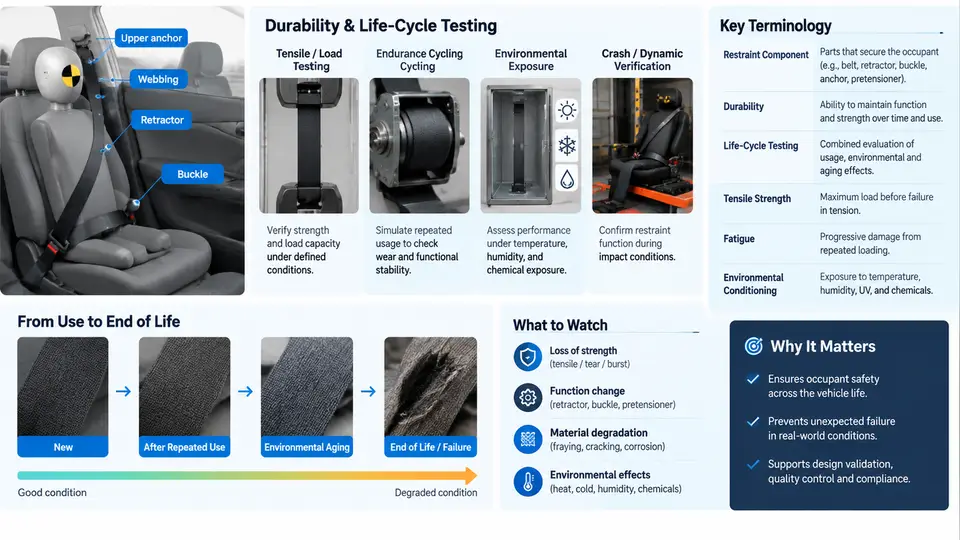
Occupant restraint systems are safety-critical assemblies whose performance is only demonstrated once — during a crash. Yet the components that make up those systems must remain functional after a decade of vibration, thermal cycling, humidity exposure, and thousands of load cycles. This course addresses the discipline that bridges those two realities: restraint component durability and life-cycle testing. The scope of the course is deliberately narrow and deep. It covers the seat belt retractor, webbing, buckle and latch plate, pretensioner, load limiter, anchorages, airbag module, inflator, and the electronic control unit (ECU) that arbitrates deployment. It does not cover vehicle body structural design or crash pulse development except where those factors define the test boundary conditions.
The central engineering question is not "does the restraint work in a crash?" but "will the restraint still work in a crash after the vehicle has aged?" Durability testing answers that question by applying representative mechanical, thermal, electrical, and environmental loads over a compressed timeline, then verifying that the component still meets its functional and performance requirements. Life-cycle testing extends this by modeling the cumulative damage across the entire service life — from end-of-line assembly through customer usage to end-of-life disposal.
Key Terminology
Precision in terminology is essential because restraint testing spans multiple standards bodies and supplier specifications. The following terms are used consistently throughout this course.
| Term | Definition | Typical Unit / Range |
|---|---|---|
| Durability | The ability of a component to withstand cyclic or sustained loads without functional degradation over its intended service life. | Cycles, hours |
| Life cycle | The full sequence of operational and environmental states from manufacture to disposal, including storage, installation, customer use, and maintenance. | Years, cumulative cycles |
| Design Verification (DV) | Testing performed on components or subsystems to confirm that the design meets specified requirements before production release. | Pass/fail against spec |
| Production Validation (PV) | Testing performed on parts from the production process to confirm that manufacturing consistently reproduces the verified design. | Pass/fail against spec |
| Load limiter | A mechanism that limits the force transmitted to the occupant by allowing controlled webbing payout or deformation after a threshold is reached. | 2–6 kN typical |
| Pretensioner | A pyrotechnic or mechanical device that removes slack from the seat belt early in a crash event. | Activation time < 20 ms |
| Accelerated life test (ALT) | A test method that compresses time by increasing load frequency, amplitude, or environmental severity while preserving the dominant failure mechanism. | Acceleration factor |
| B10 life | The time or number of cycles at which 10% of a population is expected to fail. | Cycles, hours |
| Weibull slope (β) | Shape parameter of the Weibull distribution; indicates whether failures are infant mortality (β < 1), random (β ≈ 1), or wear-out (β > 1). | Dimensionless |
Two conventions must be stated explicitly because they affect every test setup and data interpretation in this course. First, load direction is defined relative to the vehicle coordinate system: +X is forward, +Y is left, +Z is up. A seat belt load acting on the retractor in the +X direction is a forward pull. Second, cycle counting follows the ASTM E1049 rainflow method unless a supplier specification states otherwise. This matters because a retractor that sees 50,000 small extraction cycles and 200 large extraction cycles accumulates different damage than one that sees 25,000 medium cycles, even if the total stroke distance is identical.
Engineering Context: Why Life-Cycle Testing Exists
Restraint components are exposed to a wider range of conditions than almost any other automotive subsystem. A seat belt retractor in a door-mounted configuration may see surface temperatures from −40 °C to +85 °C, humidity cycling that promotes corrosion of the pawl and ratchet, dust ingress that increases friction in the locking mechanism, and repeated extraction/retraction cycles that wear the spool bearing and spring. The pretensioner contains a pyrotechnic charge whose performance can degrade with thermal aging. The airbag inflator is a pressure vessel whose propellant and seals must remain stable for 15 years or more.
The engineering response to this reality is a structured test program that separates environmental exposure from mechanical cycling and then combines them in a defined sequence. A typical DV durability sequence for a retractor might be:
- Initial functional check: locking threshold, retraction force, spool rotation torque.
- Thermal shock: 100 cycles from −40 °C to +85 °C, 15-minute dwell at each extreme.
- Humidity exposure: 240 hours at 85 °C / 85% RH per IEC 60068-2-78.
- Mechanical cycling: 50,000 extraction/retraction cycles at 0.5 Hz with a 50 mm stroke, followed by 500 cycles at full extension with a 2 kN load.
- Salt spray: 96 hours neutral salt spray per ASTM B117 on a separate set of samples.
- Post-condition functional check: repeat step 1 and compare against initial values.
The pass/fail criteria are not simply "it still works." They are quantitative: locking threshold must remain within ±10% of the initial value, retraction force must not drop below 2.5 N, and no visible corrosion product may be present on the locking pawl engagement surface. These thresholds are derived from the component's functional requirements and from field failure data.
Example — interpreting a durability result: A retractor completes 50,000 cycles with a retraction force that starts at 4.2 N and ends at 3.1 N. The specification minimum is 2.5 N, so the part passes. However, the 26% degradation over the test duration suggests a wear-out mechanism. If the Weibull slope from a sample of 12 units is β = 2.4, the B10 life can be estimated. Assuming a characteristic life η = 120,000 cycles, B10 = η × (−ln(0.9))^(1/β) ≈ 120,000 × (0.105)^0.417 ≈ 120,000 × 0.39 ≈ 46,800 cycles. This is below the 50,000-cycle requirement, so the design would fail the life requirement even though the individual unit passed the functional check. This distinction between functional pass and life pass is a recurring theme in this course.
What This Course Delivers
By the end of this course, you will be able to design a durability test plan for a restraint component, select the appropriate acceleration model, execute the test with correct instrumentation, analyze the resulting data using Weibull and degradation methods, and make a defensible pass/fail decision. You will also learn to recognize common failure modes — corrosion-induced locking delay, spring relaxation, pyrotechnic degradation, and connector fretting — and to trace them back to the correct test condition.
The course is organized around the component lifecycle rather than around individual test standards. This reflects how durability engineering is actually practiced: the standard is a tool, not the objective. The objective is a component that performs its safety function after 15 years and 200,000 km of real-world exposure.
The diagram above shows the test flow for a retractor as a representative restraint component. The sequence is not arbitrary: environmental exposure precedes mechanical cycling because corrosion and thermal aging change the friction and wear characteristics of the locking mechanism, which in turn affects how the component responds to mechanical cycling. Reversing the order would produce a different — and less representative — damage state. This principle, that exposure sequence matters, applies across all restraint components and is a recurring consideration in the test plans developed throughout this course.
Practical note: When reviewing a supplier's durability report, always check the order of test stages and the dwell times. A report that lists "thermal cycling" without specifying dwell time or ramp rate cannot be reproduced, and a report that performs mechanical cycling before environmental exposure is testing a different damage mechanism than the one that occurs in service.