1. Course overview
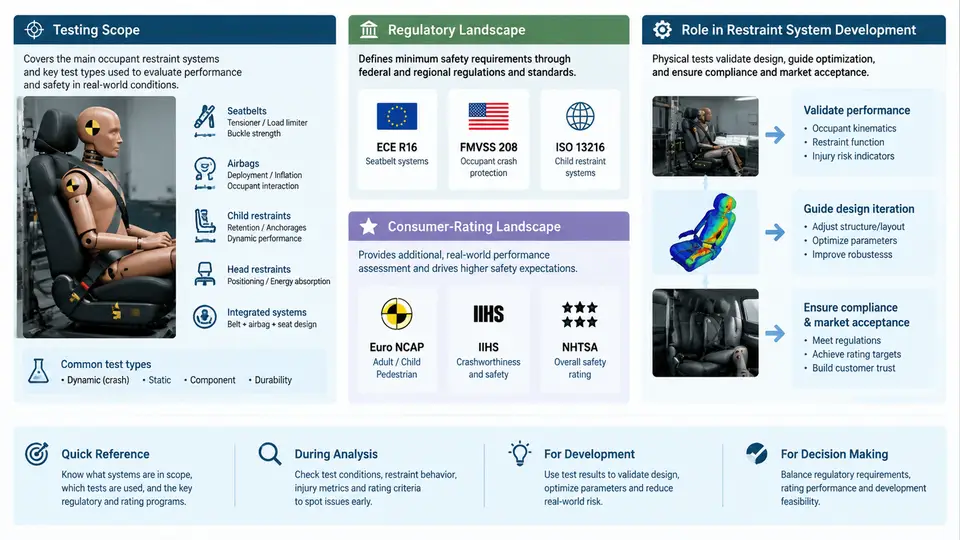
Occupant restraint physical testing is the discipline of reproducing, in a controlled laboratory environment, the deceleration events that a vehicle occupant experiences in a crash, and then measuring how the restraint system — seat belts, airbags, seat structures, pretensioners, load limiters, and child restraint systems — manages the occupant's motion. It sits at the intersection of vehicle dynamics, biomechanics, instrumentation, and regulatory compliance. This course treats physical testing as an engineering activity with its own inputs, methods, and acceptance criteria, not merely as a compliance formality.
The scope of the field is broader than a single sled or barrier test. It spans component-level bench tests, full-scale vehicle crash tests, sled-based occupant simulations, static and quasi-static strength tests, and subsystem tests such as airbag deployment in a static environment. Each test type answers a different engineering question, and a mature restraint development program uses them in a deliberate sequence.
What Physical Testing Actually Measures
At its core, a restraint test produces time histories. Accelerometers on the vehicle structure and on the occupant's head, chest, and pelvis record deceleration in g. Load cells in the belt webbing record tension in kilonewtons. Displacement sensors track belt payout, knee excursion, and seat deformation. High-speed cameras at 500–2000 frames per second provide the visual record that explains why the numbers look the way they do.
From these raw signals, engineers derive the injury criteria that determine pass or fail. The most common are:
- HIC (Head Injury Criterion) — a weighted integral of resultant head acceleration over a 15 ms window, computed as HIC15.
- Chest deflection and chest acceleration — measured in millimetres and
g, with a 3 ms clip criterion for acceleration. - Femur axial force — measured in kilonewtons, used to assess lower-extremity loading.
- Neck injury criteria (Nij) — combining axial force and bending moment.
- Belt forces and belt payout — used to understand how the restraint system distributes load.
These criteria are not arbitrary. They originate from biomechanical research correlating measured dummy responses with real-world injury outcomes. Understanding their derivation matters because it tells you which physical parameters you can influence through design and which you cannot.
The Regulatory and Consumer-Rating Landscape
Restraint testing operates within a framework of mandatory regulations and voluntary consumer rating programs. The two serve different purposes and often use different test conditions.
| Program | Region | Primary Test Types | Key Dummies | Purpose |
|---|---|---|---|---|
| FMVSS 208 | United States | Frontal barrier, sled, unbelted and belted | Hybrid III 50th, 5th percentile female | Mandatory compliance |
| FMVSS 214 | United States | Side impact, pole and barrier | ES-2re, SID-IIs | Mandatory compliance |
| ECE R94 / R95 | Europe | Frontal offset deformable barrier, side impact | Hybrid III 50th, ES-2 | Mandatory compliance |
| Euro NCAP | Europe | Frontal ODB, MPDB, side barrier, pole | Hybrid III 50th, THOR, WorldSID | Consumer rating |
| US NCAP | United States | Frontal 56 km/h rigid barrier, side MDB | Hybrid III 50th, SID-IIs | Consumer rating |
| C-NCAP | China | Frontal ODB, MPDB, side barrier | Hybrid III 50th, WorldSID | Consumer rating |
Regulations define minimum performance thresholds. Consumer rating programs push beyond those minimums, often adding more severe conditions, additional dummy sizes, and new test modes such as the mobile progressive deformable barrier (MPDB) or far-side occupant protection. For a restraint engineer, the practical consequence is that a system must be designed to satisfy the most demanding combination of regulatory and rating requirements simultaneously, because the same hardware is tested under all of them.
Where Physical Testing Fits in Restraint System Development
Physical testing is not the first step. It is the verification step in a development cycle that begins with requirements definition, proceeds through CAE simulation, and culminates in hardware validation. The typical sequence is:
- Requirements and target setting — define the injury criteria targets, test matrix, and dummy configurations based on regulatory and rating requirements.
- Concept design and CAE simulation — use finite element and multibody models to explore restraint parameters: belt geometry, pretensioner timing, load limiter force level, airbag venting, and seat stiffness.
- Component and subsystem testing — validate individual elements such as pretensioner performance, airbag deployment pressure, and belt anchorage strength.
- Sled testing — mount a body-in-white or buck with seats and restraints on a sled and reproduce the crash pulse. This isolates occupant restraint performance from vehicle structural deformation.
- Full-scale vehicle crash testing — the final validation, where the complete vehicle, restraint system, and occupant interact under real crash conditions.
Sled testing deserves particular emphasis because it is the workhorse of restraint development. A sled test replaces the vehicle's crash pulse with a programmed deceleration profile, allowing engineers to test many restraint configurations quickly and at lower cost than full vehicle tests. The sled pulse is derived from actual vehicle crash data or from a standard pulse defined by the regulation. The occupant kinematics on the sled should match those in the full vehicle test if the pulse and buck geometry are correct.
Why Physical Tests Remain Irreplaceable
CAE models have become remarkably accurate, but they still rely on material models, contact definitions, and failure criteria that are calibrated against physical tests. When a new airbag fabric, a new pretensioner design, or a new seat structure is introduced, the simulation must be validated against hardware. Physical testing also captures phenomena that models struggle with: airbag fabric permeability under rapid inflation, belt webbing stretch at high strain rates, seat foam compression behavior, and the complex interaction between the occupant and the deploying airbag.
Moreover, regulatory compliance is legally defined by physical test results. A simulation cannot certify a vehicle. The physical test is the legal record.
What This Course Covers
Over the following chapters, we will move from the fundamentals of crash pulses and dummy instrumentation through the detailed setup and execution of sled and full-scale tests, into data analysis, troubleshooting, and advanced topics such as far-side and rear-seat occupant protection. Each chapter builds on the previous one, and the emphasis throughout is on the practical knowledge required to plan, execute, and interpret restraint physical tests correctly.
By the end of this course, you should be able to read a restraint test request, understand what each test type can and cannot tell you, set up a sled or vehicle test with correct instrumentation and dummy positioning, analyze the resulting data against the relevant criteria, and diagnose common failure modes when a test does not meet its targets.