1. Crash test dummy ecosystem
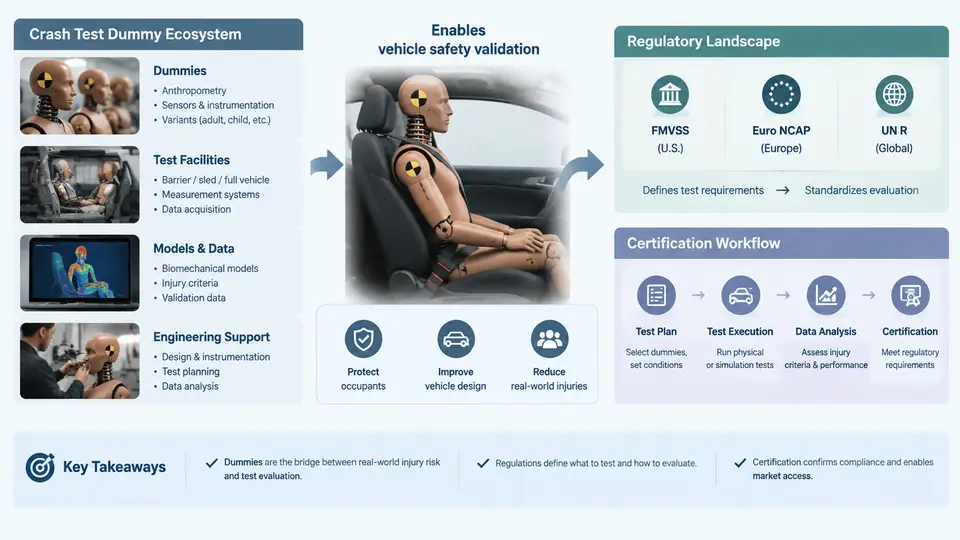
A crash test dummy is not a passive mannequin. It is a calibrated anthropomorphic test device (ATD) whose measured responses — accelerations, loads, moments, and deflections — are used as legal evidence that a vehicle protects its occupants. Because those measurements feed directly into regulatory pass/fail decisions and consumer ratings, the dummy itself must be treated as a controlled instrument: identified, configured, calibrated, and traceable. This chapter maps the ecosystem in which that happens, from the role ATDs play in vehicle safety validation through the regulatory landscape to the certification workflow that keeps a dummy legally usable.
Why the Dummy Is the Measuring Instrument, Not the Test Article
In a frontal sled or full-scale barrier test, the vehicle is the test article and the ATD is the sensor platform. The distinction matters operationally. If a dummy's knee slider friction is out of specification, the measured femur loads may shift enough to change an injury criterion outcome — and the resulting test may be invalid regardless of how well the vehicle performed. Every ATD family is therefore defined by a set of response channels with specified locations, axes, and sign conventions, and by a certification corridor: a tolerance band that the dummy must reproduce under a defined calibration procedure.
Consider a Hybrid III 50th percentile male, the most widely used frontal ATD. Its primary channels include head resultant acceleration at the head CG, upper-neck shear force and bending moment, chest deflection, and femur axial force. Each channel has a defined positive direction. For example, chest deflection is positive in the sternum-to-spine (rearward) direction, and femur force is positive in compression along the femur axis. These conventions are not cosmetic: a sign error in a data channel will invert an injury criterion and can silently invalidate a report. Establish the convention once, document it, and keep it consistent across the dummy, the data acquisition system, and the analysis.
The Regulatory and Ratings Landscape
ATD usage is driven by three overlapping forces: government regulation, consumer information programs, and internal OEM requirements. They differ in legal weight but share the same dummy hardware, which is why a single certification program can serve multiple markets.
| Driver | Typical ATD | What it governs |
|---|---|---|
| FMVSS 208 (US frontal occupant protection) | Hybrid III 50th male, 5th female, 95th male; THOR in newer programs | Barrier and sled test conditions, injury criteria limits, dummy certification requirements |
| FMVSS 214 / 226 (side impact, ejection) | ES-2re, SID-IIs, WorldSID 50th | Side impact performance, head and thorax criteria |
| UN ECE R94 / R95 | Hybrid III, ES-2 | European frontal and side impact type approval |
| Euro NCAP / US NCAP | Hybrid III, THOR, WorldSID, Q-series child ATDs | Star ratings, often stricter than regulation |
Two consequences follow. First, a laboratory may need several ATD families on the same test floor, each with its own calibration schedule. Second, because ratings programs evolve faster than regulations, the certification workflow must be able to absorb new procedures — for example, the addition of THOR-based frontal testing or WorldSID-based side testing — without rebuilding the entire quality system.
Certification Versus Calibration: A Necessary Distinction
These terms are often used interchangeably and should not be. Calibration is the adjustment of a dummy or its subassemblies so that it meets specified response values. Certification is the documented verification, performed at defined intervals, that the dummy still meets those values. In practice, a lab performs periodic certification tests; if a channel falls outside its corridor, the affected subassembly is adjusted or replaced and then re-certified.
Certification intervals are set by the governing procedure, not by convenience. A typical frontal ATD program uses a 12-month cycle for the full dummy, with shorter intervals for high-wear items. The following is a representative schedule for a Hybrid III 50th male; actual intervals must follow the controlling regulation or OEM specification.
- Full dummy certification: every 12 months, or after any major repair or a test exceeding specified severity.
- Head drop: every 12 months; peak resultant acceleration and the lateral drop response are both checked.
- Neck pendulum: every 12 months; flexion and extension moment-time corridors.
- Thorax impact: every 12 months; chest deflection and hysteresis.
- Knee slider: every 6 months or after any test with high knee loading.
- Femur / tibia: as specified, typically 12 months.
The Certification Workflow End to End
The workflow below is the backbone of ATD quality management. It is deliberately cyclical: a dummy moves from identification through preparation, certification testing, disposition, and back into service, with records at every step.
Each stage produces a record. Identification establishes which physical dummy was tested. Inspection catches damage before it corrupts a certification result. Subassembly tests generate the raw response data. Corridor comparison is the decision point. Disposition determines whether the dummy is released, quarantined, or repaired. Return to service closes the loop and sets the next due date.
A Worked Example: Head Drop Certification
The head drop test is a good first case because it is simple, fast, and highly diagnostic. The procedure is defined in the controlling regulation, but the engineering logic is as follows.
- Prepare the head assembly. Remove the head from the neck, verify the accelerometer mounting and cable routing, and confirm the head mass is within specification. A typical Hybrid III 50th head assembly is approximately 4.54 kg.
- Set the drop height and surface. The head is dropped onto a rigid, flat steel plate from a specified height, typically 376 mm for the frontal drop, guided so that the impact is repeatable.
- Record the response. The triaxial accelerometer at the head CG records the impact. The certification criterion is the peak resultant acceleration, which must fall within a specified band — for the Hybrid III 50th frontal drop, the target is commonly stated as 225 g with a tolerance of ±22.5 g, and the peak must occur within a specified time window.
- Compare and decide. If the peak is inside the corridor and the pulse shape is acceptable, the head is certified. If the peak is low, the likely causes are a damaged or loose accelerometer, incorrect drop height, or a contaminated impact surface. If the peak is high, suspect a stiff or damaged head skin, a misaligned guide, or a hard mounting interface.
What the Ecosystem Requires of the Engineer
Working inside this ecosystem means accepting three disciplines. First, traceability: every dummy, subassembly, sensor, and calibration result must be linked to a serial number and a date. Second, procedure fidelity: certification procedures specify drop heights, impact surfaces, mounting torques, and filter classes; deviating from them invalidates the result even if the numbers look reasonable. Third, documentation: the certification record is the legal artifact that allows a test to be submitted. A dummy without a current certification record is, for regulatory purposes, not a usable instrument.
The rest of this course builds on this foundation. Later chapters will cover specific ATD families and their instrumentation, the detailed certification procedures for each subassembly, data acquisition and filtering, and the quality systems that keep a fleet of dummies in compliance across multiple test programs.