1. Crash sled testing fundamentals
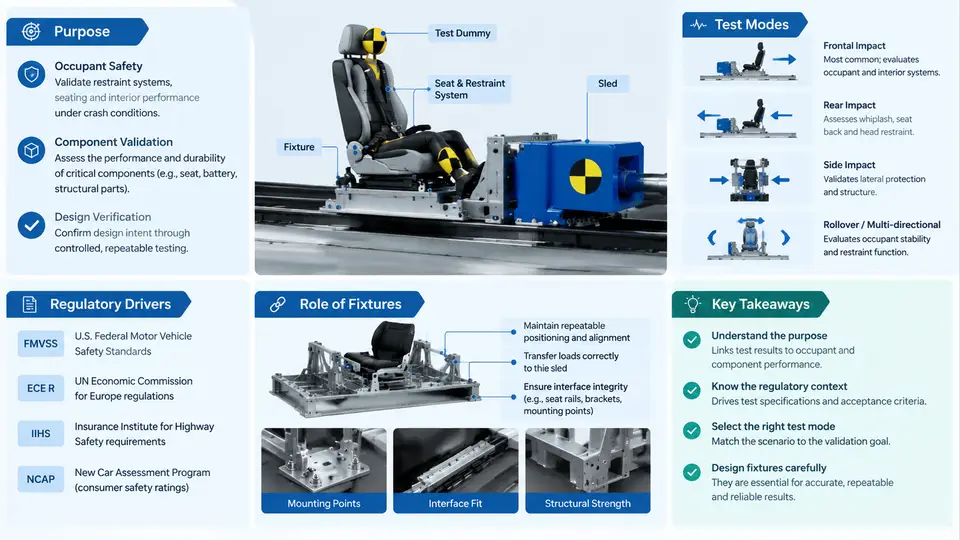
Crash sled testing is a controlled, laboratory-based method for reproducing the deceleration pulse of a vehicle collision without destroying a full vehicle body. A sled — a heavy carriage running on rails or a guided track — is accelerated to a target velocity and then decelerated by a programmable braking system, producing a time-history of acceleration that mimics a real crash event. The structure under investigation, together with its fixtures, is mounted on the sled and experiences that pulse. The result is a repeatable, instrumented, and comparatively inexpensive experiment that isolates the behaviour of a subsystem: a seat, a restraint system, a steering column, a battery module, an instrument panel, or a complete occupant compartment.
The purpose of sled testing is therefore threefold. First, it provides occupant validation: anthropomorphic test devices (ATDs, commonly called crash test dummies) are seated in the fixture and their injury metrics — head injury criterion (HIC), chest deflection, femur loads, neck injury criterion (Nij) — are measured against regulatory or consumer-rating limits. Second, it provides component and subsystem validation: airbag deployment timing, seat belt load limiter behaviour, seat structure integrity, and energy-absorber performance can be evaluated in isolation from the confounding variables of a full vehicle. Third, it provides design iteration speed: a sled test can be prepared and run in days, whereas a full vehicle crash test requires a complete prototype and weeks of build time.
Regulatory and Consumer-Rating Drivers
Sled testing is not an arbitrary engineering exercise; it exists because regulations and rating programmes explicitly permit or require it. In the United States, FMVSS 207 (seating systems), FMVSS 208 (occupant crash protection, including the sled-based option for belted and unbelted configurations), FMVSS 213 (child restraint systems), and FMVSS 225 (child restraint anchorage systems) all contain sled-test procedures. In Europe, UN Regulation No. 16 (safety belts), UN R17 (seats), UN R44 and R129 (child restraints), and UN R94/R95 (frontal and side impact) define sled pulses and fixture requirements. Consumer programmes such as Euro NCAP and NHTSA's New Car Assessment Program use sled tests for whiplash evaluation (the Euro NCAP seat and head restraint test) and for child restraint assessment.
The regulatory driver matters for fixture design because each regulation prescribes not only the pulse but also the fixture geometry, mounting points, and boundary conditions. A seat tested to UN R17 must be mounted on a specific test bench with defined anchorages; a child restraint tested to UN R129 must be attached to a specific sled buck with a defined ISOFIX or belt routing. Deviating from the prescribed fixture invalidates the test result, regardless of how well the pulse is reproduced.
Test Modes
Sled tests are classified by the direction and nature of the applied pulse. The most common modes are:
- Frontal sled test — the sled decelerates along the longitudinal axis, simulating a frontal impact. The pulse is typically a trapezoidal or half-sine deceleration of 20–50 g peak, with a velocity change (Δv) of 30–64 km/h. This is the dominant mode for occupant restraint validation.
- Rear sled test — the sled accelerates forward (or the buck is oriented rearward) to simulate a rear impact. Used for whiplash assessment and seat back strength. Pulses are often lower in magnitude (10–20 g) but longer in duration.
- Side sled test — the sled is accelerated laterally, or the buck is rotated 90°, to simulate a side impact. Used for side airbag and door trim evaluation.
- Rollover / quasi-static sled test — a slow or controlled rotation used to evaluate roof strength or occupant retention, sometimes combined with a sled for dynamic rollover simulation.
Each mode imposes different demands on the fixture. A frontal sled fixture must resist large longitudinal inertia loads and keep the seat and ATD aligned with the deceleration vector. A side sled fixture must resist lateral loads and often requires a rotated buck. A rear sled fixture must manage the rebound of the seat back and the rearward motion of the ATD's head.
The Role of Fixtures
The fixture is the mechanical interface between the sled and the test article. Its job is to hold the test article in the correct spatial orientation, transmit the sled pulse without introducing unintended compliance or resonance, and provide the mounting points and boundary conditions specified by the applicable regulation or test protocol. A poorly designed fixture can absorb energy, introduce vibration, or allow the test article to move relative to the sled — all of which corrupt the test result.
Fixtures fall into several categories. A seat buck is a rigid frame that replicates the vehicle floor and seat mounting points. A body-in-white (BIW) buck is a section of the actual vehicle structure, used when the local stiffness of the vehicle body matters. A component fixture holds a single component, such as a steering column or a battery module, in a defined orientation. A child restraint fixture is a standardized bench defined by regulation. In all cases, the fixture must be stiff enough that its first natural frequency is well above the frequency content of the sled pulse — a common rule of thumb is a first mode above 100 Hz for frontal sled fixtures.
From Pulse to Fixture: A Worked Example
Consider a frontal sled test for a driver seat. The target pulse is a trapezoidal deceleration with a 35 g plateau and a Δv of 50 km/h. The seat, with an ATD, has a combined mass of 95 kg. The fixture must transmit the deceleration to the seat without exceeding a defined deflection limit.
A first-order check: the peak inertial force on the fixture is F = m·a = 95 kg × 35 × 9.81 m/s² ≈ 32.6 kN. If the fixture is a steel frame with four M12 grade 10.9 bolts at the sled interface, each bolt sees approximately 8.2 kN in shear. A single M12 grade 10.9 bolt has a shear capacity of roughly 45 kN, so the bolted joint is not the weak point. The weak point is more likely to be the fixture's own bending stiffness. If the seat mounting plate spans 500 mm between supports and the plate is 10 mm thick steel, the deflection under 32.6 kN can be estimated; if it exceeds a few millimetres, the seat will rotate relative to the sled and the ATD kinematics will be affected.
This is why fixture design and structural verification are inseparable. The fixture must be analysed — by hand calculation, finite element analysis (FEA), or both — before it is built. The verification typically includes a static load case (the peak inertial force), a modal analysis (to confirm the first natural frequency), and a check of the bolted joints and welds.
What the Fixture Must Deliver
From the chain shown above, the fixture's requirements can be stated precisely. It must:
- Preserve the pulse. The fixture's dynamic response must not filter or amplify the sled deceleration in the frequency range that matters for occupant response (typically 0–100 Hz). This is verified by a modal analysis and, in some cases, by an instrumented fixture check run.
- Maintain geometry. The seat, steering column, or component must remain in the position specified by the test protocol throughout the event. Permanent deformation of the fixture is a test failure.
- Provide correct boundary conditions. The mounting points, bolt sizes, and local stiffness must match the vehicle or the regulatory bench. A seat mounted on a flexible fixture will behave differently from a seat mounted on a vehicle floor.
- Be instrumented. Fixtures often carry accelerometers, load cells, and displacement sensors to record what the test article actually experienced. This data is used to validate the fixture and to interpret the occupant response.
Why This Matters for the Rest of the Course
Every subsequent chapter builds on the distinction introduced here: the sled provides the pulse, the test article provides the response, and the fixture provides the boundary conditions that connect them. If the fixture is wrong, the test is wrong — no amount of instrumentation or analysis can recover a corrupted boundary condition. The chapters that follow will develop the methods for designing, analysing, and verifying fixtures so that the test article sees exactly what the regulation or the vehicle programme intends.
The next time you see a sled test report, look first at the fixture description and the pulse verification data. That is where the validity of the entire test is established.