1. Crash sled test fundamentals
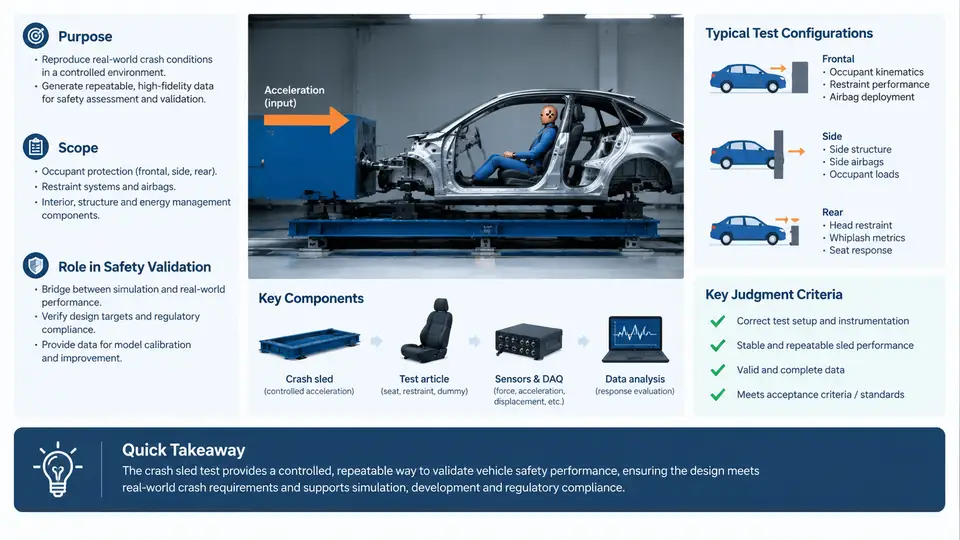
A crash sled test is a controlled, laboratory-based dynamic test in which a test buck — a simplified structure carrying seats, restraints, instrumentation, and often a partial body-in-white — is accelerated or decelerated along a straight rail to reproduce the occupant loading environment of a real vehicle crash. The sled itself is not a vehicle. It is a loading machine whose job is to deliver a prescribed acceleration pulse to a test article while removing the geometric and manufacturing complexity of a full car. Understanding this distinction is the foundation of everything that follows in sled test engineering: the sled buys repeatability, instrumentation access, and cost efficiency at the price of geometric fidelity, and the engineer's task is to know when that trade is acceptable.
Why the Sled Exists
A full-scale vehicle crash test is the definitive validation event, but it is a poor development tool. A single frontal barrier test consumes a complete vehicle, a dedicated facility, and a large instrumentation effort, and it produces exactly one data point. If a restraint calibration is wrong, the engineer learns this only after the vehicle is destroyed. Sled testing inverts this economics. Because the pulse is generated by a programmable system rather than by crushing sheet metal, the same pulse can be repeated dozens of times per week, and individual variables — seat belt load limiter force, airbag vent size, seat pan angle, pretensioner timing — can be changed one at a time.
The regulatory and consumer-rating framework reinforces this role. FMVSS 208 (occupant crash protection), FMVSS 207/210 (seating and anchorages), FMVSS 213 (child restraint systems), ECE R16/R17, and the various Euro NCAP and IIHS protocols all contain test configurations that are either performed directly on a sled or are developed and pre-validated on one. In practice, a modern occupant safety program runs hundreds of sled tests for every full-vehicle test.
What the Sled Reproduces — and What It Does Not
The primary quantity a sled reproduces is the acceleration–time history at the occupant compartment. In a real frontal impact, the vehicle's front structure crushes and the occupant compartment decelerates according to the crash pulse measured at the B-pillar or tunnel. A sled test takes that measured pulse, or a target pulse derived from CAE, and commands the sled to follow it. Everything downstream — occupant kinematics, belt loading, airbag interaction — is driven by this pulse.
What the sled does not reproduce is equally important. There is no crush, so there is no structural deformation of the occupant compartment, no steering column intrusion, no pedal displacement, and no engine movement into the firewall. There is no yaw or pitch unless the fixture is designed to allow it. There is no real-world variability in impact angle. These omissions are acceptable when the research question concerns restraint performance, and unacceptable when it concerns structural intrusion or occupant compartment integrity. Knowing which question is being asked is the first engineering decision in any sled program.
The Sled Test System at a Glance
A complete sled facility consists of the propulsion system, the rail and carriage, the pulse-shaping device, the test buck, the restraint system, and the data acquisition chain. The propulsion system may be a hydraulic catapult, a bungee or pneumatic accelerator, or a deceleration-type system in which the sled is brought up to speed and then stopped by a programmable brake. The pulse-shaping device — crush tubes, honeycomb, hydraulic dampers, or a servo-controlled brake — converts the propulsion energy into the desired acceleration profile. The buck carries the seats and restraints and is instrumented with accelerometers, load cells, and displacement sensors. Anthropomorphic test devices (ATDs, commonly called crash test dummies) are seated and instrumented according to the protocol being simulated.
Where the Sled Sits in the Validation Pyramid
Vehicle safety validation is a layered process, and the sled occupies the middle layer. At the base are component and material tests: belt webbing tensile tests, airbag inflator tank tests, seat frame static strength, and material coupon tests. These establish that individual parts meet specification. At the top are full-scale vehicle crash tests, which confirm that the integrated system performs in the real event. The sled sits between them, and its unique value is that it tests the interaction of components — belt, pretensioner, load limiter, airbag, seat, and occupant — under realistic dynamic loading, without the cost and variability of a full vehicle.
This position determines the typical workflow. A new restraint system is first analyzed in CAE, then validated on the sled across a matrix of pulses and occupant sizes, and only then confirmed in full-vehicle tests. If a full-vehicle test later reveals a problem, the sled is used to isolate the cause: is it the pulse, the restraint, or the structure? Because the sled allows the pulse to be held constant while the restraint is varied, it is the natural tool for this kind of root-cause work.
Scope: What a Sled Program Covers
A well-defined sled program specifies, at minimum, the following. The target event — frontal, side, rear, or a specific regulatory or rating protocol. The pulse — either a measured vehicle pulse or a standardized corridor such as the FMVSS 208 48 km/h frontal pulse or the Euro NCAP ODB pulse. The occupant set — which ATDs (Hybrid III 50th percentile male, 5th percentile female, THOR, Q-series child dummies) and which seating positions. The fixture — a rigid buck, a decoupled seat, or a partial body-in-white, depending on whether structural interaction matters. The instrumentation — accelerometers, load cells, potentiometers, and high-speed cameras. And the acceptance criteria — the injury assessment reference values (IARVs) or performance targets against which the results will be judged.
Two practical constraints shape every program. First, the pulse must be achievable: the pulse shaper has finite energy capacity, and a very high-magnitude, short-duration pulse may exceed what the facility can generate. Second, the fixture must be stiff enough that its own vibration does not contaminate the measurement — a flexible buck can ring at frequencies that appear in the accelerometer data and are mistaken for occupant response. Both constraints are checked during setup, not after the test.
Reading a Sled Test Result
The primary output is a set of time-history channels. The engineer compares the achieved sled acceleration against the target pulse; a close match in both magnitude and duration confirms the pulse was delivered correctly. Then the occupant channels are examined: head resultant acceleration and the resulting HIC, chest deflection and the 3 ms clip, belt forces, and femur loads. These are compared against the IARVs for the protocol. A result that passes all channels is a pass; a result that exceeds one channel identifies the specific loading path that needs attention.
Typical failure symptoms have characteristic signatures. If the achieved pulse is too high in the early phase, the occupant loads earlier and more severely than intended, and the fix is in the pulse shaper, not the restraint. If the belt load spikes without a corresponding chest deflection increase, the load limiter may be bottoming out. If head acceleration is high but chest deflection is normal, the airbag may be deploying late or the belt may be allowing too much forward excursion. Learning to read these signatures is the core skill of sled test engineering, and it is what the remainder of this course develops.
Key Takeaways
- A crash sled reproduces the occupant compartment acceleration pulse, not the full vehicle crash; its validity depends on pulse, fixture, and restraint boundary conditions together.
- The sled's value is repeatability, instrumentation access, and cost efficiency, enabling component-interaction testing between coupon tests and full-vehicle tests.
- A sled program must define the target event, pulse, occupant set, fixture, instrumentation, and acceptance criteria before any test is run.
- Results are read as time-history channels compared against IARVs, and the first check is always whether the intended pulse was actually delivered.