1. Crash laboratory quality management syst
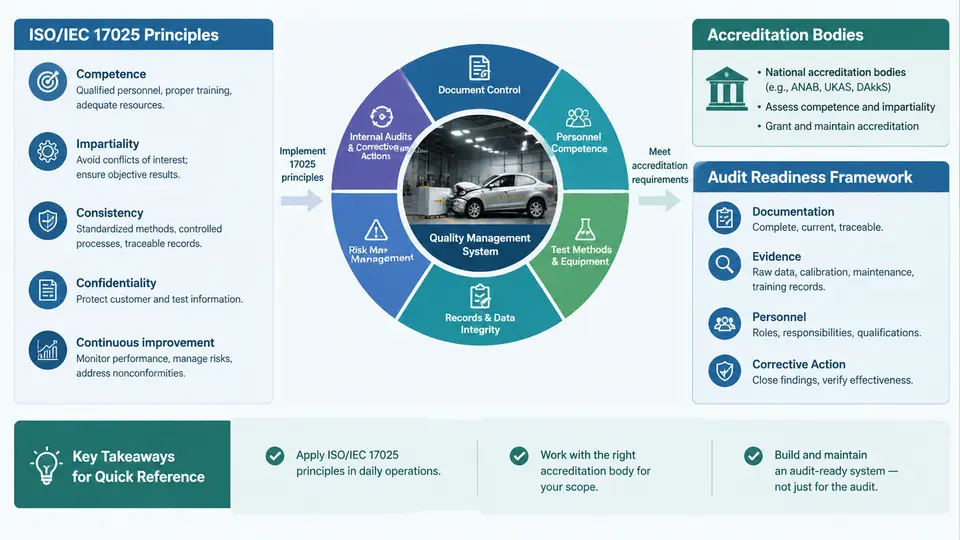
A crash laboratory produces data that regulators, vehicle manufacturers, and courts may rely on to make safety-critical decisions. A frontal offset test result can determine whether an airbag deployment strategy is acceptable, whether a restraint system meets a homologation requirement, or whether a product recall is warranted. Because the consequences of an incorrect result are severe, the laboratory must be able to demonstrate that its measurements are technically valid and that its processes are controlled. ISO/IEC 17025, General requirements for the competence of testing and calibration laboratories, is the international standard that defines how a laboratory builds and maintains that demonstration.
What ISO/IEC 17025 Actually Requires
ISO/IEC 17025 is not a product standard and it does not prescribe how a crash test must be run. It prescribes how the laboratory manages competence, traceability, and impartiality so that the technical result can be trusted. The standard is organized around several interacting requirement clusters:
- General requirements — impartiality, confidentiality, and freedom from commercial or organizational conflicts that could influence results.
- Structural requirements — a defined legal entity, documented laboratory management, and personnel with the authority and resources to carry out testing.
- Resource requirements — competent personnel, suitable facilities and environmental conditions, calibrated and maintained equipment, and a system for managing measurement traceability.
- Process requirements — review of requests, selection and validation of methods, sampling, handling of test items, technical records, evaluation of measurement uncertainty, and reporting of results.
- Management system requirements — documented policies, control of records and documents, risk and opportunity management, corrective actions, internal audits, and management review.
For a crash laboratory, the resource and process clusters carry the greatest technical weight. A load cell used to measure seatbelt anchor forces must be traceable to a national metrology institute through an unbroken calibration chain. A high-speed camera used to determine occupant kinematics must have its frame rate, timing, and spatial calibration verified. The environmental conditions in the test hall — temperature, humidity, and sometimes air velocity — must be recorded because they can affect sensor behavior and dummy response.
Accreditation Bodies and the Assessment Process
Accreditation is the formal recognition by an authoritative body that a laboratory is competent to perform specific tests. Accreditation bodies operate under a national or regional framework and are themselves evaluated against ISO/IEC 17011. In practice, a crash laboratory seeking accreditation submits an application describing the scope of testing it wants recognized — for example, "frontal impact test at 64 km/h with 40% overlap, measurement of occupant injury criteria" — and then undergoes a two-stage assessment.
The first stage is a documentation review: the quality manual, procedures, method descriptions, and records are examined for conformity. The second stage is an on-site assessment where assessors observe actual tests, interview technical staff, examine equipment and calibration records, and witness the handling of a real or simulated test item. If nonconformities are found, the laboratory must propose root-cause analysis and corrective action, and the accreditation body verifies closure before granting or maintaining accreditation.
Accreditation is scope-specific. A laboratory may be accredited for sled tests but not for full-scale barrier tests, or for component-level calibration but not for whole-vehicle crash testing. The scope statement is a public document and is the first thing an auditor or customer checks.
Building an Audit-Ready Framework
Audit readiness is not a last-minute preparation exercise. It is the normal operating state of a compliant laboratory. The framework rests on four practical pillars:
- Document control. Every procedure, work instruction, and form has a unique identifier, revision number, effective date, and approval signature. Superseded documents are removed from active use but retained for traceability.
- Record integrity. Raw data — sensor voltages, camera timestamps, dummy channel outputs — are recorded at the time of test and cannot be altered after the fact. Corrections are made by a separate, signed amendment that preserves the original entry.
- Traceability and uncertainty. Each measurement result is linked to a calibration certificate, and the uncertainty budget for the test is documented. For a crash test, this includes sensor uncertainty, data acquisition uncertainty, and the uncertainty introduced by filtering and signal processing.
- Internal audit and corrective action. The laboratory audits itself on a planned schedule, records findings, and tracks corrective actions to closure. This is the mechanism that turns a finding into a permanent improvement rather than a temporary fix.
How the Elements Interact
The diagram below shows the relationship between the standard's requirement clusters, the accreditation process, and the evidence that supports audit readiness. The flow is not strictly linear: corrective actions feed back into the management system, and internal audit results inform the next management review.
Practical Implications for the Crash Laboratory
Three practical consequences follow from this framework. First, the laboratory must treat calibration and traceability as continuous obligations, not annual events. A load cell that drifts between calibrations can invalidate an entire test campaign, and the laboratory must have a process for detecting and responding to drift. Second, personnel competence must be documented for each test method in the scope. A technician who is qualified to run a sled test is not automatically qualified to run a full-scale frontal impact test; the training and authorization records must reflect the specific method. Third, the laboratory must be able to reconstruct any test from its records. If an assessor selects a test performed eighteen months ago and asks for the raw data, the calibration status of every sensor, the environmental conditions, the method revision, and the personnel involved, the laboratory should be able to produce all of it within a reasonable time.
Audit readiness ultimately depends on whether the quality management system is integrated into daily work or treated as a separate administrative layer. When test engineers record data correctly the first time, when calibration status is checked before every test, and when findings are corrected at the root cause rather than patched at the surface, the laboratory is not preparing for an audit — it is simply operating correctly. That is the condition ISO/IEC 17025 is designed to produce.